Avoid 3 Costly Life Insurance Beneficiary Mistakes

A life insurance beneficiary is the person, trust, or organization you name to receive the death benefit when you die, and that single form usually overrides your will and skips probate entirely. Naming a primary beneficiary is not enough. You also need a contingent beneficiary, a backup who collects if your first choice can’t, because without one your payout can land in probate court instead of a bank account.
TL;DR:
- Failing to name a contingent beneficiary can cause proceeds to go into probate, and the designation form overrides the will in most cases.
- Irrevocable beneficiaries secure the right to the death benefit, making it difficult to change or borrow against the policy without their consent.
- Minor beneficiaries require a trust or custodial account, as insurers usually won’t pay directly to a child, and state or employer rules can override personal plans after divorce.
- Changing a beneficiary requires correct, confirmed paperwork; incomplete or unconfirmed forms remain legally ineffective until properly processed.
- Beneficiaries paid directly are generally shielded from creditors, but proceeds paid to an estate are vulnerable to debts and estate taxes.
Table of Contents
- What Is a Beneficiary on Life Insurance, and How Does Priority Work?
- Revocable vs. Irrevocable Beneficiary Designations
- Who Can You Name, and What About Minors, Trusts, and Charities?
- How to Name or Change a Beneficiary: Forms, Percentages, and Distribution Rules
- Divorce, Community Property, and ERISA: The Traps That Undo Good Intentions
- How Payouts Actually Work: Claims, Timing, Taxes, and Creditors
- How Do You Find Out If You’re a Beneficiary, and How Do You File a Claim?
- Your Beneficiary Checklist Before You Close This Tab
- What I’ve Learned Reviewing Beneficiary Mistakes
- Get Your Beneficiary Designations Reviewed the Right Way
- Sources
- FAQ
What Is a Beneficiary on Life Insurance, and How Does Priority Work?
Beneficiaries on life insurance fall into two tiers, and the order matters more than most policyholders realize. The designation form you sign instructs the insurer exactly who gets paid, and that instruction generally controls even if your will says something different.
A primary beneficiary is first in line. When you die, the insurer verifies that person’s identity and eligibility, then pays the death benefit directly, often without touching your estate at all. A contingent beneficiary only collects if every primary beneficiary has died, disclaimed the benefit, or can’t be located, according to MoneyGeek’s breakdown of beneficiary rules. Think of the contingent tier as your policy’s seatbelt: you hope you never need it, but the moment you do, you’re glad it’s there.
Common real-world setups look like this:
- Married couple: spouse named primary, adult children named contingent, split evenly.
- Single parent: children named primary in equal shares, a sibling or trust named contingent.
- Business owner: a partner named primary for a buyout agreement, the business entity named contingent.
Skipping the contingent slot is one of the most frequent and costly oversights in beneficiary planning, because it can send proceeds straight into probate.
Revocable vs. Irrevocable Beneficiary Designations
Most policies default to revocable designations, meaning you keep full control while you’re alive. You can add a beneficiary, remove one, or change percentages any time you want, with no one else’s permission required.
Irrevocable designations work the opposite way. Once you name an irrevocable beneficiary, that person gains a vested legal right to the death benefit, and you generally can’t change the designation or take a policy loan against it without their written consent.
Irrevocable arrangements show up most often in:
- Divorce settlements, where a court orders a spouse to remain a beneficiary to secure alimony or child support.
- Business agreements, where a lender or partner requires an irrevocable interest as collateral for a loan or buyout.
These arrangements are commonly used to secure court-ordered obligations, and once signed, they’re difficult to undo without the named beneficiary’s cooperation.
Pro Tip: Before you agree to an irrevocable designation for any reason, read the actual policy language on loans and cash value access. Some irrevocable setups quietly freeze your ability to borrow against the policy, not just your ability to change beneficiaries.
Who Can You Name, and What About Minors, Trusts, and Charities?
You can name almost anyone or anything as a beneficiary: a spouse, children, friends, a trust, a charity, a business, or your own estate. That last option, naming your estate, is technically valid but rarely a good idea, since it drags the payout back into probate and exposes it to creditors and estate taxes.
Minors create a specific problem. Insurers typically won’t hand a death benefit directly to a child, so you need a workaround:
- A Uniform Transfers to Minors Act (UTMA) account, which lets a custodian manage the funds until the child reaches the age set by state law, usually 18 or 21.
- A trust, which offers more control over timing and conditions but costs more to set up and maintain.
Most insurers refuse direct payment to minors, which is why custodial accounts or trusts are the standard fix. If you’re naming a charity or business as beneficiary, the insurer will ask for the organization’s legal name exactly as registered and its taxpayer identification number, so gather that paperwork before you sit down to fill out the form.
How to Name or Change a Beneficiary: Forms, Percentages, and Distribution Rules
Changing a beneficiary is usually faster than people expect, but the details trip up a surprising number of policyholders. Here’s the process:
- Get the right form. For an individual policy, log into the insurer’s portal or call your agent. For a workplace policy, go through HR or the plan administrator, since group plans use their own paperwork.
- Fill in the required fields. Full legal name, date of birth, Social Security number, and relationship to you are standard requirements for every named beneficiary.
- Allocate percentages. If you’re naming more than one primary beneficiary, the shares must total exactly 100%. A form listing three children at 30%, 30%, and 30% will bounce back for correction.
- Choose per stirpes or per capita. Per stirpes means a deceased beneficiary’s share passes down to their own children. Per capita means it’s redistributed among the surviving named beneficiaries instead. These two distribution rules produce very different outcomes if one of your named beneficiaries dies before you do.
- Submit and confirm. Send the signed form, then request written confirmation.
A change-of-beneficiary form only takes effect once the insurer has actually received and recorded it. That’s not a technicality. If you fill out the form but never mail it, or mail it and never confirm receipt, your old beneficiary designation still stands legally. Keep proof of delivery and the confirmation letter in a file you can find later, because insurers have been known to lose paperwork.
Divorce, Community Property, and ERISA: The Traps That Undo Good Intentions
State and federal rules can override what you think you’ve arranged, and this is where good intentions go sideways.
- Many states automatically revoke an ex-spouse’s beneficiary status the moment a divorce is finalized, but this automatic-revocation rule generally does not apply to employer-sponsored group plans.
- For those workplace policies, ERISA preemption means the plan document controls, not state divorce law, a principle confirmed by the Supreme Court’s Egelhoff v. Egelhoff decision. If you don’t manually update your employer’s HR portal after a divorce, your ex could still legally collect.
- In community property states, a spouse may need to consent before you can name someone else as beneficiary if premiums came from marital income. Nine states have community property rules that can create a legitimate spousal claim on proceeds, even when the policyholder named a different beneficiary entirely.
- Slayer statutes bar a beneficiary from collecting if they caused the insured’s death, and simultaneous death rules (the Uniform Simultaneous Death Act) determine payout order when a policyholder and beneficiary die in the same event, close enough in time that neither is presumed to have survived the other.
How Payouts Actually Work: Claims, Timing, Taxes, and Creditors
Filing a claim starts with a certified death certificate and a completed claim form from the insurer, plus any additional documentation the policy requires. Insurers often process complete life insurance death claims within 14 to 60 days, though disputes, missing paperwork, or an unresolved probate matter can stretch that timeline considerably.
On taxes, the news is good for most beneficiaries. Federal law generally excludes life insurance death proceeds from a beneficiary’s gross income under 26 USC 101. The exception: if proceeds are payable to the estate rather than a named person, they can be pulled into the decedent’s gross estate and become subject to estate tax.
Creditor protection follows a similar pattern:
- Proceeds paid directly to a named beneficiary are usually shielded from the deceased’s creditors.
- Proceeds paid to an estate lose that protection and become fair game for outstanding debts.
- Some states extend creditor protection to the beneficiary’s own creditors too, but this varies enough that it’s worth checking your state’s specific statute before assuming you’re covered.
How Do You Find Out If You’re a Beneficiary, and How Do You File a Claim?
If you suspect someone named you but you’re not sure, here’s how to track it down:
- Ask the policyholder directly, if they’re alive, or search their files for a policy declarations page.
- Contact the insurer or HR department for a group plan if you know the carrier’s name.
- Use a state life insurance policy locator service if you don’t know which company holds the policy. Most state insurance departments run one.
- Gather documents once you confirm you’re named: a certified death certificate, your government ID, and the claim form the insurer sends you.
- Expect a review period after filing, then a payout within the insurer’s standard processing window.
If two people file competing claims, or the insurer flags a dispute over who’s actually entitled, expect the payout to be held (an interpleader action) until the conflict is resolved, sometimes in court.
Your Beneficiary Checklist Before You Close This Tab
Run through this list now, not after something forces the issue:
- Name a primary beneficiary AND a contingent beneficiary. Never leave the contingent slot blank.
- Confirm your percentages actually total 100% if you’ve named more than one person.
- Pick per stirpes or per capita deliberately, don’t let the insurer default for you.
- Set up a UTMA account or trust if any named beneficiary is a minor.
- Update your employer’s beneficiary form separately after any divorce or remarriage. Your personal policy update does not touch your workplace plan.
Free consultations are available to walk residents through this kind of policy review, at no cost whether or not they enroll through an agency like an independent insurance agency.
What I’ve Learned Reviewing Beneficiary Mistakes
The same three errors show up again and again: naming an estate instead of a person, skipping the contingent beneficiary entirely, and forgetting that a workplace policy runs on its own separate paperwork. None of these are exotic mistakes. They’re the result of filling out a form once, years ago, and never looking at it again.
If you take one action from this article, make it this: review your beneficiary forms after every major life event, marriage, divorce, a new child, and keep the insurer’s written confirmation somewhere you can actually find it.
— Jesse Zimmerman
Get Your Beneficiary Designations Reviewed the Right Way
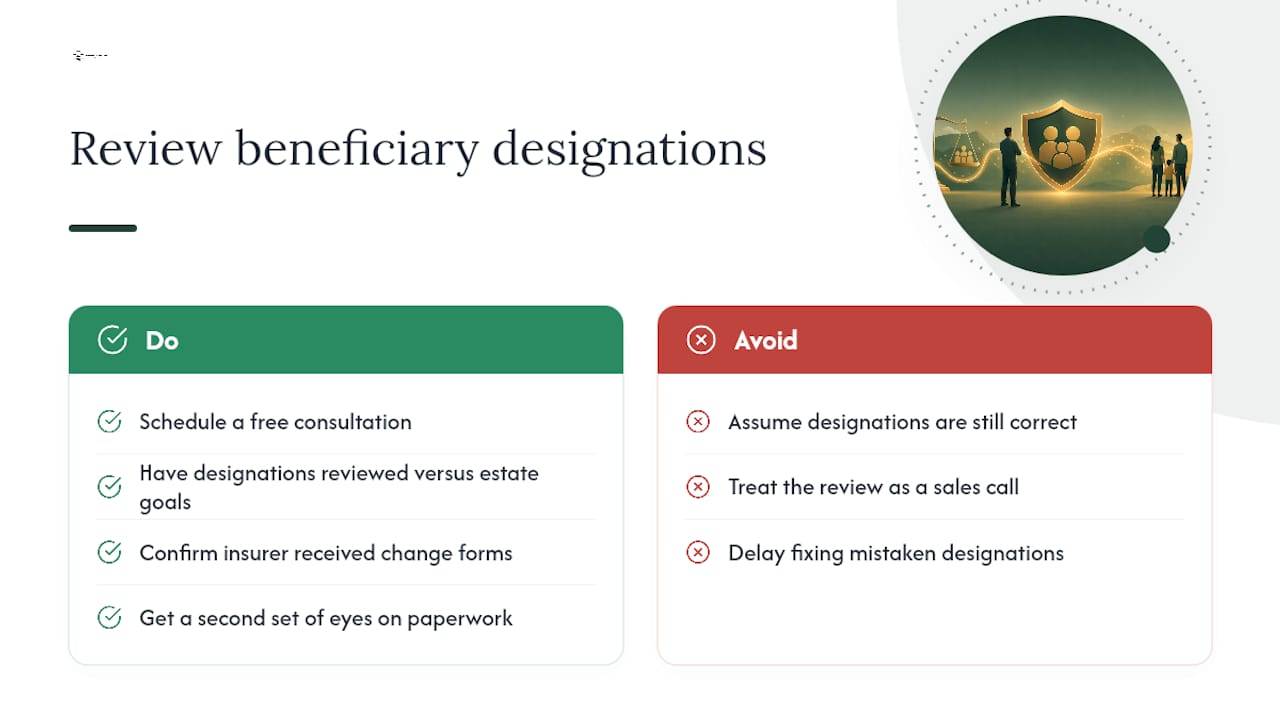
A change-of-beneficiary form filled out wrong, or never confirmed by the insurer, can undo years of careful planning. Free policy reviews check your current beneficiary designations against your estate goals, help you complete change forms correctly, and coordinate with local estate or trust attorneys when a situation calls for one. This isn’t a sales call disguised as a consultation. It’s the same education-first approach used for Medicare and dental coverage, applied to a decision that’s just as easy to get wrong and just as hard to fix after the fact. If you’re not sure whether your beneficiaries, percentages, or per stirpes elections still match what you actually want, schedule a free consultation with Mountaintop Insurance and get a second set of eyes on the paperwork before it matters.
This article is general information, not a substitute for advice from a qualified financial advisor. Consult a qualified financial professional about your own circumstances before acting on anything here.
Sources
- Life Insurance Beneficiaries: Designation Rules and Payout Rights - LegalClarity
- What Is a Life Insurance Beneficiary: Definition, Rules & How It Works - MoneyGeek
- Life insurance — Legal Information Institute (Cornell Law)
FAQ
Who Should You Name as a Beneficiary on a Life Insurance Policy?
Most people name a spouse or partner as primary beneficiary and their children or another close relative as contingent, but the right choice depends on who depends on you financially and whether a minor or trust needs to be involved.
Do Beneficiaries Have to Pay Taxes on Inherited Life Insurance?
Generally, no. Federal law excludes life insurance death proceeds from a beneficiary’s gross income, though proceeds paid to an estate rather than a named person can become subject to estate tax.
Will I Be Notified If I Am a Beneficiary of a Life Insurance Policy?
Insurers typically try to notify named beneficiaries once they learn of the policyholder’s death, but there’s no guarantee, which is why checking directly with the insurer, an employer’s HR department, or a state policy locator service matters if you suspect you were named.
What Happens When There Are Two Beneficiaries on a Life Insurance Policy?
The death benefit is split according to the percentages listed on the designation form, and those percentages must total 100%; if one of the two beneficiaries has died, the per stirpes or per capita election on file determines whether that share passes to their descendants or is redistributed to the surviving beneficiary.
Recommended
Disclaimer: This article is for general educational purposes only and does not constitute personalized advice. Medicare rules and plan details change frequently.
Discuss Your Situation With Us