Medicare Excess Charges: What They Cost and How to Avoid Them

Medicare Part B excess charges are the extra fees a provider can bill you above Medicare’s approved amount when they don’t accept Medicare assignment. Before your next appointment, do three things: ask “Do you accept Medicare assignment for this service?”, Medicare, and check whether your Medigap plan covers excess charges.
- Ask about assignment per service. A provider may accept assignment for a routine visit but not for a procedure done the same day.
- Use Medicare’s provider search at Medicare.gov to confirm participation status before you arrive.
- Know the cap. Non-participating providers can charge up to 15% above Medicare’s approved amount for most Part B services. That’s the legal ceiling, called the limiting charge.
- Check your Medigap plan. Plans F and G can cover excess charges entirely, depending on your eligibility.
- The Part B deductible is $283. You pay that first, then 20% coinsurance, and any excess charge on top of that.
- Eight states ban or limit excess charges: Connecticut, Massachusetts, Minnesota, New York, Ohio, Pennsylvania, Rhode Island, and Vermont.
Key Takeaways
Avoiding Medicare excess charges comes down to one habit: ask about assignment before every service, not just once per provider.
| Point | Details |
|---|---|
| The 15% limiting charge | Non-participating providers can bill up to 15% above Medicare’s approved amount for most Part B services. |
| Excess charges stack separately | Excess charges don’t count toward your $283 Part B deductible and are paid on top of your 20% coinsurance. |
| Eight states ban excess charges | CT, MA, MN, NY, OH, PA, RI, and VT prohibit or limit excess charges; protection applies where care is received. |
| Medigap Plan G covers excess charges | Plan G is available to new beneficiaries and covers excess charges; Plan F covers more but is closed to those eligible after January 1, 2020. |
| Mountaintop Insurance | Free consultations in Bend, Oregon for Medigap comparisons, provider verification, and Medicare billing questions. |
Table of Contents
- What are Medicare Part B excess charges?
- How excess charges are calculated
- Which states ban excess charges?
- How to avoid excess charges before and during care
- Does Medigap cover Part B excess charges?
- What to do if you receive an excess charge bill
- What happens when a provider has opted out of Medicare?
- The part of this conversation most people skip
- Mountaintop Insurance offers free local help with Medicare costs
- Sources
- FAQ
What are Medicare Part B excess charges?
Medicare sets an approved amount for every covered service. When a provider accepts assignment, they agree to that amount as payment in full, submit the claim directly to Medicare, and you owe only your deductible and coinsurance.
Providers fall into three categories:
| Provider status | What they agree to | What you may owe |
|---|---|---|
| Participating (accepts assignment) | Medicare-approved amount as full payment | Deductible + 20% coinsurance only |
| Non-participating (accepts Medicare, not assignment) | May accept assignment case-by-case | Deductible + 20% coinsurance + up to 15% excess charge |
| Opted out | No Medicare payment at all; private contract only | Full billed amount, no Medicare reimbursement |
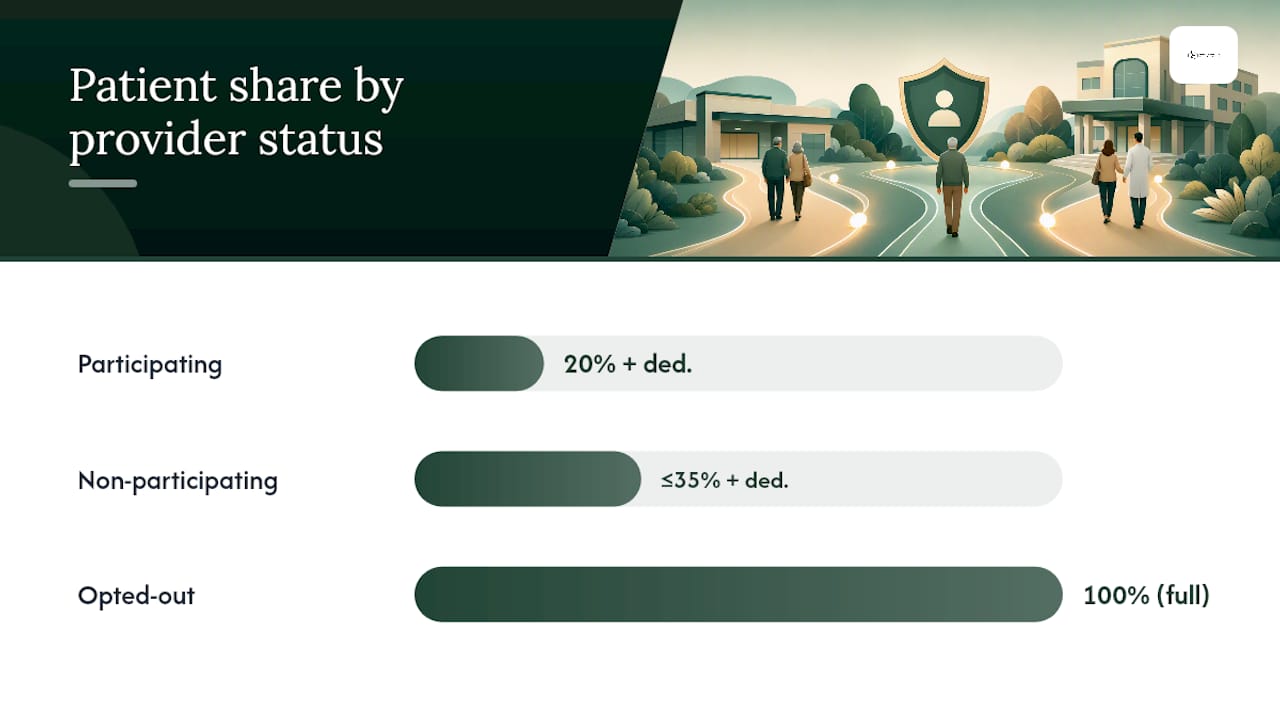
Non-participating providers can still choose to accept assignment on individual claims, which is why you need to ask per visit, not just once. The 15% limiting charge applies to most Part B services, though certain durable medical equipment suppliers and some other categories have different rules. Opted-out providers are a separate situation entirely and are covered later in this article.
How excess charges are calculated
The math stacks in a way that surprises many beneficiaries. Here’s how it works for a non-participating provider who doesn’t accept assignment on a given claim:
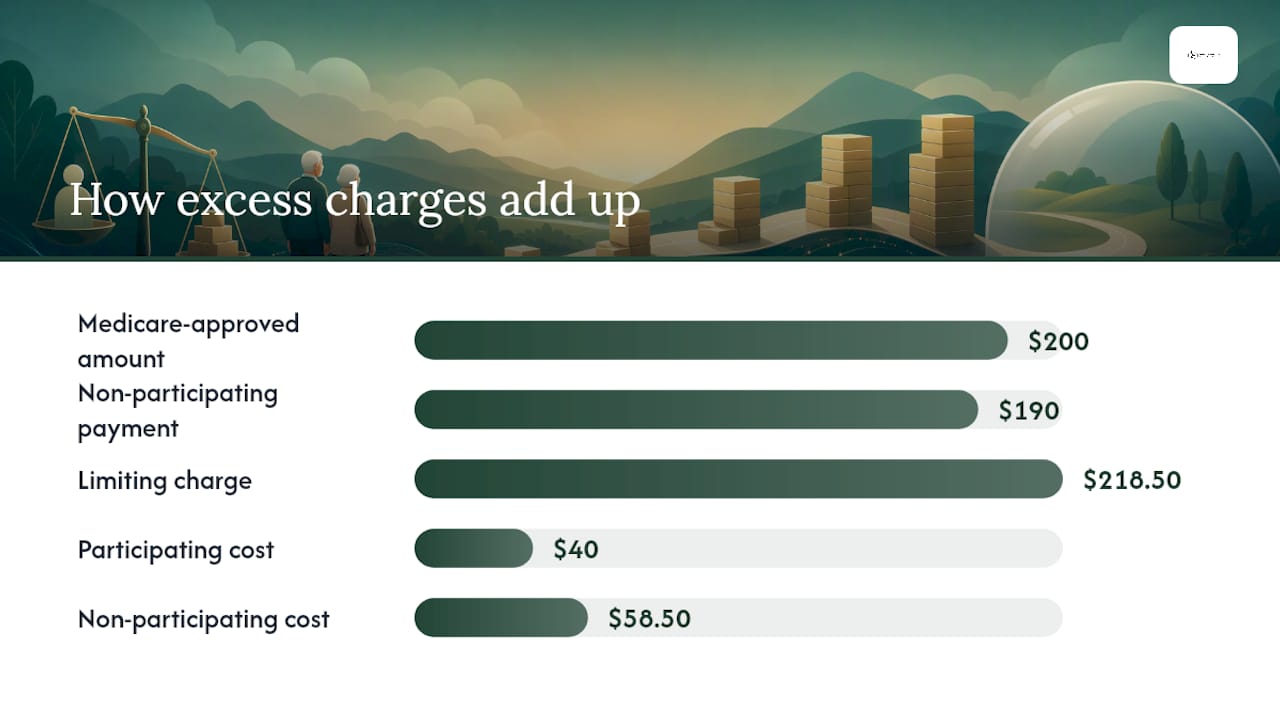
- Medicare sets the approved amount. Say it’s $200 for a specialist visit.
- Non-participating providers receive a slightly reduced rate. Medicare’s fee schedule for non-participating providers is 95% of the standard approved amount, so $190 in this example.
- The limiting charge is 115% of that reduced rate. $190 × 1.15 = $218.50. That’s the most the provider can legally bill.
- You pay 20% coinsurance on the Medicare-approved amount ($200 × 20% = $40), plus the $18.50 excess charge on top.
- The excess charge does not count toward your annual deductible. It’s purely additional out-of-pocket cost, separate from the $283 Part B deductible you’re already working through in 2026.
With a participating provider, that same $200 visit costs you $40 in coinsurance (after the deductible). With a non-participating provider who doesn’t accept assignment, it costs $58.50. Over a year of regular specialist visits, that gap adds up fast.
Pro Tip: Some services carry mandatory assignment, meaning providers must accept Medicare’s rate regardless of their participation status. Lab tests and clinical diagnostic services fall into this category. Ask your provider’s billing office specifically which services are mandatory-assignment items.
Which states ban excess charges?
Eight states have enacted laws banning or strictly limiting Part B excess charges: Connecticut, Massachusetts, Minnesota, New York, Ohio, Pennsylvania, Rhode Island, and Vermont.
The protection follows the service, not your home address. If you live in Oregon but receive care in New York, New York’s ban applies. If you live in Massachusetts but travel to Florida for a procedure, Florida’s rules apply and excess charges are permitted there.
A few practical notes for travelers and snowbirds:
- Confirm the rules of the state where you’ll receive care, not where you live.
- Out-of-state specialists, even ones you’ve used before, may have different assignment policies at their other locations.
- State bans typically cover most Part B services but may have narrow exceptions for specific provider types or settings.
Oregon does not currently ban excess charges, so Central Oregon residents on Original Medicare without Medigap coverage are fully exposed to the limiting charge when seeing non-participating providers.
How to avoid excess charges before and during care
Most excess charges are preventable with a short conversation before the appointment.
Before you call or arrive:
- Search the provider at Medicare.gov to see their participation status.
- Review your Medigap plan’s coverage for excess charges before scheduling.
- Check the questions to ask when comparing providers and insurers.
When you call to schedule:
Ask: “Do you accept Medicare assignment for this specific service?” Write down the date, the name of the person you spoke with, and their answer. A provider may accept assignment for an office visit but not for an imaging study ordered the same day.
At check-in:
- Confirm assignment status again, especially if the visit involves multiple services or specialists.
- If the provider says they don’t accept assignment, ask whether they’ll submit the claim to Medicare anyway. Medicare requires non-participating providers to submit claims for covered services even when they don’t accept assignment.
- Get written confirmation of billing policies when possible.
Pro Tip: Phone script: “I’m a Medicare beneficiary. Before I schedule, can you confirm whether your office accepts Medicare assignment for [specific service]? And will you bill Medicare directly?” Log the rep’s name and the date.
If you’re unsure about your current Medigap coverage or want help verifying a provider’s status, a State Health Insurance Assistance Program (SHIP) counselor offers free guidance, as does a local Medicare agent.
Does Medigap cover Part B excess charges?
Two Medigap plans cover excess charges: Plan F and Plan G.
Plan F covers excess charges, the Part B deductible, coinsurance, and most other Original Medicare gaps. The catch: Plan F is only available to people who were eligible for Medicare before January 1, 2020. If you turned 65 after that date, Plan F is not an option.
Plan G covers excess charges and nearly everything Plan F covers, with one difference: it does not cover the Part B deductible. In 2026, that deductible is $283, so you pay that amount yourself each year, then Plan G handles the rest, including any excess charges. For most new beneficiaries, Plan G is the strongest available protection against excess charges.
Both plans have high-deductible variants with lower premiums and higher out-of-pocket thresholds before coverage kicks in.
One practical warning: even with a Medigap plan that covers excess charges, some providers require full payment at the time of service. You then submit for reimbursement. Confirm the provider’s billing policy before the visit so you’re not caught short on cash at check-in.
Medigap premiums, availability, and underwriting rules vary by insurer and state. A local agent can compare actual plan costs in your area rather than giving you a national average that may not apply.
What to do if you receive an excess charge bill
If a bill arrives and you weren’t expecting an excess charge, work through these steps:
- Pull your Medicare Summary Notice (MSN). The MSN shows the Medicare-approved amount and what Medicare paid. Compare it to the provider’s bill to calculate whether the charge exceeds the 15% limiting charge.
- Contact the provider’s billing office. Request an itemized bill. If the charge exceeds the legal limit, point that out in writing and ask for a correction.
- Call 1-800-MEDICARE. If the provider won’t correct an overcharge, file a complaint. Medicare can investigate billing violations.
- Contact your Medigap insurer. If your plan covers excess charges, submit the claim with the MSN and provider bill attached.
- Reach out to SHIP. SHIP counselors provide free, unbiased help disputing bills and navigating reimbursement.
Documents to keep: the provider bill, your MSN, proof of payment, the provider’s name and NPI number, dates of service, and written notes from every phone call including the date and the name of the person you spoke with.
What happens when a provider has opted out of Medicare?
An opted-out provider has formally refused Medicare payment for all services. This is different from being non-participating. There is no limiting charge protection, no Medicare reimbursement, and no Medigap coverage for services from an opted-out provider.
Red flags to watch for:
- The provider asks you to sign a private contract before treatment.
- They refuse to submit any claim to Medicare.
- They demand full payment up front without explaining your options.
- They cannot be found in Medicare’s provider search.
Opt-out status typically lasts at least two years and applies to all Medicare-covered services the provider offers. If you accept care from an opted-out provider and sign a private contract, you are generally responsible for the full billed amount.
Avoid opted-out providers unless the care is genuinely unavailable elsewhere. If you must proceed, get the private contract in writing, read it carefully, and understand your total financial exposure before agreeing.
The part of this conversation most people skip
Most articles about Medicare excess charges focus on the 15% cap as if knowing the ceiling is the same as being protected. It isn’t. The real risk isn’t a single $18 excess charge on a $200 visit. It’s the accumulation: a specialist who doesn’t accept assignment, a follow-up procedure, a diagnostic test ordered the same day, each carrying its own excess charge, none of it counting toward your deductible.
The conventional advice to “check your provider’s assignment status” is correct but incomplete. You need to ask per service, per visit, and confirm it in writing when the stakes are high. A provider’s front desk may not know the billing policy for every procedure the doctor orders.
What I’d tell any Central Oregon senior on Original Medicare: Plan G is worth the premium calculation. The $283 deductible you pay yourself each year is a known, fixed cost. Unlimited excess charge exposure is not. Run the numbers with someone who can show you actual Plan G premiums in your zip code, not a national estimate.
Mountaintop Insurance offers free local help with Medicare costs
Sorting through provider assignment status, Medigap plan differences, and billing disputes is exactly the kind of work that benefits from a local expert who knows the Oregon market. Mountaintop Insurance offers free consultations for Central Oregon residents, covering Medicare Parts A, B, C, and D, Medigap comparisons including Plan G, and hands-on help with provider verification and billing questions.
No call center scripts, no pressure. You get a real conversation about your specific situation, including whether Plan G makes financial sense for you, which local providers accept assignment, and what to do if a bill looks wrong.
Schedule your free Medicare consultation with Mountaintop Insurance in Bend, Oregon, or visit Mountaintopins to learn more about local Medicare services.
Sources
- Does your provider accept Medicare as full payment? | Medicare
- What Are Medicare Part B Excess Charges? - NerdWallet
- Medicare Part B excess charges: What to know - Medical News Today
- Medicare Part B excess charges: How to avoid them - Healthline
- What Are Medicare Part B Excess Charges? - LegalClarity
- Medicare Part B excess charges: What to know - Healthgrades Resources
This article is general information, not a substitute for advice from a qualified financial advisor. Consult a qualified financial professional about your own circumstances before acting on anything here.
FAQ
What are Medicare Part B excess charges?
Medicare Part B excess charges are fees above Medicare’s approved amount that a non-participating provider can bill you. The legal cap is 15% above the Medicare-approved rate for most services.
Which Medigap plans cover excess charges?
Plans F and G both cover Part B excess charges. Plan F is only available to beneficiaries who were eligible for Medicare before January 1, 2020; Plan G is available to new enrollees.
Do excess charges count toward my deductible?
No. Excess charges are separate from your Part B deductible ($283 in 2026) and do not count toward it. They are paid in addition to your regular coinsurance.
How do I check if my provider accepts Medicare assignment?
Use the provider search tool at Medicare.gov, or call the provider’s billing office and ask directly. Ask per service, since a provider may accept assignment for some services but not others.
What if I was billed more than the legal limiting charge?
Compare your provider bill to your Medicare Summary Notice to confirm the overcharge, then contact the provider’s billing office. If unresolved, call 1-800-MEDICARE to file a complaint or contact a SHIP counselor for free assistance.
Recommended
Disclaimer: This article is for general educational purposes only and does not constitute personalized advice. Medicare rules and plan details change frequently.
Discuss Your Situation With Us