Medicare GLP-1 Bridge Program: What Part D Beneficiaries Need to Know
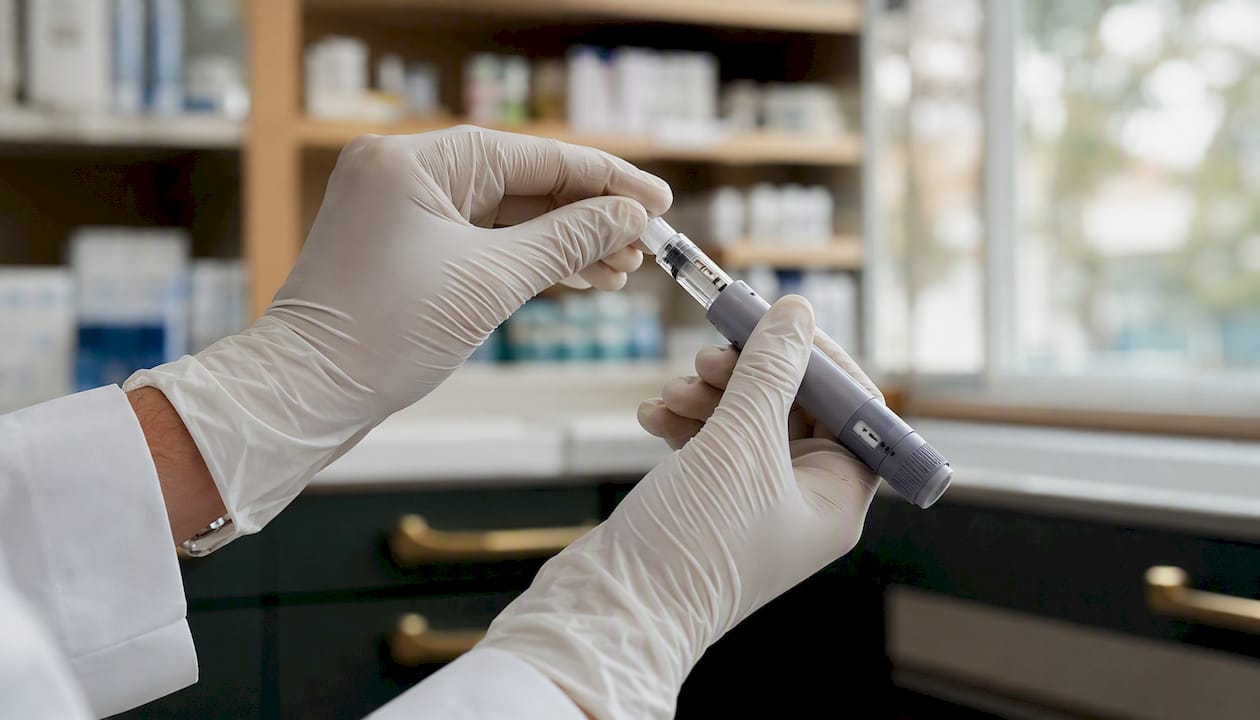
The Medicare GLP-1 Bridge program is real, and it matters. Starting July 1, 2026, eligible Medicare Part D beneficiaries can access certain GLP-1 weight-loss drugs for a flat $50 monthly copay through a short-term CMS demonstration that runs outside the standard Part D benefit through December 31, 2027.
Here is what you need to do right now:
- Check your plan type. Standalone PDPs, MA-PD coordinated care plans, SNPs, EGWPs, and LI NET plans are eligible. Private fee-for-service and PACE plans are not.
- Talk to your prescriber. They must confirm you meet the clinical BMI criteria and that the drug is for weight management as part of a lifestyle program.
- Expect a prior authorization. Your pharmacy will send a prior authorization request to your prescriber, typically within 24–72 hours of submitting the claim.
- Pay $50 at the pharmacy. That copay is the same regardless of your Part D benefit phase, and it does not count toward your Part D deductible or True Out-of-Pocket (TrOOP) costs.
For questions, call 1-800-MEDICARE (1-800-633-4227), TTY 1-877-486-2048, or visit Medicare.
Key Takeaways
The Medicare GLP-1 Bridge gives eligible Part D beneficiaries access to Foundayo, Wegovy, and Zepbound (KwikPen) for a $50 monthly copay through December 31, 2027, but the copay does not count toward Part D deductible or TrOOP.
| Point | Details |
|---|---|
| Program timeframe | The Bridge runs July 1, 2026 through December 31, 2027 as a CMS demonstration outside Part D. |
| Covered drugs | Foundayo (tablet), Wegovy (injection and tablet), and Zepbound (KwikPen only) are covered; single-dose vials and pens are not. |
| $50 copay and Part D | The $50 monthly copay does not count toward your Part D deductible, TrOOP, or catastrophic coverage threshold. |
| Key exclusions | Beneficiaries already receiving a GLP-1 through Part D, or with type 2 diabetes, moderate-to-severe OSA, or MASH, are not eligible. |
| Mountaintop Insurance | Free consultations help Central Oregon beneficiaries confirm plan eligibility, review Part D options, and prepare for the prior authorization process. |
Table of Contents
- What is the Medicare GLP-1 Bridge and why did CMS create it?
- Which GLP-1 drugs and formulations does the Bridge cover?
- Who qualifies, and which Medicare plan types are eligible?
- How do you actually get GLP-1 drugs through the Bridge?
- What does the Bridge cost, and how does it affect your Part D benefits?
- What to bring to your appointment and what providers need for prior authorization
- Why local Medicare help can simplify the Bridge process
- Mountaintop Insurance can help you sort out your Medicare options
- Sources
- FAQ
What is the Medicare GLP-1 Bridge and why did CMS create it?
The Medicare GLP-1 Bridge is a short-term CMS demonstration, not a permanent Part D benefit expansion. It operates entirely outside the Part D coverage and payment flow, using a single central processor to handle prior authorization, claims adjudication, and pharmacy payments. That distinction matters practically: your Part D plan is not the payer here, and the Bridge has its own separate eligibility and claims pathway.
CMS launched the demonstration to collect real-world utilization data on GLP-1 weight-loss drugs in the Medicare population and to test a payment approach that makes these medications accessible at a predictable, low cost. GLP-1 drugs for obesity were not previously covered under Part D for weight management, so this program fills a specific gap for beneficiaries who need them for that purpose alone.
Timeline: The demonstration runs from July 1, 2026 through December 31, 2027. Verify the latest updates and any program changes at cms.gov/medicare/coverage/prescription-drug-coverage/medicare-glp-1-bridge.
The program is time-limited by design. CMS has not committed to extending it beyond December 31, 2027, so beneficiaries who qualify should act during the demonstration window rather than assume the same access will continue afterward.
Which GLP-1 drugs and formulations does the Bridge cover?
Three GLP-1 medications are covered under the Bridge, and the specific formulation matters. Prescribing or dispensing the wrong form can result in a claim rejection, so both prescribers and pharmacists need to verify the exact product before submitting.
Covered drugs per the Medicare fact sheet:
- Foundayo (oral tablet)
- Wegovy (subcutaneous injection and oral tablet)
- Zepbound (KwikPen only)
What is NOT covered:
- Zepbound single-dose vials
- Zepbound single-dose pens
- Any GLP-1 formulation not on the CMS-approved NDC list
The NDC (National Drug Code) list is the definitive reference. A drug that looks like a covered product but carries a different NDC may not process correctly through the Bridge’s central processor.
Pro Tip: Prescribers and pharmacists should pull the current CMS NDC list directly from cms.gov/priorities/innovation/innovation-models/medicare-glp-1-bridge before submitting any Bridge claim. Formulation-level details can change, and the NDC list is the authoritative source.
One practical note for patients: if your prescriber writes for Zepbound, confirm the prescription specifies the KwikPen. A single-dose vial prescription will not go through the Bridge, and you would be responsible for the full cost.
Who qualifies, and which Medicare plan types are eligible?
Clinical eligibility criteria
The Bridge is strictly for weight management, not for treating diabetes or other conditions. To qualify clinically, you must be 18 or older and meet one of the following BMI thresholds, with the drug prescribed as part of a lifestyle modification program:
- BMI 35 or higher (no additional qualifying condition required)
- BMI 30 or higher with at least one of: heart failure, hypertension, or chronic kidney disease
- BMI 27 or higher with at least one of: prediabetes, or a prior myocardial infarction, stroke, or peripheral artery disease
Who is excluded
Meeting the BMI criteria alone is not enough. You are not eligible for the Bridge if:
- You are already receiving a GLP-1 drug through your Part D plan for any indication. Switching to the Bridge to reduce your copay is not permitted if the drug is already covered by Part D.
- You have a Part D-coverable diagnosis such as type 2 diabetes, moderate-to-severe obstructive sleep apnea (OSA), or metabolic-associated steatohepatitis (MASH). Even if you meet the BMI threshold, these diagnoses route you back to your Part D plan.
That second exclusion catches a lot of people off guard. A beneficiary with prediabetes and a BMI of 28 may qualify. A beneficiary with a confirmed type 2 diabetes diagnosis does not, regardless of BMI.
Eligible and ineligible Medicare plan types
| Plan Type | Bridge Eligible? |
|---|---|
| Standalone Prescription Drug Plan (PDP) | Yes |
| Medicare Advantage Prescription Drug (MA-PD) coordinated care plan | Yes |
| Special Needs Plans (SNPs) | Yes |
| Employer Group Waiver Plans (EGWPs) | Yes |
| Medicare Limited Income NET (LI NET) | Yes |
| Private Fee-for-Service (PFFS) plans | No |
| PACE plans | No |
| Cost-contract plans (unless also enrolled in a PDP) | No |
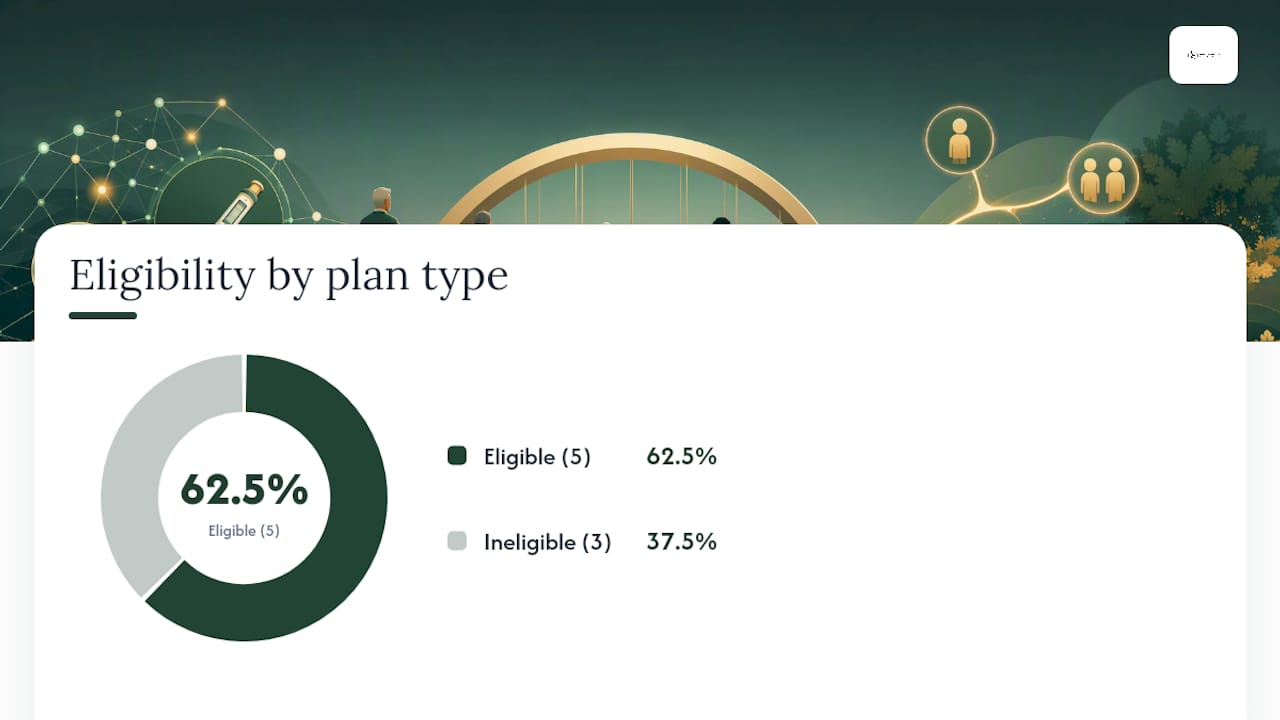
If you are in a Medicare Advantage coordinated care plan, you are likely eligible as long as you meet the clinical criteria and are not already receiving a GLP-1 through Part D. If you are in a PFFS plan, you will need to explore other GLP-1 access options through your plan or prescriber.
How do you actually get GLP-1 drugs through the Bridge?
The workflow runs from you to your prescriber to your pharmacy, with a prior authorization step in the middle. Here is the exact sequence:
-
Talk to your provider. Confirm your BMI, qualifying conditions, and that you are not already receiving a GLP-1 through Part D. Ask whether your Medicare plan type is eligible.
-
Your prescriber writes the prescription. They must attest that the drug is for weight management and that you are enrolled in or referred to a lifestyle modification program. The prescription must include an obesity diagnosis code from the E66 family.
-
The prescription goes to a participating pharmacy. The pharmacy submits the claim to the Bridge’s central processor, not to your Part D plan. The prescription must be annotated with “SEND TO BRIDGE FOR WEIGHT MANAGEMENT” so the pharmacy routes it correctly.
-
The pharmacy sends a prior authorization request to your prescriber. Per CMS prescriber guidance, this typically happens within 24–72 hours. Electronic prior authorization (ePA) is encouraged to speed the process.
-
Your prescriber responds to the prior authorization request. They confirm clinical criteria and the lifestyle program attestation. Delays here are the most common bottleneck.
-
The pharmacy dispenses a 28- or 30-day supply. You pay the $50 copay at the counter.
-
Refills. Subsequent fills do not require a new prior authorization unless you switch to a different covered drug. Your prescription remains valid through December 31, 2027, unless the drug changes.
If a claim is denied, your prescriber and pharmacist can review the denial reason and resubmit with corrected documentation. The most common issues are missing E66 codes, incorrect formulation NDCs, and missing Bridge annotation on the prescription.
Pro Tip: Ask your pharmacist whether they have processed Bridge claims before. Not every pharmacy has set up the Bridge claim routing yet. If yours has not, you may need to transfer the prescription to one that has.
The prior authorization form and full prescriber instructions are available at cms.gov/priorities/innovation/innovation-models/medicare-glp-1-bridge. CMS strongly encourages ePA submission to reduce turnaround time.
What does the Bridge cost, and how does it affect your Part D benefits?
The cost structure is straightforward on the surface, but the interaction with your Part D benefits trips up a lot of beneficiaries.
The basics:
- You pay a $50 monthly copay for each covered GLP-1 drug, regardless of which Part D benefit phase you are in.
- That $50 is the same whether you are in the deductible phase, the coverage gap, or catastrophic coverage.
- Low-income subsidy (LIS/Extra Help) does not apply to the Bridge copay. If you receive Extra Help, it will not reduce your $50.
How the Bridge does NOT interact with Part D:
- The $50 copay does not count toward your Part D deductible.
- Bridge payments do not count toward your TrOOP (True Out-of-Pocket) costs, which means they do not move you toward catastrophic coverage.
- Bridge fills will not appear on your Part D Explanation of Benefits (EOB) or Medicare Summary Notice (MSN).
That last point is worth sitting with. If you are tracking your Part D spending to reach catastrophic coverage, Bridge fills are invisible to that calculation. Every dollar you spend on the Bridge is separate from your Part D cost-sharing trajectory.
Program pricing note: CMS expects participating manufacturers to provide covered GLP-1 drugs at a net price of $245 per monthly supply for the program. That manufacturer net price is what CMS uses to structure Bridge payments — it is a system-level figure, not something you negotiate or see at the pharmacy counter.
Pro Tip: Call 1-800-MEDICARE (1-800-633-4227) or contact your local State Health Insurance Assistance Program (SHIP) counselor if you have questions about how Bridge spending interacts with your specific Part D plan’s cost-sharing. SHIP counselors provide free, unbiased help and can walk through your individual situation.
What to bring to your appointment and what providers need for prior authorization
Getting through the prior authorization without delays comes down to preparation on both sides of the desk.
Before your appointment, bring:
- Your Medicare card and, if asked, the last four digits of your Social Security number (pharmacies may request this for eligibility verification)
- A current medication list, including any GLP-1 drugs you have taken or are currently taking
- Recent height and weight measurements (your BMI will be verified)
- Documentation of any qualifying conditions: heart failure, hypertension, chronic kidney disease, prediabetes, or history of MI, stroke, or peripheral artery disease
Questions to ask your provider:
- Do I meet the Bridge clinical criteria based on my BMI and medical history?
- Will you submit the Bridge prior authorization form, and do you use ePA?
- Which specific formulation should you prescribe (injection, tablet, or KwikPen)?
- Am I currently receiving any GLP-1 through my Part D plan?
What your prescriber and pharmacist need to do:
- Include an E66-family obesity diagnosis code on the prescription and prior authorization
- Annotate the prescription: “SEND TO BRIDGE FOR WEIGHT MANAGEMENT”
- Respond to the pharmacy’s prior authorization request within the 24–72 hour window
- Confirm the correct NDC for the covered formulation
Pro Tip: Save a copy of your prior authorization approval letter. It confirms your eligibility and the drug covered, and it is useful if you encounter any claim issues at refill. Your authorization remains valid through December 31, 2027, unless you switch drugs.
Starting GLP-1 therapy also brings health considerations beyond the prescription itself. Some people experience changes in appetite, muscle mass, and mood during treatment. Coordinating with your full care team, including any behavioral health providers, can help you manage the transition well. Resources on GLP-1 medications and mental health and muscle loss risks for GLP-1 users are worth reviewing before you start.
Why local Medicare help can simplify the Bridge process
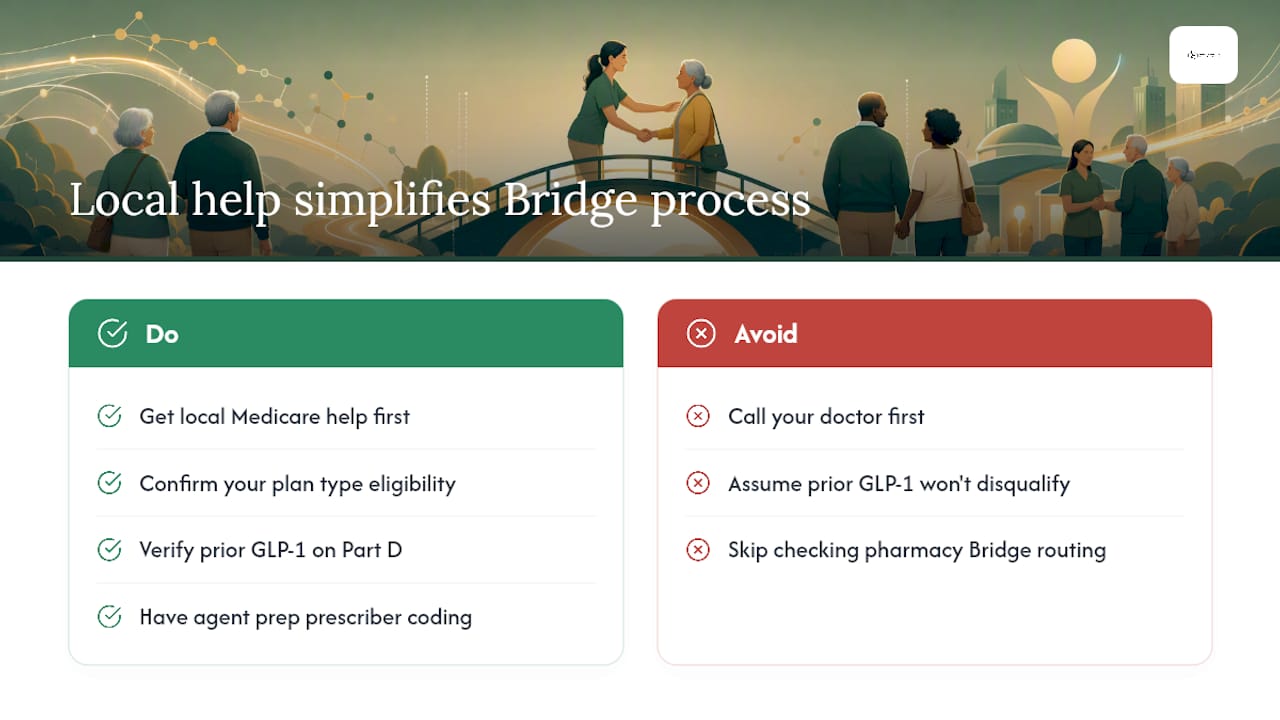
The Medicare GLP-1 Bridge program has more moving parts than most Medicare benefits. You need to confirm your plan type is eligible, verify you are not already receiving a GLP-1 through Part D, make sure your prescriber knows the exact annotation and coding requirements, and find a pharmacy that has set up Bridge claim routing. Any one of those steps can stall the process.
That is where local, personalized help makes a real difference. A knowledgeable Medicare agent or SHIP counselor can pull up your specific plan type, check whether you are in a PDP, MA-PD coordinated care plan, or an ineligible plan like PFFS, and tell you in plain language whether you are likely eligible before you ever call your doctor. They can also help you prepare the right questions for your prescriber and flag potential issues, like a prior GLP-1 prescription on your Part D record, before they become a denial.
Consider a beneficiary enrolled in a standalone PDP in Central Oregon who had been prescribed semaglutide two years ago for blood sugar management. Before calling their doctor, they were not sure whether that prior prescription would disqualify them from the Bridge. A quick conversation with a local Medicare advisor clarified that the prior prescription was for a Part D-covered diagnosis, which did make them ineligible for the Bridge. That conversation saved them time and set them on the right path to talk to their prescriber about Part D options instead.
If you are unsure about your plan type, whether a prior GLP-1 prescription affects your eligibility, or how to prepare your documentation, getting local help before your provider appointment is the most efficient move you can make.
Mountaintop Insurance can help you sort out your Medicare options
Sorting out whether your Medicare plan qualifies for the Bridge, and what to do if it does not, is exactly the kind of question Mountaintop Insurance handles every day. The agency serves Medicare beneficiaries in Bend, Oregon and remotely across Central Oregon, offering free consultations focused on education rather than pressure.
During a consultation, Mountaintop Insurance can help you identify your current plan type, check your Part D status, explain how the Bridge interacts with your specific coverage, and refer you to SHIP counselors for additional free guidance. If your plan is not eligible or you need to review your Part D options for the upcoming plan year, the agency can walk you through your choices and help you enroll in coverage that fits your situation.
Schedule a free Medicare consultation with Mountaintop Insurance to get clear answers about your plan type, Bridge eligibility, and next steps, with no sales pressure and no obligation.
Sources
Use these official CMS and Medicare resources to verify program details, download forms, and get personalized help:
This article is general information, not a substitute for advice from a qualified doctor. Consult a qualified healthcare professional about your own circumstances before acting on anything here.
FAQ
Who qualifies for the Medicare GLP-1 Bridge?
Eligible beneficiaries must be 18 or older, enrolled in a qualifying Medicare plan type (such as a PDP, MA-PD coordinated care plan, SNP, EGWP, or LI NET), and meet one of three BMI thresholds with the drug prescribed for weight management as part of a lifestyle program. Beneficiaries already receiving a GLP-1 through Part D, or with type 2 diabetes, moderate-to-severe OSA, or MASH, are not eligible.
Which GLP-1 drugs will Medicare pay for through the Bridge?
Medicare covers three drugs under the Bridge: Foundayo (tablet), Wegovy (subcutaneous injection and tablet), and Zepbound (KwikPen only). Zepbound single-dose vials and single-dose pens are not covered.
Is Medicare paying for GLP-1 drugs in 2026?
Yes, through the Medicare GLP-1 Bridge demonstration, which began July 1, 2026. Eligible Part D beneficiaries pay a $50 monthly copay; the program runs through December 31, 2027.
Does Zepbound have a bridge program through Medicare?
Yes. Zepbound is covered under the Medicare GLP-1 Bridge, but only in the KwikPen formulation. Single-dose vials and single-dose pens are excluded, so the prescription must specify the KwikPen.
Can Mountaintop Insurance help me figure out if I qualify?
Yes. Mountaintop Insurance offers free Medicare consultations for Central Oregon beneficiaries, in person in Bend or remotely, and can help you confirm your plan type, review your Part D status, and prepare for the prior authorization process before your provider appointment.
Recommended
Disclaimer: This article is for general educational purposes only and does not constitute personalized advice. Medicare rules and plan details change frequently.
Discuss Your Situation With Us