30 Day Medigap Free Look for Medicare: Cancel, Document, Get Refund

Medigap policies include a free look period during which you can return the policy for a full refund, no questions asked. The clock starts when you receive the new policy, not when you buy it, and this right applies specifically to Medicare Supplement insurance, not Medicare Advantage plans. During those 30 days, you can cancel for any reason and get your money back.
TL;DR:
- The 30-day free look period begins when you receive your Medigap policy, not when you sign or the insurer approves it, and mailing delays can affect the start date.
- During the free look, you can cancel and get a full refund without needing to justify your decision, but you may pay premiums on both policies during overlap.
- Returning a policy requires prompt, documented communication with the insurer, ideally via certified mail with a return receipt, to prove timely cancellation.
- The free look protects your purchase but should not be used as a tool for multiple policy hopping, especially outside your open enrollment or guaranteed-issue periods.
- In states like Massachusetts, Minnesota, and Wisconsin, rules may differ, so checking local regulations or consulting SHIP counselors ensures accurate understanding of the free look process.
Table of Contents
- What Is the Medigap Free Look Period?
- How Long Does the Free Look Last, and When Does It Start?
- What Rights Do You Have During the Free Look?
- How Do You Cancel a Medigap Policy During the Free Look?
- How Does the Free Look Interact With Open Enrollment and Guaranteed Issue?
- Do Any States Handle the Free Look Differently?
- What Documentation Should You Keep, and When Should You Call an Agent?
- The Free Look Is a Safety Net, Not a Shopping Strategy
- Get Help Reviewing Your Medigap Policy Before the Clock Runs Out
- Sources
- FAQ
What Is the Medigap Free Look Period?
Medigap policies are Medicare Supplement plans sold by private insurance companies to help cover the out-of-pocket costs Original Medicare leaves behind, things like copayments, coinsurance, and deductibles. Because these are private contracts, federal regulators built in a consumer safeguard: the free look period.
According to Medicare, the free look is a 30-day window that lets you return a newly purchased Medigap policy for a full refund, for any reason at all. You don’t need to justify the decision or prove the policy failed you in some way. You just decide it isn’t right and send it back.
Here’s the part that trips people up: this protection does not extend to Medicare Advantage plans. Medicare Advantage has its own separate trial right, called the Medicare Advantage Open Enrollment Period, with different rules and a different timeline. If you’re comparing a Medigap policy against an Advantage plan, don’t assume the same 30-day cancellation math applies to both. It doesn’t.
How Long Does the Free Look Last, and When Does It Start?
The free look window is defined to begin when you receive your new Medigap policy, not the day you sign the application or the day the insurer approves you. That distinction matters because there’s often a gap of a week or more between approval and the policy actually landing in your mailbox.
Check two dates on your policy documents: the issue date and the delivery date. The official Medicare guide to choosing a Medigap policy recommends confirming receipt in writing with your insurer if there’s any ambiguity about when the clock started.
Mailing delays are the most common pitfall. If your policy arrives later than expected, your 30 days start from that later date, not from when the insurer says it was mailed. If you received the policy electronically, ask your insurer directly how they’re calculating the start date, since practices vary by carrier and state.
What Rights Do You Have During the Free Look?
The free look isn’t just a grace period. It’s a genuine trial run with real financial protection built in. During this period, you keep every right you had before buying the new policy, plus a full exit if you change your mind.
Here’s what that actually looks like in practice:
- You can cancel the new Medigap policy and receive a full refund of premiums paid.
- You should keep your original Medigap policy active during the free look while testing the new one.
- You may pay premiums on both policies during the overlap month, since most insurers don’t prorate or waive this.
- You lose nothing by waiting the full 30 days before deciding, since the refund right doesn’t shrink as the deadline approaches.
That overlap premium is the detail most people don’t expect. It feels like double paying, and technically it is. But the Medicare guide to choosing a Medigap policy is blunt about the tradeoff: a month of extra premium is a small price compared to canceling your old policy too early and finding out the new one doesn’t work out.
How Do You Cancel a Medigap Policy During the Free Look?
Returning a policy isn’t complicated, but the sequence matters, especially if you want documentation on your side in case of a dispute. Follow these steps in order.
- Read the new policy immediately upon arrival and note the delivery date in writing.
- Contact the insurer as soon as you decide to cancel. Ask specifically what their return process requires.
- Request written confirmation of your cancellation request, including the date they received it.
- Send your cancellation via certified mail with a return receipt, or use the insurer’s approved electronic return method if one exists.
- Keep copies of everything: the policy, your cancellation letter, the mail receipt, and any email confirmations.
- Expect your refund within a few weeks. If it’s delayed or denied, follow up in writing and escalate to your state insurance department if needed.
Pro Tip: Certified mail with a return receipt is worth the few extra dollars. State insurance guidance consistently points to this as the single best way to prove your return was timely if the insurer later disputes the date.
How Does the Free Look Interact With Open Enrollment and Guaranteed Issue?
The free look and the Medigap Open Enrollment Period are two different protections, and confusing them can cost you real money. Your Medigap Open Enrollment Period is a one-time, six-month window that starts the month you’re both 65 or older and enrolled in Medicare Part B. During this window, insurers must sell you any Medigap policy they offer, regardless of your health history, and can’t charge you more because of a pre-existing condition.
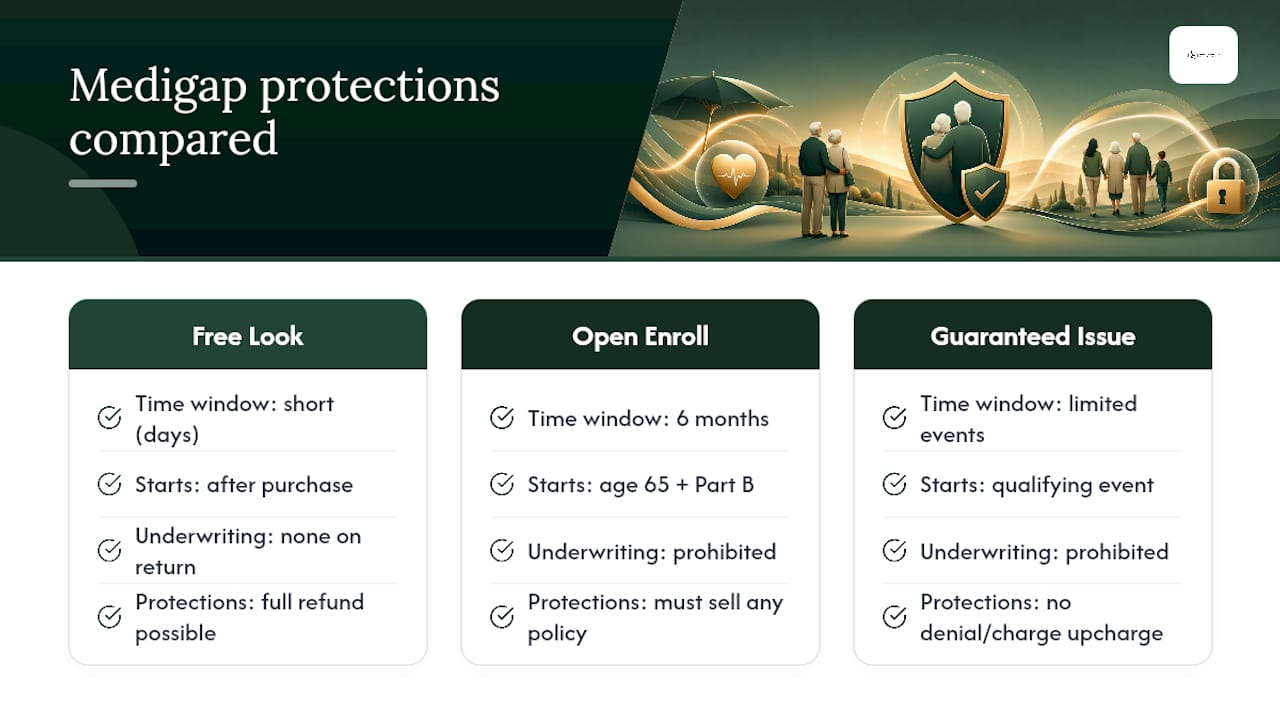
Guaranteed-issue rights work similarly but apply in specific, more limited circumstances outside that six-month window, such as losing employer coverage or your Medicare Advantage plan leaving your area.
Here’s the risk: once your Open Enrollment Period ends and no guaranteed-issue situation applies, insurers can require medical underwriting for a new Medigap policy. That means they can review your health history, charge more, or deny coverage outright. The Medicare guide also notes that switching policies can trigger a new pre-existing condition waiting period of up to six months, unless your prior coverage counts toward it. If you’re using the free look to test a policy purchased outside your protected enrollment window, understand that returning it doesn’t guarantee you can easily get another one on the same favorable terms.
Do Any States Handle the Free Look Differently?
Most states follow the standard federal 30-day free look, but a handful have their own wrinkles. Federal Medicare materials specifically flag Massachusetts, Minnesota, and Wisconsin as states where Medigap rules, including standardized plan structures, differ from the rest of the country.
These states codify consumer protections and plan standardization somewhat differently, which can affect timing, documentation requirements, or even which plans are available. If you live in one of these three states, or honestly anywhere, it’s worth a direct call to your State Health Insurance Assistance Program (SHIP) or your state insurance department before you assume the general rules apply exactly as described. SHIP counselors are free, unbiased, and deal with these exact questions daily.
What Documentation Should You Keep, and When Should You Call an Agent?
Treat your free look period like a small paper trail project. Keep a dated copy of the policy itself, your certified mail receipt, any written confirmation from the insurer, and a simple timeline noting when you received the policy, when you contacted the insurer, and when you sent your cancellation. If a dispute ever comes up about whether you returned the policy on time, this is what settles it.

You can absolutely handle a straightforward return yourself. But if the insurer is slow to respond, the paperwork feels unclear, or you’re not sure whether canceling now affects your guaranteed-issue rights later, that’s when a licensed agent earns their keep. Mountaintop Insurance reviews policy language, confirms your exact deadline, and can help you draft a return request that documents everything correctly the first time.
The Free Look Is a Safety Net, Not a Shopping Strategy
The biggest misconception I see about the Medigap free look is treating it like a 30-day audition where you can bounce between three or four policies to find the perfect fit. That’s not what it’s designed for, and using it that way invites real risk. The free look exists to protect you from one bad decision, not to replace the homework you should do before you ever apply.
The conventional advice online tends to oversell the safety net and undersell the overlap premium and the guaranteed-issue cliff. Readers walk away thinking the free look means zero cost and zero consequence. It doesn’t. You’re paying double for a month, and if you’re outside your Open Enrollment Period, the next policy you want might come with underwriting attached.
What I’d prioritize first: know your Open Enrollment dates before you ever sign anything, because that window is where your leverage actually lives. The free look is your backstop if something goes wrong, not your primary strategy. Use it that way, and it works exactly as intended.
— Jesse Zimmerman
Get Help Reviewing Your Medigap Policy Before the Clock Runs Out
Mountaintop Insurance is the alternative to a national call center when you’re staring down a 30-day deadline and don’t want to guess whether you’re reading your policy documents correctly. A free consultation gets you a plain-language review of your new Medigap policy, a confirmed deadline based on your actual delivery date, and a second set of eyes on whether the coverage fits your situation before that window closes.
This is local, education-first work rooted in Central Oregon, with remote consultations available if an in-person visit doesn’t fit your schedule. Whether you’re comparing plans for the first time or trying to decide if a return makes sense, Mountaintop Insurance’s Medicare services team walks through the specifics with you at no cost. Visit the Mountaintop Insurance site to schedule a consultation and get a clear answer before your 30 days run out.
This article is general information, not a substitute for advice from a qualified financial advisor. Consult a qualified financial professional about your own circumstances before acting on anything here.
Sources
- Can I change my Medigap policy? | Medicare
- Medicare supplement insurance guide | Texas Department of Insurance
FAQ
Which Medicare Supplement Policies Offer a Free Look Period?
All standardized Medigap policies sold by private insurers include the 30-day free look, since it’s a federal consumer protection tied to the policy type itself rather than a specific plan letter or carrier.
What State Has the Lowest Medigap Premiums?
Premiums vary widely by state, insurer, age, and pricing method (community-rated, issue-age-rated, or attained-age-rated), so there’s no single state with universally lower costs. Comparing quotes locally, which Mountaintop Insurance can help with, is the only reliable way to find your actual lowest price.
What Disqualifies You From Medigap?
Outside your Medigap Open Enrollment Period or a guaranteed-issue situation, insurers can use medical underwriting to deny coverage or charge more based on your health history, which is why timing your application correctly matters so much.
Does Medigap Cover Care Outside the Country?
Some Medigap plans include limited foreign travel emergency coverage, typically after a deductible and up to a lifetime cap, but coverage details vary by plan, so it’s worth confirming the specific terms of your policy directly with the insurer or your agent.
Recommended
Disclaimer: This article is for general educational purposes only and does not constitute personalized advice. Medicare rules and plan details change frequently.
Discuss Your Situation With Us