Set a 1 Year Reminder: U.S. Term Life Conversion Steps and Free Review

Most convertible term policies let you switch to permanent coverage without a medical exam, as long as you act inside the conversion window. That’s the entire trade: you keep your original health classification and skip new underwriting, but you pay premiums based on your current age and the permanent product you choose. Guaranteed acceptance costs money. Whether that trade is worth it depends on your health, your timeline, and what you actually need the coverage for.
TL;DR:
- Converting at the right time can lock in your original health classification, even if your health has since declined or worsened.
- Most policies allow conversion within a window of 5 to 20 years from issue or until age 65 to 75, with some offering extended options through riders.
- Converting late in the term typically results in higher premiums due to increased age, while early conversions can benefit from lower costs and potential credits.
- Partial conversions enable locking in lifelong coverage for specific needs while leaving the rest of the policy as term to reduce costs.
- Always get a written illustration, confirm eligibility deadlines, and clarify whether a conversion credit applies before proceeding with a conversion.
Table of Contents
- What Is Term Life Conversion and How Does It Work?
- Who Should Actually Convert Term Life Insurance?
- When Does the Conversion Window Close?
- How Much Does It Cost to Convert Term Life Insurance?
- How Do You Convert a Term Policy Step by Step?
- Which Permanent Policy Types Can You Convert Into?
- Can You Convert Just Part of Your Term Policy?
- What Should You Ask Your Insurer Before Converting?
- How Mountaintop Insurance Helps You Evaluate a Conversion
- The Conservative Case for Converting Term Life
- Get a Free Policy Review Before Your Window Closes
- Where to Verify Conversion Rules and Tax Treatment
- Sources
- FAQ
What Is Term Life Conversion and How Does It Work?
A term life conversion is a contractual right built into most convertible term policies. It lets you exchange all or part of your term coverage for a permanent policy from the same insurer, without reapplying from scratch. That’s the key difference from buying new coverage: a fresh application means a fresh medical exam, updated health questions, and a real chance of getting rated up or turned down if anything’s changed. Conversion skips all of that.
Insurers generally carry your original health classification forward into the new policy, according to MoneyGeek’s breakdown of the conversion process. If you qualified as “preferred plus” at 32, you keep that rating at 52, even if you’ve since developed high blood pressure or a heart condition that would sink a new application. This is the entire point of the privilege, and it’s why insurance regulators flag it as one of the more valuable, underused features sitting inside an ordinary term contract.
What doesn’t carry over is your age. The insurer reprices the new permanent policy using your current age at the time of conversion, not the age you were when you bought the term policy. A few other things to know before you assume conversion works exactly like buying new coverage:
- No medical exam or health questionnaire is required for a standard conversion.
- The insurer sets new premiums based on age at conversion, not the original issue age.
- Your original underwriting class (preferred, standard, etc.) usually transfers to the new policy.
- Insurers can limit which permanent products are eligible for conversion, so not every term policy converts into every type of permanent plan they sell.
Who Should Actually Convert Term Life Insurance?
Conversion isn’t a universal upgrade. It solves a specific problem: the fear that your health will disqualify you from getting new coverage later. If that fear doesn’t apply to you, converting might just mean paying more for something you don’t need.
- Your health has changed since you bought the policy. This is the strongest case for converting, full stop. A cancer diagnosis, diabetes, a cardiac event, even a new medication regimen can wreck a fresh application. Conversion sidesteps all of it, since the insurer already priced your risk years ago and can’t reprice your health now.
- You have dependents or estate obligations that outlast your term. If you’re supporting a family member with lifelong needs, or you want a policy that funds estate taxes or final expenses no matter when you die, permanent coverage matches that timeline better than term ever will.
- Your term is expiring and you still need coverage. If renewal rates are about to spike and you don’t want to shop a new policy, converting locks in coverage without the underwriting gamble.
- You should probably skip conversion if your need is temporary. A mortgage payoff or a kid’s college years has an end date. Term coverage that matches that window is usually cheaper and simpler.
- Skip it, too, if you’re still healthy and price-shopping wins. Forbes Advisor notes that comparing conversion costs against fresh new-policy quotes makes sense whenever your health is still solid, since a new medically underwritten policy might beat the converted price outright.
When Does the Conversion Window Close?
Every convertible term policy has a deadline, and missing it means losing the guaranteed right entirely. The specifics live in your policy contract, not in general industry rules, so the numbers below are common patterns, not universal law.
Most insurers set the window using one of two formats:
- A fixed number of years from issue. Common ranges run 5 to 20 years from when you bought the policy, depending on the carrier and the term length you originally selected.
- An age cutoff. Many contracts close the conversion window somewhere between age 65 and 75, regardless of how long you’ve held the policy.
- A combination of both. Some policies use whichever limit comes first, so a 20-year term bought at 50 might have its conversion right expire at 70, not at year 20.
- Extended conversion riders. Some insurers sell an add-on that stretches the window well past the standard cutoff. If your policy includes one, the exact terms will be spelled out in the rider language, and it’s worth reading closely, similar to how other life insurance riders modify a base policy’s standard terms.
Miss the deadline, and the guaranteed conversion right disappears. At that point, getting permanent coverage means applying as a new customer, complete with medical underwriting and full exposure to whatever health changes have happened since. There’s no grace period once the contractual window closes.
Pro Tip: Set a calendar reminder at least a year before your conversion deadline, not the month before. Insurers process conversions faster than new applications, but you still need time to compare permanent product options and request illustrations before the window shuts for good.
How Much Does It Cost to Convert Term Life Insurance?
Permanent coverage costs more than term, in every case, because it insures you for life and builds cash value instead of expiring at a set date. Converting doesn’t change that math. It just changes how the insurer prices you: your original health class carries forward, but your current age does not.
That age effect is the real driver of cost. Converting at 40 instead of 60 keeps the age based multiplier far lower, since permanent premiums climb steeply the older you get at issue, according to MoneyGeek’s analysis of conversion timing. Wait until your term is nearly expired to convert, and you’ll likely pay a much steeper rate than someone who converted the same policy a decade earlier.
A rough sense of the gap: whole life premiums for the same face amount can run several times higher than term premiums, particularly when the conversion happens at an older age. Exact multiples depend on your carrier, health class, and the specific permanent product, but the direction is consistent: later conversion means a meaningfully higher price tag.
There’s one offset worth asking about directly. Many insurers apply a conversion credit, a discount against the first year’s permanent premium, commonly equal to roughly one year’s worth of your term premium, per Forbes Advisor’s coverage of conversion mechanics. The exact credit calculation varies by carrier, so get it in writing rather than assuming it matches what a friend’s policy offered.
A few cost factors to keep in front of you before converting:
- Permanent premiums reflect your current age, not your original issue age.
- Your health classification carries over, so a rated policy stays rated and a preferred policy stays preferred.
- Conversion credits can offset part of the first year’s cost, but the size and eligibility rules differ by insurer.
- Waiting until close to your deadline to convert generally locks in a higher lifetime premium than converting earlier.
How Do You Convert a Term Policy Step by Step?
Converting isn’t complicated, but it does require paperwork and a few decisions you shouldn’t rush. Here’s the practical sequence:
- Confirm your policy is convertible and find the deadline. Check your policy contract for a conversion clause, or call your insurer directly. Don’t rely on memory. Get the exact date or age cutoff in writing.
- Request the list of permanent products you’re eligible to convert into. Not every insurer offers every permanent product for conversion, so ask specifically which ones apply to your policy.
- Ask for sample illustrations for each option. A proper illustration shows projected premiums, cash value growth, and guaranteed versus non-guaranteed elements side by side. Never convert based on a verbal estimate.
- Decide between full and partial conversion. You don’t have to convert the entire face amount. Many people convert only part of it and leave the rest as term.
- Review the numbers with a licensed agent. A second set of eyes catches details, like conversion credit eligibility or product restrictions, that are easy to miss reading a contract alone.
- Complete the conversion paperwork and get written confirmation. Once you’ve chosen a product, the insurer processes the paperwork without new underwriting. Confirm the effective date and new premium in writing before your old term coverage lapses.
Which Permanent Policy Types Can You Convert Into?
Insurers don’t all offer the same menu, and the product you convert into shapes both your cost and your flexibility for decades. Availability depends entirely on your insurer and the specific policy language, so treat this as a framework for the conversation, not a guarantee of what’s on your table.
- Whole life gives you guaranteed cash value growth and level premiums that never change. It costs more up front than other permanent options, but it’s the most predictable, with no market risk and no premium surprises down the road.
- Universal life trades some of that predictability for flexibility. You can often adjust premium payments and death benefits within limits, and cash value growth is tied to the insurer’s current interest crediting rate rather than a fixed guarantee.
- Indexed universal life links cash value growth to a market index, offering higher upside potential than standard universal life, along with more moving parts to track and manage over time.
- Variable universal life puts your cash value directly into investment subaccounts you choose. That means real upside, but also real downside risk. It suits people comfortable with market exposure, not people who want a set-it-and-forget-it policy.
Some insurers, according to Ameritas’s guide to conversion decisions, allow conversion into any permanent product they currently sell. Others restrict conversions to one or two specific products. Request illustrations for every option you’re eligible for before deciding, since the differences in long-term cost and cash value performance can be substantial.
Can You Convert Just Part of Your Term Policy?
Yes, and partial conversion solves a real budgeting problem. Instead of converting the entire face amount, you convert only the portion you actually need permanently and leave the rest running as term.

Say you’re carrying a $500,000 term policy. Your mortgage will be paid off in twelve years, but you also want $150,000 in coverage that never expires, to fund final expenses and leave something for a dependent with lifelong care needs. Converting $150,000 to whole life and leaving $350,000 as term does exactly that, without forcing you to pay permanent-level premiums on money you only need temporarily.
A few practical notes on running a hybrid setup like this:
- Partial conversion lets you match coverage type to actual need instead of converting everything by default.
- Common use cases: convert the amount tied to lifelong obligations, keep the rest in term for debts with a clear end date, like a mortgage.
- Holding two policies means two premium bills and two sets of paperwork to track, so factor in that administrative overhead when comparing partial versus full conversion.
What Should You Ask Your Insurer Before Converting?
Get these answers in writing, not over the phone, before you sign anything:
- “Is my policy convertible, and what’s the exact deadline?”
- “Which permanent products am I eligible to convert into?”
- “Is there a conversion credit, and how is it calculated?”
- “Are there any fees associated with the conversion itself?”
- “Can I do a partial conversion, and how does that affect my remaining term coverage?”
Ask for a sample illustration for every eligible product, plus written confirmation of the deadline, the credit amount, and the new premium once you decide. The NAIC’s consumer life insurance guidance specifically recommends reading rider language carefully rather than assuming your policy works like a friend’s or a generic online example.
Pro Tip: Treat a vague answer as a red flag, not a formality. If an agent won’t give you a written deadline, won’t produce an illustration, or dodges the conversion credit question, ask someone else, or ask the insurer’s home office directly.
How Mountaintop Insurance Helps You Evaluate a Conversion
Reviewing a conversion rider on your own is doable, but the numbers get complicated fast once you’re comparing multiple permanent products against a term policy that’s aging out. An insurance agency based in Bend, Oregon, works with Central Oregon residents through free, no-pressure consultations built around education rather than a sales quota.
That typically means a policy review to confirm your convertible status and deadline, help requesting insurer illustrations across the products you’re eligible for, and a straightforward walk-through of how age and product choice change your premium. A consult tends to matter most if your health has changed since you bought your term policy, if you’re weighing a partial conversion, or if the coverage ties into broader estate planning goals. The team focuses on making sure you understand the actual numbers before you commit to anything.
The Conservative Case for Converting Term Life
Conversion earns its reputation as the safe move for one reason: it removes underwriting risk at the exact moment your health is least certain to cooperate. If you’re healthy and your need is temporary, skip it. If your health has slipped, or you need coverage that outlasts your term, converting locks in access you might not get any other way.
Document your deadline the day you read this. Get a written illustration before you commit to a product. And if the math gets tangled between partial conversion, credits, and product options, get a licensed agent involved before the window closes, not after.
— Jesse Zimmerman
Get a Free Policy Review Before Your Window Closes
Some local agencies offer a real conversation with someone who will actually read your policy with you. If you’re staring down a conversion deadline and don’t know whether your term policy even qualifies, that’s exactly what a free consultation is for.
Bring your policy documents, the issue date, your beneficiary information, and a clear sense of what you’re trying to accomplish, whether that’s lifelong coverage for a dependent, estate planning, or simply locking in insurability while you still can. A knowledgeable agent can help confirm your convertible status, request illustrations from your insurer, and walk through how age and product choice affect your premium, all without pressure to buy anything on the spot. Schedule your free consultation to get clear answers before your conversion window narrows any further.
Where to Verify Conversion Rules and Tax Treatment
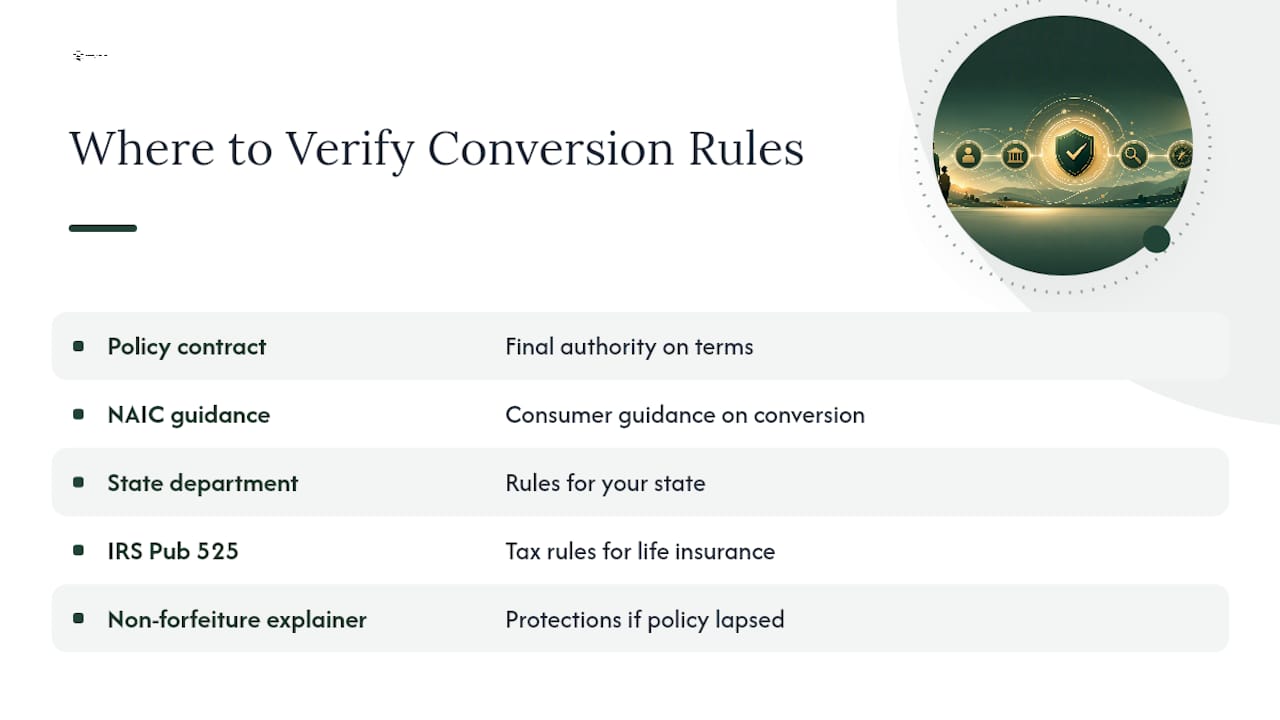
Your policy contract is the final word on your specific conversion terms, but a few outside sources help confirm general rules and catch anything your insurer’s fine print glosses over. The NAIC’s consumer guidance on life insurance covers conversion rights and consumer protections state by state, and your own state insurance department can confirm rules specific to your policy’s jurisdiction. For tax questions, particularly around cash value withdrawals or loans against a converted policy, IRS Publication 525 covers how life insurance proceeds and related transactions are taxed. If a policy has already lapsed rather than converted, this explainer on non-forfeiture options breaks down what protections still apply.
This article is general information, not a substitute for advice from a qualified financial advisor. Consult a qualified financial professional about your own circumstances before acting on anything here.
Sources
- Convert Term Life Insurance to Whole Life — MoneyGeek
- What Is Convertible Term Life Insurance? — NerdWallet
- NAIC consumer life insurance guidance
- How and Why to Convert Term Life to Permanent Life Insurance — Forbes Advisor
- Should You Convert Term Life Insurance to Permanent? — Ameritas
FAQ
Is Converting Term Life to Whole Life Worth It?
It’s worth it if your health has declined since you bought your term policy or you need coverage that lasts your entire life. It’s usually not worth it if you’re still healthy and only need coverage for a set number of years, since a new term policy or fresh underwriting might cost less.
What Does Dave Ramsey Say About Term Life Insurance?
Dave Ramsey generally recommends buying affordable term life insurance and investing the premium difference rather than paying for permanent coverage. That advice assumes you stay insurable throughout the term, which is exactly the scenario conversion exists to protect against if your health changes unexpectedly.
Do You Get Your Money Back if You Outlive Term Life Insurance?
No. Standard term life insurance has no cash value and pays nothing if you outlive the policy term. That’s a core reason some policyholders convert a portion to permanent coverage, since permanent policies build cash value you can access later, unlike level term.
How Much Does It Cost to Convert Term Life Insurance to Permanent?
There’s no single number, since cost depends on your age at conversion, the permanent product you choose, and your original health class. Permanent premiums run meaningfully higher than term premiums for the same death benefit, though a conversion credit commonly worth about one year’s term premium can offset part of the first year’s cost.
Recommended
Disclaimer: This article is for general educational purposes only and does not constitute personalized advice. Medicare rules and plan details change frequently.
Discuss Your Situation With Us