C-SNP Medicare Plans: Eligibility, Benefits, and How to Enroll

TL;DR:
- C-SNP Medicare plans provide coordinated care tailored to specific severe or disabling chronic conditions. They require verified diagnosis, active provider participation, and a CMS-approved Model of Care to ensure genuine clinical management. Availability depends on local market and eligibility, with enrollment verification being a critical step to avoid disenrollment.
If you have a qualifying chronic condition, a C-SNP Medicare plan may give you better-coordinated care than standard Medicare Advantage. A Chronic Condition Special Needs Plan (C-SNP) is a type of Medicare Advantage plan restricted by federal law to people with specific severe or disabling chronic conditions recognized by the Centers for Medicare & Medicaid Services (CMS). These are not general Medicare plans with a wellness add-on. They are purpose-built around a required Model of Care (MOC) that must include dedicated care teams and clinical workflows targeting your condition.
Your immediate next steps if you think you qualify:
- Confirm your diagnosis with your treating provider and ask whether it matches a CMS-approved C-SNP condition.
- Enter your ZIP code into Medicare Plan Finder to see which C-SNPs are active in your area.
- Contact a licensed local agent for a ZIP-specific search and help with the verification paperwork.
C-SNPs are not available everywhere, and not every chronic condition qualifies. The sections below explain exactly who qualifies, what these plans cover, and how to get through enrollment without delays.
Table of Contents
- What are C-SNP Medicare plans and how do they differ from other SNP types?
- Which chronic conditions qualify you for a C-SNP?
- How do C-SNPs actually work day to day?
- How does eligibility verification and enrollment work for C-SNPs?
- How do you find C-SNP plans available in your ZIP code?
- What costs and coverage details should you compare before enrolling?
- How do you decide whether a C-SNP is the right fit?
- Key Takeaways
- What agents see that beneficiaries often miss
- Mountaintop Insurance helps you find and enroll in the right C-SNP
- Useful sources for C-SNP research
- FAQ
What are C-SNP Medicare plans and how do they differ from other SNP types?
A C-SNP is a Medicare Advantage Coordinated Care Plan (CCP) that limits membership to people with one or more of the CMS-approved severe or disabling chronic conditions defined in 42 CFR §422.2 and the Medicare Managed Care Manual Chapter 16-B. The plan must go beyond basic Parts A and B services to earn the SNP designation — meaning it must demonstrate clinical value through its Model of Care, not just label itself a specialty plan.
There are three types of Special Needs Plans. Here is how they differ:
| SNP Type | Who It Serves | Key Eligibility Driver |
|---|---|---|
| C-SNP | People with specific severe or disabling chronic conditions | CMS-approved clinical diagnosis |
| D-SNP | People dually eligible for Medicare and Medicaid | Medicaid enrollment status |
| I-SNP | People living in or expected to need an institution | Institutional residency or equivalent need |
The distinction matters practically. D-SNP eligibility in 2026 turns on Medicaid status, not diagnosis. A C-SNP, by contrast, requires a confirmed clinical condition regardless of income or institutional setting. You could be a high-income beneficiary with diabetes and still qualify for a C-SNP.
The Model of Care requirement is what separates C-SNPs from standard Medicare Advantage plans most sharply. CMS requires every C-SNP to submit an MOC describing its care management team structure, clinical workflows, and measurable goals for the target condition. A plan cannot simply offer lower copays for endocrinology visits and call itself a C-SNP. The MOC must show how the plan will actually manage the condition across the member’s care continuum.
Which chronic conditions qualify you for a C-SNP?
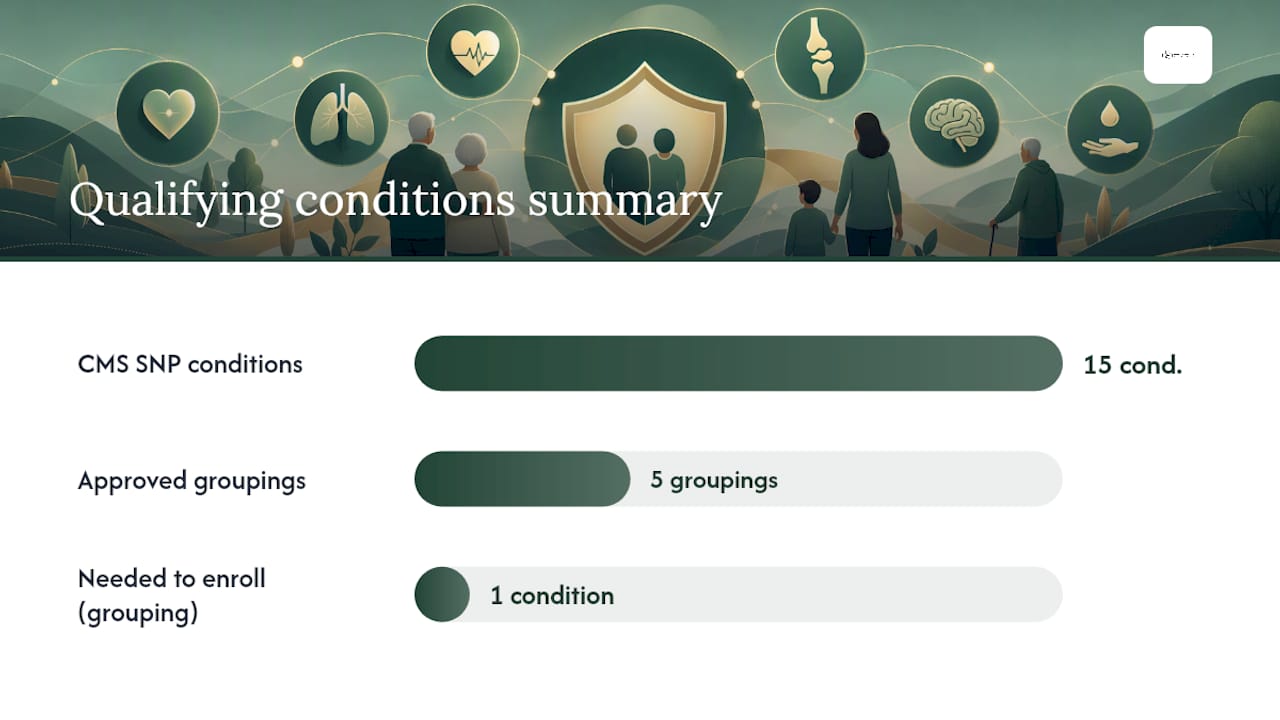
CMS maintains a list of 15 SNP-specific chronic conditions that C-SNPs may target. Plans apply to CMS to serve one condition, a CMS-approved multi-condition grouping, or a Medicare Advantage Organization (MAO)-customized combination that CMS reviews separately.
| # | CMS Qualifying Chronic Condition |
|---|---|
| 1 | Chronic Alcohol and Other Drug Dependence |
| 2 | Autoimmune Disorders |
| 3 | Cancer (excluding pre-cancer conditions) |
| 4 | Cardiovascular Disorders |
| 5 | Chronic Heart Failure |
| 6 | Dementia |
| 7 | Diabetes Mellitus |
| 8 | End-Stage Liver Disease |
| — | End-Stage Renal Disease (ESRD) requiring dialysis |
| 10 | Hematologic Disorders |
| — | HIV/AIDS |
| — | Chronic Lung Disorders |
| — | Chronic and Disabling Mental Health Conditions |
| — | Neurological Disorders |
| 15 | Stroke |
CMS also recognizes five approved multi-condition groupings — combinations of commonly co-existing conditions such as diabetes paired with chronic heart failure. When a plan targets one of these groupings, you need only one condition from the group to enroll. You do not have to have both diagnoses.
This is a point many beneficiaries miss. A C-SNP built around the diabetes-plus-chronic-heart-failure grouping will accept a member who has diabetes alone, as long as the plan’s MOC and benefits package are designed to serve both conditions adequately. CMS reviews the MOC for adequacy across all grouped conditions before approving the plan.
Pro Tip: Ask any C-SNP you are considering which specific condition or grouping it is approved for. A plan targeting cardiovascular disorders broadly may have a very different network and formulary than one targeting chronic heart failure specifically.
How do C-SNPs actually work day to day?
The Model of Care is the operational backbone of every C-SNP. A quality MOC includes a multidisciplinary care team (typically a primary care physician, nurse case manager, and condition-specific specialists), defined care coordination workflows, and measurable clinical goals tied to the target condition. CMS expects this to represent genuine clinical value, not just a branding layer on a standard Medicare Advantage plan.
In practice, C-SNP members typically receive:
- Extra benefits: — Plans may cover diabetic supplies, continuous glucose monitors, in-home services, or transportation to specialist visits — benefits standard Medicare Advantage plans are not required to include.
Consider what this looks like for a member with chronic heart failure. After a hospitalization, the plan’s care coordinator schedules a cardiology follow-up within seven days, arranges home health visits, reviews the medication list for diuretic adherence, and flags any weight changes that suggest fluid retention. That level of active management is what the MOC is supposed to produce.
C-SNPs also typically include Part D prescription drug coverage, which means you get medical and drug coverage in one plan. Confirm this when comparing options, because not every plan design is identical.
How does eligibility verification and enrollment work for C-SNPs?
Enrollment in a C-SNP requires the plan to confirm your qualifying condition. There are two main verification pathways, and understanding them helps you avoid the most common enrollment snag.
Pre-enrollment verification
The plan contacts your provider before completing enrollment. Your provider confirms the diagnosis, and enrollment proceeds once verification is received. This path is slower but eliminates post-enrollment uncertainty.
PQAT provisional enrollment
Many carriers use a Pre-Qualification Assessment Tool (PQAT). You complete a self-report form describing your condition, and the plan provisionally enrolls you based on that. The plan then sends a Verification of Chronic Condition (VCC) form to your provider for post-enrollment confirmation.
The risk: if your provider does not respond or cannot confirm the diagnosis, you may be disenrolled at the end of the second month. Provider nonresponse is the most common cause of verification failure. CMS and HHS guidance makes clear that plans must verify eligibility and can no longer rely on expanded alternative methodologies that were once permitted.
Enrollment windows
The CY-2026 enrollment and disenrollment guidance confirms the following windows for C-SNP enrollment:
- Initial Enrollment Period (IEP): — The seven-month window around your 65th birthday or Medicare eligibility date.
Pro Tip: Before you submit a PQAT form, call your provider’s office and confirm they have the plan’s VCC fax number on file. Ask them to flag the incoming form as time-sensitive. That one call prevents the most common reason for disenrollment.
How do you find C-SNP plans available in your ZIP code?
C-SNP availability is hyper-local. A plan available in Portland may not exist in Bend. Here is how to search effectively:
- Go to Medicare Plan Finder on Medicare.gov and enter your ZIP code.
- Filter results by plan type and select “Special Needs Plans.”
- Review which C-SNPs appear and note the specific condition each targets.
- Visit the insurer’s plan page directly (carriers like Aetna and Humana publish ZIP-based availability tools) to confirm network providers and formulary details.
- Cross-check that your current specialists are in-network before proceeding.
- Contact a licensed local agent for a side-by-side comparison of every C-SNP active in your ZIP code.
Some ZIP codes have no C-SNP at all. CMS publishes contract and enrollment data that shows plan availability by county, but the fastest way to confirm local options is a direct search or a call to an agent who already knows the market.
Aetna and Humana both offer C-SNP products in select markets and publish condition-specific plan details on their websites. Availability changes annually as carriers enter or exit service areas, so a plan that was not available last year may be an option now.
For Central Oregon residents, Mountaintop Insurance’s Medicare services include a ZIP-specific C-SNP search at no cost, along with help navigating the PQAT and VCC process.
What costs and coverage details should you compare before enrolling?
Premium is the number most people look at first. For C-SNPs, it is often not the most important number. Here is what to actually compare:
- Maximum out-of-pocket (MOOP): — Federal rules cap annual out-of-pocket costs for in-network services on Medicare Advantage plans. Verify the specific MOOP for each C-SNP you consider, since it varies by plan.
- Extra benefits: Some plans cover diabetic supplies, continuous glucose monitors, or in-home support services. Carriers like UnitedHealthcare list these extras on their C-SNP plan pages as examples of what condition-focused plans can include.
| Cost Element | What to Ask the Plan |
|---|---|
| Monthly premium | Is Part D included? |
| MOOP | What is the in-network annual cap? |
| Specialist copay | What do I pay per cardiology/nephrology/etc. visit? |
| Drug tier | What tier are my current medications? |
| Extra benefits | Are diabetic supplies or home services covered? |
| Prior authorization | Which of my current treatments require PA? |
Confirming your providers are in-network before you enroll is non-negotiable. Switching to a C-SNP and then discovering your specialist is out-of-network creates exactly the care disruption these plans are designed to prevent. For a deeper look at Medicare parts and coverage, Mountaintop Insurance’s blog breaks down Parts A, B, C, and D in plain terms.
How do you decide whether a C-SNP is the right fit?
A C-SNP is worth pursuing when your diagnosis matches the plan’s target condition, your key specialists are in-network, and the MOC describes active care management rather than passive coverage. Start with those three filters before comparing premiums.
Questions to ask the plan directly:
- Which specific condition or CMS-approved grouping does this plan target?
- Who is on my care team, and how often will they contact me?
- How does the plan handle medication changes recommended by my specialist?
- What is the process if I need an out-of-area specialist or emergency care?
- How does the plan coordinate between my primary care physician and my specialists?
For guidance on what else to ask before choosing, this plan comparison checklist covers the questions that matter most.
Red flags to watch for:
- Vague MOC descriptions: If the plan cannot explain concretely how it manages your condition, the MOC may be a compliance document rather than an operational one.
- Narrow specialist network: A C-SNP for chronic heart failure with no cardiologists within a reasonable distance is a structural problem, not a minor inconvenience.
- Formulary gaps: If the plan’s formulary does not cover your current condition medications at a reasonable tier, the cost savings elsewhere may not offset the drug costs.
- Slow or complicated verification: Excessive delays in the PQAT or VCC process can signal administrative problems that will persist after enrollment.
Emergency and out-of-area care follows standard Medicare Advantage rules. C-SNPs must cover emergency and urgently needed care anywhere in the United States, regardless of network. Routine care outside the service area is typically not covered unless the plan specifically includes it.
On disenrollment: if you lose eligibility because your condition no longer meets plan criteria or you move out of the service area, you have a Special Enrollment Period to switch to another plan without a coverage gap. Enrollment timing details are covered in the key enrollment windows guide from Mountaintop Insurance.
Key Takeaways
C-SNPs are the most condition-specific Medicare Advantage option available, but they require confirmed eligibility, active provider participation in verification, and careful comparison of MOC quality and network access before enrolling.
| Point | Details |
|---|---|
| Eligibility is condition-specific | CMS recognizes 15 qualifying chronic conditions; you must have at least one confirmed by a provider. |
| MOC quality varies by plan | Compare care team structure and workflows, not just premium, before choosing a C-SNP. |
| PQAT verification has real risk | Provider nonresponse after provisional enrollment can result in disenrollment at the end of month two. |
| SEPs protect you if eligibility changes | Federal rules provide a Special Enrollment Period if you lose C-SNP eligibility or move out of the service area. |
| Mountaintop Insurance | Offers free ZIP-specific C-SNP searches and PQAT/VCC assistance for Central Oregon residents. |
What agents see that beneficiaries often miss
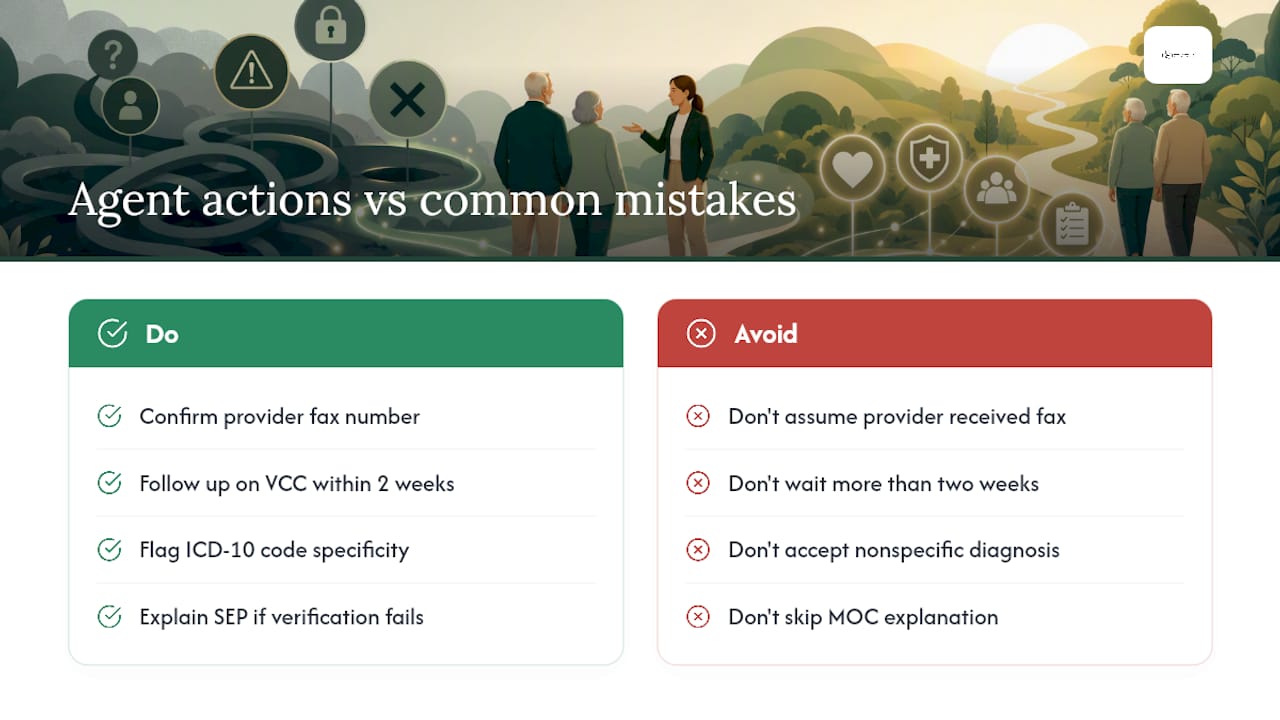
The most common enrollment problem I see is not a wrong diagnosis or a missing document. It is a provider’s office that never responds to the VCC fax. The plan sends the verification form, the fax sits in a queue, and the member has no idea anything is wrong until they receive a disenrollment notice six weeks later.
By that point, the member has already seen their cardiologist twice under the new plan, assumed everything was fine, and now faces a gap in coverage. The fix is straightforward in theory: follow up with both the plan and the provider office within the first two weeks of enrollment. In practice, most beneficiaries do not know to do that, and most provider offices do not flag incoming VCC forms as urgent.
The second friction point is diagnosis code specificity. A provider may document “heart disease” in the chart when the C-SNP requires a specific ICD-10 code for chronic heart failure. The plan’s verification team rejects the form, and the process starts over. An agent who knows the plan’s requirements can flag this before the form goes out.
What a local agent actually does in this process: confirms the plan has the correct provider fax number, follows up on VCC status, explains SEP options if verification fails, and walks the member through the MOC so they know what care coordination to expect. That is not paperwork help. It is the difference between staying enrolled and starting over.
Mountaintop Insurance offers free consultations for Central Oregon residents, including ZIP-specific plan searches and hands-on PQAT and VCC follow-up. No pressure, no obligation.
Mountaintop Insurance helps you find and enroll in the right C-SNP
Sorting through C-SNP options on your own means cross-referencing ZIP codes, MOC documents, formularies, and provider networks simultaneously. Mountaintop Insurance does that work for you, at no cost, as a local Medicare agency serving Central Oregon.
A free consultation includes a ZIP-specific search for every C-SNP active in your area, a plain-language comparison of MOC features and formularies, and direct assistance with the PQAT and VCC process. Bring your current medication list, recent lab results, your provider’s contact information, and any specialist visit notes from the past year.
You can reach Mountaintop Insurance by phone, online, or in person. To get started with a Medicare consultation in Bend, Oregon, book a free appointment and bring your provider’s information. The consultation costs nothing, and you leave knowing exactly which plans are available to you and what each one actually covers.
Useful sources for C-SNP research
The sources below are the primary references for C-SNP definitions, qualifying conditions, verification rules, and enrollment guidance. Go to these directly to verify any detail before enrolling.
- Medicare Managed Care Manual Chapter 16-B (mc86c16b.pdf)
- Chronic Condition Special Needs Plans (C-SNPs) | CMS
- Verification of Beneficiary Eligibility in a C‑SNP | HHS
- CY-2026 Coordination/Enrollment and Disenrollment Guidance (cy-2026-cd-enrollment-and-disenrollment-guidance.pdf)
FAQ
What is a C-SNP in Medicare?
A C-SNP (Chronic Condition Special Needs Plan) is a Medicare Advantage plan restricted to people with one of 15 CMS-approved severe or disabling chronic conditions, such as diabetes, chronic heart failure, ESRD requiring dialysis, or dementia. Unlike standard Medicare Advantage plans, C-SNPs must operate under a CMS-approved Model of Care with dedicated care teams and condition-specific clinical workflows.
Do you need both Medicare and Medicaid to join a C-SNP?
No. C-SNPs require a qualifying chronic condition, not Medicaid enrollment. Dual eligibility for Medicare and Medicaid is the requirement for D-SNPs, a separate plan type.
What happens if my provider does not return the C-SNP verification form?
If the plan cannot confirm your qualifying condition through provider attestation after provisional enrollment, you may be disenrolled at the end of the second month. Proactive follow-up with both your provider’s office and the plan within the first two weeks of enrollment is the most reliable way to prevent this.
Can you switch to a C-SNP outside of open enrollment?
Yes, in specific circumstances. CMS provides a Special Enrollment Period for C-SNPs when you gain a qualifying condition, lose eligibility, or move out of the plan’s service area, allowing you to switch without a coverage gap under the CY-2026 enrollment guidance.
How do C-SNPs differ from regular Medicare Advantage plans?
C-SNPs cover the same Medicare Parts A and B services as standard Medicare Advantage plans but add a required Model of Care, condition-specific care coordination, focused formularies, and extra benefits tailored to the qualifying condition. Membership is also restricted, meaning you must have a confirmed qualifying condition to enroll and remain enrolled.
Recommended
Disclaimer: This article is for general educational purposes only and does not constitute personalized advice. Medicare rules and plan details change frequently.
Discuss Your Situation With Us