Extra Help Medicare 2026: What Beneficiaries Need to Know

If your income is below the stated limits for a single person or a married couple and your countable resources stay under the published resource limits, you likely qualify for Extra Help in 2026. The program, formally called the Part D Low-Income Subsidy (LIS), can eliminate your Medicare drug plan premium and deductible entirely, cap your copays at $5.10 for generics and $12.65 for brand-name drugs, and cut your costs to $0 once you hit the $2,100 catastrophic threshold for the year.
Some people qualify automatically and don’t need to apply at all:
- You receive full Medicaid coverage
- You’re enrolled in a Medicare Savings Program that pays your Part B premium
- You receive Supplemental Security Income (SSI)
If any of those apply to you, Extra Help is already yours — watch for a notice from CMS and skip straight to the plan-selection step. Everyone else, read on.
Key Takeaways
Extra Help in 2026 eliminates Part D premiums and deductibles for most eligible beneficiaries, caps copays at $5.10 for generics and $12.65 for brand-name drugs, and cuts costs to $0 after the $2,100 catastrophic threshold.
| Point | Details |
|---|---|
| 2026 income limits | $23,940 for individuals; $32,460 for married couples (48 states and D.C.). |
| 2026 resource limits | $16,590 individual; $33,100 married; burial exception raises each by $1,500 per person. |
| Automatic qualifiers | Full Medicaid, Medicare Savings Program (Part B payers), and SSI recipients qualify without applying. |
| How to apply | Apply online at secure.ssa.gov, call 1-800-772-1213, or mail Form SSA-1020. |
| Mountaintop Insurance | Offers free in-person and remote consultations in Central Oregon to review eligibility and compare Part D plans after approval. |
This article is general information, not a substitute for advice from a qualified financial advisor. Consult a qualified financial professional about your own circumstances before acting on anything here.
Table of Contents
- What Extra Help (Part D Low-Income Subsidy) actually covers
- Who qualifies for Extra Help in 2026: income limits, resource limits, and exceptions
- What you’ll actually pay for drugs in 2026 with Extra Help
- How to apply for Extra Help: step-by-step
- What happens after you apply
- Research-backed reasons to apply and common myths
- Official resources and where to get free local help
- Why Extra Help education matters more than most people realize
- Free Extra Help consultation with Mountaintop Insurance
- Sources
- FAQ
What Extra Help (Part D Low-Income Subsidy) actually covers
Extra Help is a federal subsidy that reduces what Medicare beneficiaries pay for prescription drugs under Part D. One sentence covers it: the program pays a portion (or all) of your Part D costs so that low-income beneficiaries aren’t forced to choose between medications and groceries.
The costs it addresses include:
- Monthly plan premium — eliminated or sharply reduced for most recipients
- Annual deductible — waived entirely for qualifying beneficiaries
- Copayments — capped at $5.10 per generic fill and $12.65 per brand-name drug in 2026
- Late-enrollment penalty — waived as long as you have Extra Help
- Catastrophic coverage threshold — once you hit $2,100 in out-of-pocket drug costs, you pay $0 for covered drugs for the rest of the year
Three federal bodies shape this program. The Social Security Administration (SSA) takes applications and determines eligibility. The Centers for Medicare & Medicaid Services (CMS) administers the Part D program and sets the benefit rules. The National Council on Aging (NCOA) publishes consumer guidance and tracks the program’s financial impact on beneficiaries. For a broader look at how Part D fits into your overall Medicare picture, the Medicare Parts explained page on the Mountaintop Insurance site is a useful starting point.
Who qualifies for Extra Help in 2026: income limits, resource limits, and exceptions
Automatic qualifiers
Three groups qualify without filing a separate Extra Help application, per SSA’s Extra Help guidance:
- Full Medicaid recipients
- People enrolled in a Medicare Savings Program that covers their Part B premium (QMB, SLMB, or QI)
- SSI recipients
CMS notifies these beneficiaries directly, usually through a colored notice in the mail.
2026 income and resource limits
For everyone else, SSA applies two tests: income and countable resources.
Income and resource limits apply for eligibility, with higher limits for Alaska and Hawaii residents. A burial exception allows you to set aside up to $1,500 per person in a designated burial account without it counting toward your resource total.
What counts as a resource (and what doesn’t)
SSA counts bank accounts, stocks, bonds, mutual funds, and IRAs toward your resource total. It does not count your primary home, one vehicle, personal belongings, or burial plots.
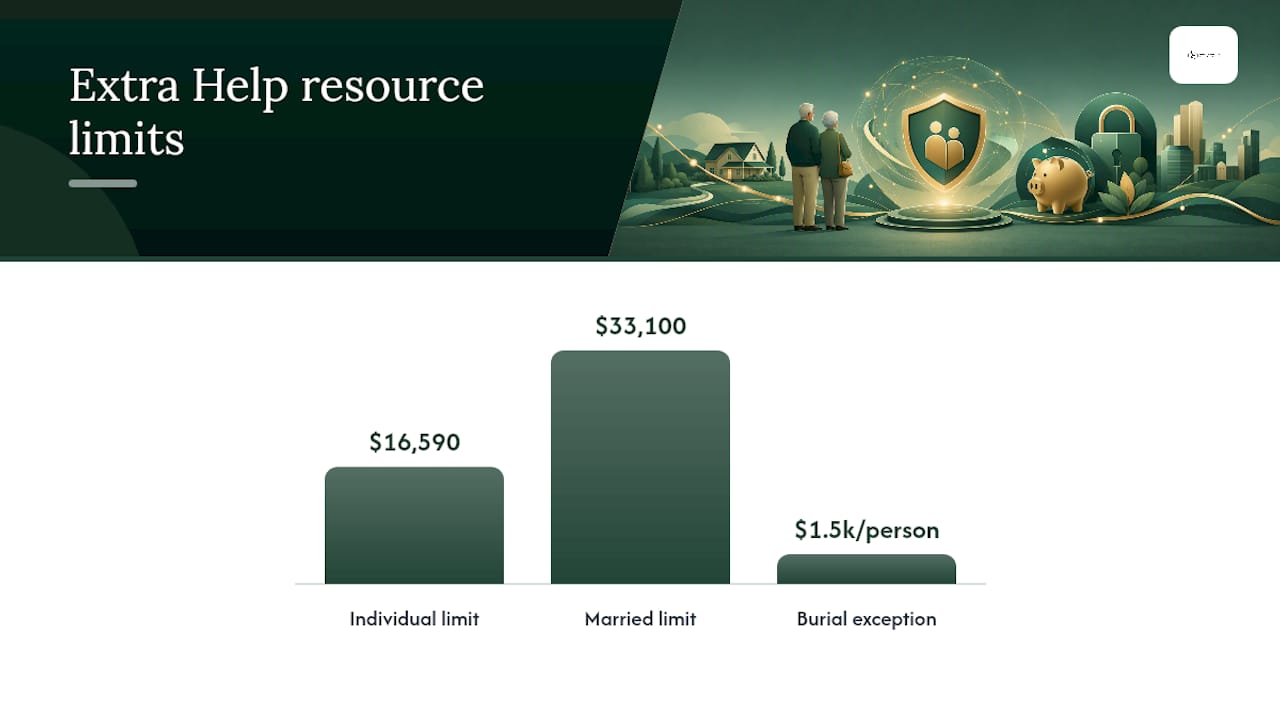
A single retiree with $14,000 in a savings account and a modest IRA worth $2,000 sits at $16,000 in countable resources — under the $16,590 limit. A married couple with two small IRAs totaling $30,000 and a joint checking account with $2,500 would land at $32,500, just under the $33,100 married limit.
Pro Tip: If you’re close to the resource limit, check whether any of your accounts qualify for the burial exception. Designating up to $1,500 per person for burial expenses can bring you under the threshold without spending a dollar.
The 2026 resource rules under POMS confirm that following the Inflation Reduction Act, eligible applicants are treated at the full subsidy level, which simplifies the math considerably compared to prior years.
What you’ll actually pay for drugs in 2026 with Extra Help
The numbers here are specific enough to be worth writing down.
Per Medicare’s drug cost help page, once you reach the $2,100 catastrophic threshold, you pay nothing for covered drugs for the remainder of the calendar year. That protection alone is worth thousands of dollars for anyone managing a chronic condition with expensive medications.
The NCOA estimates Extra Help’s annual value at roughly $5,700–$6,200 for eligible beneficiaries — a figure that reflects premium savings, deductible elimination, and reduced copays combined.
For dual-eligible beneficiaries (those with both Medicare and Medicaid, often called QMB recipients), copays may be even lower, sometimes $0 for certain drugs. Auto-enrollment into a benchmark plan does not lock you into that plan; you retain the right to switch to a plan that better covers your specific medications.
A quick worked example: someone taking two brand-name drugs and one generic monthly, without Extra Help, might spend $1,200 or more per year in copays alone, plus a $400 deductible and $480 in premiums — roughly $2,080 before hitting catastrophic. With Extra Help, that same person pays $5.10 for the generic and $12.65 twice for the brand-name drugs each month, totaling about $364 annually in copays, with no deductible and no premium. The difference is real money, not a rounding error.

How to apply for Extra Help: step-by-step
Applying is simpler than most people expect. You have four routes.
- Online — Start at the SSA’s secure online application portal. The form takes roughly 15–20 minutes and you’ll get a confirmation number immediately.
- By phone — Call SSA at 1-800-772-1213 (TTY: 1-800-325-0778), Monday through Friday, 8 AM to 7 PM local time. A representative will walk you through the application.
- By mail — Request or download Form SSA-1020, complete it, and mail it to your local SSA office.
- In person — Visit a local Social Security office. Find your nearest location at SSA.gov.
If you don’t yet have a Part D plan when you apply and get approved, SSA can enroll you in a temporary plan through the Limited Income Newly Eligible Transition (LINET) program so you’re not left without coverage while you choose a permanent plan.
What the application asks for
You’ll need to report the following — but you usually don’t need to bring documents:
- Income sources (Social Security, wages, pension, rental income)
- Countable resources (bank balances, investment accounts)
- Household size
- Whether you or your spouse have any life insurance policies with cash value
Pro Tip: SSA typically accepts self-reported financial information and only contacts you for documentation if something needs verification. Don’t delay applying because you can’t find your bank statements — just report your best estimates and SSA will follow up if needed. The PHLP 2026 LIS guide confirms this is standard practice.
After applying, SSA sends a written notice within a few weeks. Keep that notice — it explains your eligibility status, your effective date, and any next steps.
What happens after you apply
Decision timeline and notices
SSA typically processes a completed Extra Help application within a few weeks. You’ll receive a written notice by mail. The color of the notice matters:
- Purple notice — You’ve been automatically enrolled in Extra Help and assigned to a benchmark Part D plan (usually because you’re newly eligible or lost prior coverage)
- Green notice — You qualify for Extra Help and already have a Part D plan; your costs will be reduced
- Yellow notice — You don’t qualify based on the information provided, but you have the right to appeal
Effective date
Extra Help generally takes effect the first day of the month after SSA approves your application. If you applied in March and were approved in April, your reduced costs typically begin May 1.
Switching plans after approval
Auto-enrollment into a benchmark plan does not lock you in. You have a Special Enrollment Period (SEP) that lets you switch to any Part D plan once per quarter during the first three quarters of the year, and once during the fourth quarter. The key enrollment windows guide explains SEP rules in detail. Use that flexibility — a plan that covers your specific drugs at the lowest tier can save you hundreds even within the capped copay structure.
Appealing a denial
If you receive a yellow notice and believe the decision is wrong:
- Request a reconsideration from SSA within 60 days of the notice date
- Call 1-800-772-1213 to start the appeal by phone
- Visit SSA.gov for appeal forms and instructions
- Contact 1-800-MEDICARE (1-800-633-4227) if you need help understanding the denial or your rights
Research-backed reasons to apply and common myths
The numbers make the case
NCOA’s analysis puts Extra Help’s annual value at $5,700–$6,200 for a typical eligible beneficiary. That’s not a one-time benefit — it compounds year over year. People who think of their drug costs as “manageable” often underestimate what a single new diagnosis or medication change can do to their annual spending. The catastrophic protection at $2,100 is the real backstop: without it, a cancer diagnosis or a new specialty drug can push out-of-pocket costs into the tens of thousands.
Myths that stop people from applying
- “I have to submit tax returns.” False. SSA accepts self-reported income and resources. You report what you know; SSA verifies only when necessary.
- “Extra Help limits which plans I can choose.” False. You can enroll in any Part D plan. Auto-enrollment into a benchmark plan is a starting point, not a permanent assignment.
- “I make too much to qualify.” Check the actual limits before assuming. Many people earning modest Social Security income plus a small pension still fall under the $23,940 individual threshold.
- “I own a home, so my resources are too high.” Your primary residence doesn’t count. Neither does your car.
What the Inflation Reduction Act changed
Starting January 1, 2024, and continuing through 2026, the Inflation Reduction Act simplified Extra Help’s subsidy tiers. Previously, partial and full subsidy levels created different benefit amounts depending on exactly where your income and resources landed. Now, per POMS policy, eligible applicants are treated at the full subsidy level, which means fewer people fall into a gray zone of partial benefits. If you were told years ago that you only partially qualified, the rules may now work in your favor. It’s worth a fresh application.
Avoiding common enrollment mistakes matters as much as applying correctly — the partner resource on Medicare mistakes that can cost you money covers several traps that affect Extra Help recipients specifically.
Official resources and where to get free local help
You don’t have to figure this out alone. These are the contacts worth saving:
- SSA Extra Help page — Ssa — eligibility rules, automatic qualifiers, and program overview
- SSA online application — Secure — start your application here
- Medicare drug cost help — Medicare — 2026 benefit amounts and copay caps
- Medicare & You Handbook 2026 — Medicare — the official consumer reference for all 2026 program rules
- Medicaid and SHIP local help — Medicaid — find local Medicaid offices and SHIP counselors in your state
Quick-dial contacts:
- SSA: 1-800-772-1213 (TTY: 1-800-325-0778), Monday–Friday, 8 AM–7 PM
- 1-800-MEDICARE: 1-800-633-4227, available 24/7
- Your state SHIP program — find your local SHIP at shiphelp.org for free, one-on-one counseling
The State Health Insurance Assistance Program (SHIP) offers free, unbiased help from trained counselors in every state. They can review your application, explain your notice, and help you compare plans after approval — at no cost to you.
Why Extra Help education matters more than most people realize
Most articles about Extra Help stop at the eligibility table and the phone number. What they skip is the behavioral gap: the distance between knowing you might qualify and actually applying.
The people who lose the most aren’t those who apply and get denied. They’re the ones who assume they don’t qualify, or who put off applying because they expect a pile of paperwork, or who got a partial-subsidy determination years ago and never revisited it. The Inflation Reduction Act’s shift to full-subsidy treatment for all eligible applicants is exactly the kind of policy change that should prompt a fresh look — but it rarely does, because most beneficiaries never hear about it.
Local guidance matters here in a way that a federal website can’t replicate. A counselor who knows Central Oregon’s cost-of-living context, who can sit across from you and walk through your specific income sources and resource accounts, catches the borderline cases that a self-reported online form might miss. The burial exception, the IRA question, the cash-value life insurance question — these are the details that push someone just over the limit to just under it, or confirm they’re comfortably within range.
Extra Help isn’t a charity program. It’s a subsidy you’ve earned by paying into Medicare. The only question is whether you claim it.
Free Extra Help consultation with Mountaintop Insurance
Sorting out Extra Help eligibility, completing the SSA application, and then choosing the right Part D plan afterward involves three separate decisions — and most people face them without a guide. Mountaintop Insurance offers free consultations in Bend, Oregon, and remotely for Central Oregon residents, with no sales pressure and no obligation to enroll.
During a free consultation, a Mountaintop Insurance advisor will review your income and resources against the 2026 limits, help you complete the SSA application if you’re ready to apply, and compare Part D plans once your Extra Help status is confirmed — so you end up in a plan that actually covers your medications at the lowest possible cost. The agency is paid by carriers only when you enroll; the consultation itself costs you nothing regardless of what you decide.
Schedule a free Medicare consultation or visit the Mountaintop Insurance homepage to learn more about the agency’s approach to Medicare planning in Central Oregon.
Sources
- Help with drug costs | Medicare
- Apply for Medicare Part D Extra Help program | SSA
- Secure
- Secure
- Understanding Medicare Part D Low-Income Subsidy (LIS/Extra Help) | NCOA
- Medicare Part D Extra Help 2026 guide | PHLP
FAQ
Who qualifies for Extra Help in 2026?
Anyone with income below $23,940 (individual) or $32,460 (married couple) and countable resources under $16,590 or $33,100 respectively qualifies. Full Medicaid recipients, SSI recipients, and Medicare Savings Program enrollees qualify automatically without a separate application.
What is the maximum income to qualify for Medicare Extra Help?
The 2026 income limit is $23,940 per year for an individual and $32,460 for a married couple living together, based on SSA’s published thresholds for the 48 contiguous states and D.C. Alaska and Hawaii residents have higher limits.
Are there extra cash benefits for Medicare recipients in 2026?
Extra Help is not a cash payment — it’s a subsidy applied directly to your Part D drug costs. The practical value, estimated by NCOA at roughly $5,700–$6,200 per year, shows up as eliminated premiums, waived deductibles, and capped copays rather than a check.
Who qualifies for extra benefits from Medicare?
Beyond Extra Help, Medicare Savings Programs (QMB, SLMB, QI) can cover Part B premiums and cost-sharing for people with limited income and resources. Eligibility for those programs is determined by your state Medicaid office, and qualifying for them often triggers automatic Extra Help enrollment as well.
Can Mountaintop Insurance help me apply for Extra Help?
Yes. Mountaintop Insurance offers free consultations for Central Oregon residents, in person in Bend or remotely, to review your 2026 eligibility, help complete the SSA application, and compare Part D plans once your Extra Help status is confirmed.
Recommended
Disclaimer: This article is for general educational purposes only and does not constitute personalized advice. Medicare rules and plan details change frequently.
Discuss Your Situation With Us