Medicare Enrollment Periods You Need to Know for 2026

If you’re eligible for Medicare in 2026, one of five enrollment windows applies to you right now: the Initial Enrollment Period (IEP) around your 65th birthday, the Annual Open Enrollment Period (AEP) from October 15 to December 7, the Medicare Advantage Open Enrollment Period (MA OEP) from January 1 to March 31, the General Enrollment Period (GEP) also January 1 to March 31 if you missed your IEP, or a Special Enrollment Period (SEP) triggered by a life event like losing job-based coverage. The one most people confuse with “the” enrollment period is AEP, and it carries a hard deadline.
- AEP (Oct 15 to Dec 7): switch, join, or drop a Medicare Advantage or Part D plan; changes start January 1.
- MA OEP (Jan 1 to Mar 31): for people already in Medicare Advantage who want one plan switch.
- GEP (Jan 1 to Mar 31): for anyone who missed their IEP and has no SEP available.
- SEPs: tied to specific events, such as retiring, moving, or losing coverage.
The single most time-sensitive date on this list is December 7. Miss it, and any plan change waits a full year. Start now: figure out which window fits your situation, gather your Medicare card and any coverage letters, and call the Social Security Administration or schedule a free consultation with Mountaintop Insurance if you’re not sure which path applies.
Key Takeaways
Meeting your 2026 Medicare deadline depends on identifying the correct enrollment window early and submitting complete paperwork well before that window closes.
| Point | Details |
|---|---|
| Know your window | IEP, AEP, MA OEP, GEP, and SEPs each serve a different purpose and audience. |
| AEP deadline is firm | Changes must be submitted by December 7 for a January 1 effective date. |
| IEP timing controls your start date | Enrolling in the three months before your birthday month gets coverage starting that month. |
| Penalties can be lifelong | The Part B penalty adds about 10% per full year delayed and typically never goes away. |
| 2026 forms matter | CMS’s updated model enrollment forms apply to requests received on or after January 1, 2026. |
| Get local guidance | Mountaintop Insurance offers free consultations to confirm your window and help with paperwork. |
This article is general information, not a substitute for advice from a qualified doctor. Consult a qualified healthcare professional about your own circumstances before acting on anything here.
Table of Contents
- Medicare Enrollment Periods 2026: What Each One Actually Allows
- When Coverage Starts and What Late Enrollment Costs You
- How to Sign Up: A Step-by-Step Walkthrough
- Quick Checklists by Situation
- What Nobody Tells You About These Deadlines
- Local, No-Pressure Help With Your Medicare Enrollment
- Sources
- FAQ
Medicare Enrollment Periods 2026: What Each One Actually Allows
Every enrollment window serves a different purpose, and mixing them up is how people end up with gaps in coverage or plans they didn’t mean to pick.
Initial Enrollment Period (IEP). This is a seven-month window built around your 65th birthday: it starts three months before your birthday month, includes your birthday month, and runs three more months after. If you enroll in the three months before you turn 65, coverage generally starts the month you turn 65. Enroll during your birthday month or later, and your start date shifts later, sometimes by one to three months depending on when you sign up.
Annual Open Enrollment Period (AEP), October 15 to December 7. This is the one window nearly everyone with Medicare can use. You can switch from Original Medicare to a Medicare Advantage plan, move back to Original Medicare, change Advantage plans, or join, switch, or drop a Part D drug plan. Whatever you choose, the change takes effect January 1 of the following year, no exceptions for late submissions.
Medicare Advantage Open Enrollment Period (MA OEP), January 1 to March 31. This one is narrower. It’s only for people already enrolled in a Medicare Advantage plan on January 1. You get one switch: to a different Advantage plan or back to Original Medicare (with the option to add a standalone Part D plan). If you’re on Original Medicare already, MA OEP doesn’t apply to you at all.
General Enrollment Period (GEP), January 1 to March 31. This is your backup if you missed your IEP and don’t qualify for a SEP. Coverage typically starts the month after you enroll, and a related Part D SEP opens up for about two months so you can add drug coverage without waiting for the next AEP.
Special Enrollment Periods (SEPs). The most common trigger is still working past 65 with employer group coverage: you can enroll anytime while covered, or during the eight-month window after that employment or coverage ends. Other SEPs cover moving out of your plan’s service area, losing coverage unexpectedly, or entering or leaving a nursing facility.
Pro Tip: If you’re delaying Part B because you have solid employer coverage, keep every benefits letter and termination notice. You’ll need proof of continuous coverage to use your SEP later, and plans will ask for it.
Part D follows its own clock tied to whichever window got you into Medicare. Wait too long. and a gap of 63 days or more without creditable drug coverage triggers a penalty that sticks with your premium indefinitely.
When Coverage Starts and What Late Enrollment Costs You
The general rule across most Medicare enrollment periods: coverage begins the first day of the month after your application is processed. The IEP is the exception, since enrolling in the three months before your birthday month can get you coverage starting the month you turn 65.
Late enrollment isn’t just an inconvenience. It has a price tag attached, and the two Medicare parts handle it differently:
- Part B penalty: roughly 10% added to your monthly premium for each full 12-month period you were eligible but didn’t enroll, and this penalty is typically lifelong.
- Part A penalty: applies only if you owe a premium for Part A (most people don’t); the penalty period generally runs twice the number of years you delayed, unlike Part B’s lifetime charge.
- Part D penalty: accumulates for every month you went without creditable drug coverage after a gap of 63 days or more, added to your Part D premium for as long as you have Part D.
If you enroll in Part A or B through the GEP, it triggers a Special Enrollment Period for Part D, with coverage usually starting July 1, which is later than the standard ‘first of next month’ effective date.
One more thing to watch for in 2026 specifically: CMS updated its enrollment and disenrollment guidance for contract year 2026, and plans are expected to use revised model enrollment forms for any request received on or after January 1, 2026. An outdated form or a missing signature line can stall processing at exactly the wrong moment. Double-check you’re using the current version before you submit anything.
How to Sign Up: A Step-by-Step Walkthrough
Getting enrolled correctly the first time saves you weeks of phone calls later. Here’s the sequence that works.
- Identify your window. Figure out whether you’re in an IEP, AEP, MA OEP, GEP, or SEP. This determines both where you apply and what you’re allowed to change.
- Pick the right entry point. Original Medicare (Parts A and B) goes through the Social Security Administration. Medicare Advantage and Part D changes go through the plan directly or through Medicare.gov, using the updated 2026 model forms.
- Gather your documents. You’ll want your Social Security number, proof of birth, proof of citizenship or lawful immigration status if applicable, employer coverage documentation if you delayed Part B, and current insurance ID cards if you’re switching plans.
- Submit early in your window. Don’t wait until the final week. Early submission protects your intended effective date and gives you time to fix errors. Save your confirmation number or letter once it’s submitted.
If you’re not yet collecting Social Security or Railroad Retirement benefits, Medicare won’t automatically mail you enrollment materials. Contact the SSA directly at 1-800-772-1213 at least three months before you turn 65 to avoid delays.
Pro Tip: Confused about which forms apply to your situation? A free consultation through Mountaintop Insurance’s enrollment assistance service can clarify your exact window before you submit anything.
Quick Checklists by Situation
Your Medicare application deadlines look different depending on what’s happening in your life. Match your situation below.
Turning 65 soon:
- Enroll in the first three months of your IEP for coverage starting your birthday month.
- Wait past your birthday month, and your start date pushes back.
Still working with employer coverage:
- Use your SEP anytime while covered, or within eight months after coverage ends.
- Keep employer letters and coverage end dates on hand.
Just lost other coverage:
- Your SEP window is time-limited, so apply as soon as the loss is confirmed.
- Have your coverage termination letter ready to submit.
Missed your IEP entirely:
- Use the GEP, January 1 to March 31.
- Expect coverage to start the month after you enroll, plus a possible Part B penalty.
- Enroll in Part D during the linked SEP to avoid a drug coverage penalty.
Moving or entering a facility: these typically open a two-month SEP window. Notify your plan promptly and document your move or admission date.
What Nobody Tells You About These Deadlines
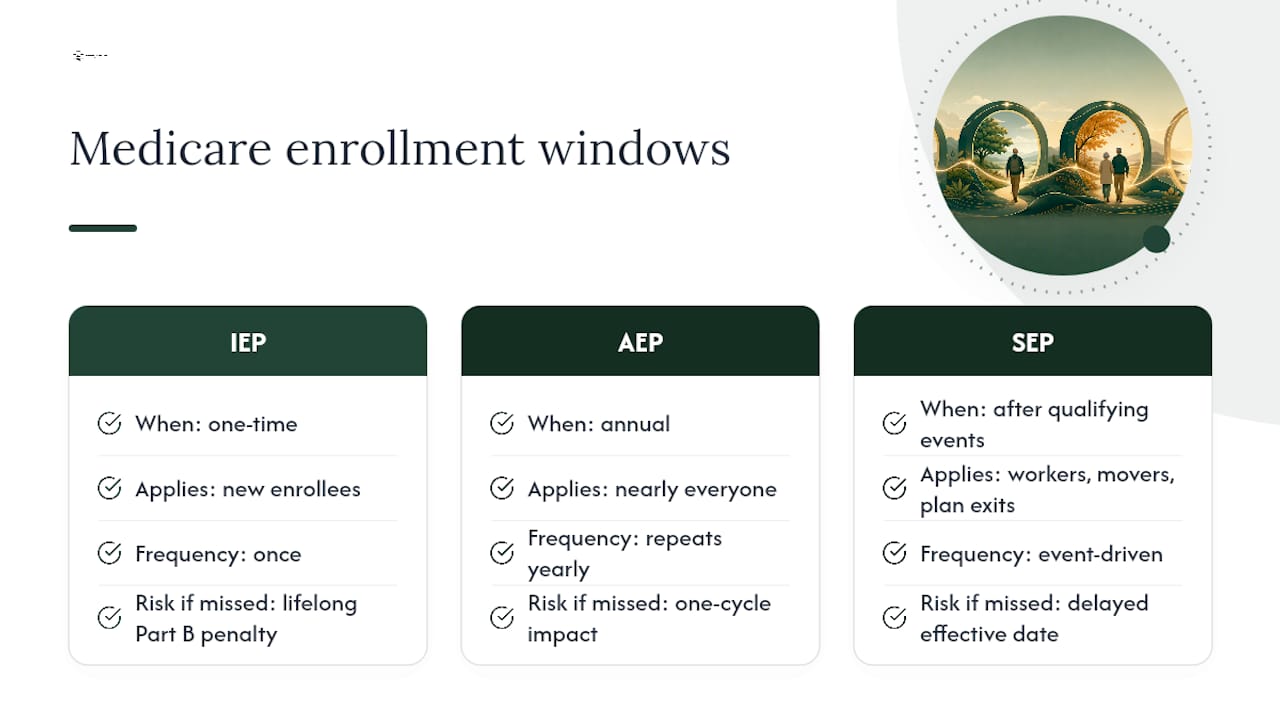
Most Medicare guides treat every deadline with equal urgency, and that’s actually bad advice. The truth is AEP gets disproportionate attention because it repeats every single year and applies to nearly everyone, while the IEP, which only comes around once, gets glossed over. That’s backward. Missing your IEP is the mistake with the longest tail, since it can trigger a Part B penalty that follows you for the rest of your life, not just for one enrollment cycle.
The other thing conventional advice underplays: SEPs are underused because people assume they don’t qualify. If you’re still working, or you just moved, or your plan just left your area, you probably have a window open right now that you don’t know about. The CY 2026 CMS guidance update on model forms sounds like bureaucratic housekeeping, but it has a real practical effect: an incorrectly formatted submission in early 2026 could stall your effective date by weeks. Don’t assume your paperwork is fine just because it worked last year.
If there’s one priority to take from all of this, it’s not memorizing every rule. It’s knowing which single window applies to you, right now, and acting inside it.
Local, No-Pressure Help With Your Medicare Enrollment
You don’t have to sort through IEP, AEP, MA OEP, GEP, and SEP rules by yourself, and you shouldn’t have to sit through a national call center’s sales script to get answers. Mountaintop Insurance offers free, no-cost consultations for Central Oregon residents, in person or remote, walking through Parts A, B, C, and D, Medigap options (including Oregon’s birthday rule), and which enrollment window actually fits your situation.

With CMS’s updated 2026 forms now in play, getting the paperwork right the first time matters more than usual, since a processing error can push your effective date back by weeks. A local agent can confirm your SEP eligibility, check what documentation you’ll need, and walk you through Medicare enrollment support step by step, without a sales quota driving the conversation.
If you’re in Bend or elsewhere in Central Oregon and want a straight answer about your enrollment window, schedule a free consultation through Mountaintop Insurance’s enrollment assistance page today.
Sources
- Medicare
- CMS — Original Medicare (Part A and B) eligibility and enrollment
- NCOA — A closer look at the Medicare General Enrollment Period
FAQ
When Does the 2026 Medicare AEP Start and End?
The Annual Open Enrollment Period runs from October 15 to December 7, 2026, and any changes made during that window take effect January 1, 2027.
Who Can Use the Medicare Advantage Open Enrollment Period?
Only people already enrolled in a Medicare Advantage plan as of January 1 can use MA OEP, and it allows just one plan switch between January 1 and March 31.
What Happens if I Miss My Initial Enrollment Period?
You can use the General Enrollment Period from January 1 to March 31, but coverage starts the month after you enroll and you may owe a Part B late-enrollment penalty.
How Do I Avoid a Part D Late-Enrollment Penalty?
Enroll in a Part D plan as soon as you’re eligible and avoid any gap of 63 days or more without creditable prescription drug coverage.
Can I Get Local Help Choosing a Medicare Plan in 2026?
Yes. Mountaintop Insurance provides free consultations for Central Oregon residents covering Medicare Parts A through D, Medigap, and enrollment paperwork.
Recommended
Disclaimer: This article is for general educational purposes only and does not constitute personalized advice. Medicare rules and plan details change frequently.
Discuss Your Situation With Us