Medicare Special Enrollment: What Eligible Adults Need to Know

TL;DR:
- A Medicare Special Enrollment Period is an event-driven window allowing enrollment or changes outside normal times. Acting quickly, especially within the correct timeframe, prevents lifetime penalties and coverage gaps.
A Medicare Special Enrollment Period (SEP) lets you enroll in or change Medicare outside the regular windows when a qualifying life event occurs. Miss the window, and you may face lifetime penalties or a coverage gap that lasts months.
The most common SEPs and their windows:
- Working past 65 (Part B SEP): a multi-month window starting the month after active employment or employer coverage ends
- Moving out of your plan’s service area or losing creditable coverage: generally 2 months after the month the event occurs
- Exceptional conditions (incarceration release, disaster, employer misrepresentation, loss of Medicaid): typically at least 6 months
- 5-star plan SEP: one-time use during a specified period running from December through late in the following year
Pro Tip: Call 1-800-MEDICARE (1-800-633-4227) the day your qualifying event happens. Document everything: termination letters, move dates, employer notices. The clock starts whether you call or not.
Table of Contents
- What is a Medicare special enrollment period?
- Which life events qualify you for an SEP?
- How long do you have, and when does coverage start?
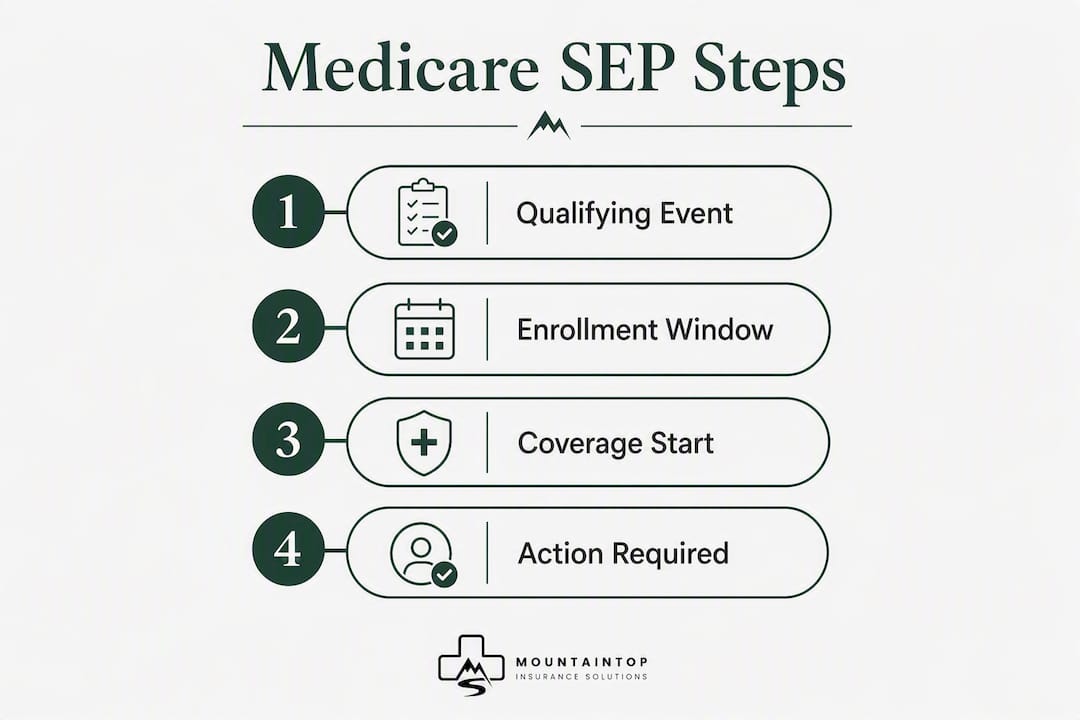
- How to use your SEP: a step-by-step checklist
- What SEPs mean for Medigap coverage
- How Mountaintop Insurance helps Central Oregon residents
- Key Takeaways
- The cost of waiting is not abstract
- Free SEP eligibility check from Mountaintop Insurance
- Useful sources for verifying SEP and Medigap rules
- FAQ
What is a Medicare special enrollment period?
A Medicare SEP is an event-driven enrollment window that reopens your ability to sign up for or change Medicare coverage outside the standard calendar. It is not a loophole — it is a federal rule built into Parts A, B, C, and D specifically for people whose circumstances change mid-year.
Here is how SEPs fit alongside the other enrollment periods:
- Annual Enrollment Period (AEP): — October 15 through December 7 each year — for switching Medicare Advantage or Part D plans
The Centers for Medicare & Medicaid Services (CMS) administers SEP rules. For Parts A and B, you file through the Social Security Administration. For Parts C and D, you contact your plan directly or call 1-800-MEDICARE.
A critical distinction: SEPs for Medicare Advantage or Part D do not automatically give you Medigap (Medicare Supplement) guaranteed-issue rights. Those are governed by a separate federal window and, in many states, by additional state law. Knowing which rules apply to your situation before you act can save you from an unpleasant surprise.
Which life events qualify you for an SEP?
Most people have one of a handful of situations that trigger a special enrollment period. Here is a practical breakdown, with the event, the SEP it triggers, and the typical window.
Losing employer or union coverage (working past 65) If you or your spouse worked past 65 and had coverage through a large employer, you get an 8-month SEP to sign up for Part B. The clock starts the month after active employment or employer-sponsored coverage ends. COBRA does not pause this clock. If you retire at 66 and take COBRA, the window has already started—enroll in Part B immediately.

Moving out of your plan’s service area Relocating to a new county or state where your Medicare Advantage or Part D plan does not operate triggers a 2-month SEP to join a new plan. The move must be permanent.
Losing other creditable coverage Losing coverage from an employer, union, or other source that qualified as creditable triggers a 2-month window for most plan-change SEPs.
Plan contract termination or area exit When a Medicare Advantage or Part D plan ends its contract with Medicare or exits your area, affected enrollees receive a 2-month SEP starting the month after the plan ends or you are notified, depending on the notice date.
Gaining or losing Medicaid or Extra Help A change in Medicaid or Low Income Subsidy (Extra Help) status is one of the exceptional-condition SEPs under 42 CFR § 407.23, generally providing at least a 6-month window to act.
Release from incarceration Qualifying as an exceptional condition, this SEP generally provides at least a 6-month window from the release date.
Disaster or declared emergency Federal or state disaster declarations can trigger an SEP for affected beneficiaries, generally providing at least a 6-month window.
Employer or plan misrepresentation If an employer or plan gave you incorrect information that caused you to miss enrollment, an exceptional-condition SEP applies, generally providing at least a 6-month window.
5-star plan availability If a Medicare Advantage, Part D, or Cost plan in your area holds a 5-star rating, you can use a one-time SEP to switch into it between December 8 and November 30 of the following plan year.
| Qualifying Event | SEP Type | Typical Window |
|---|---|---|
| Employment/employer coverage ends (age 65+) | Part B Working-Past-65 SEP | 8 months |
| Move out of plan service area | Plan-Change SEP | 2 months |
| Loss of creditable coverage | Plan-Change SEP | 2 months |
| Plan contract ends or exits area | Plan-Termination SEP | 2 months |
| Loss/gain of Medicaid or Extra Help | Exceptional-Condition SEP | at least 6 months |
| Release from incarceration | Exceptional-Condition SEP | at least 6 months |
| Disaster or emergency | Exceptional-Condition SEP | at least 6 months |
| Employer/plan misrepresentation | Exceptional-Condition SEP | at least 6 months |
| 5-star plan in area | 5-Star SEP | Dec 8 – Nov 30 |
How long do you have, and when does coverage start?
Timing is where most people get tripped up. The SEP clock does not wait for you to call Medicare.
The key windows:
- 8 months: Part B SEP for working past 65. Starts the month after employment or employer coverage ends. COBRA and retiree coverage do not restart or pause this clock.
- 2 months: Most plan-switch SEPs (moving, losing creditable coverage, plan termination). Starts the month after the event or after you are notified, depending on the SEP type.
- At least 6 months: Exceptional-condition SEPs. Start date depends on the specific event (release date, disaster declaration date, etc.).
- January 1–March 31: The General Enrollment Period fallback if no SEP applies and you missed your IEP. Coverage starts the first day of the month after enrollment, and late-enrollment penalties may apply.
Coverage effective dates vary. For most plan-change SEPs, coverage starts the first day of the month after your enrollment is processed. If you enroll in Part A and/or Part B through an exceptional-condition SEP, you typically have an additional 2 months to join a Medicare Advantage or Part D plan after that Part A/B enrollment takes effect.
A retirement + COBRA scenario: Maria retires on June 30 at age 66. Her employer coverage ends that day. Her 8-month Part B SEP begins July 1. She elects COBRA in July, thinking it extends her window. It does not. Her SEP still expires at the end of February. If she waits until March to enroll in Part B, she has missed her SEP and faces the GEP and a potential lifetime penalty.
Bottom line on COBRA: COBRA is not treated as current employer coverage for the purpose of the Part B SEP. Enroll in Part B the month your active employment ends.
How to use your SEP: a step-by-step checklist
Acting fast matters more than acting perfectly. Here is the sequence.
- Identify your SEP. Match your life event to the SEP type (see the table above). If you are unsure, call 1-800-MEDICARE before doing anything else.
- Record the exact date of the qualifying event. Write it down. The SEP clock starts on a specific date, and you will need to prove it.
- Gather your documentation. What you need depends on the event:
- Employer coverage ending: termination letter or employer notice with the last day of coverage
- Moving: lease, utility bill, or official change-of-address confirmation
- Medicaid/Extra Help change: official notice from your state Medicaid agency
- Plan termination: the notice your plan sent you
- Contact the right office.
- Parts A and B: Social Security Administration at 1-800-772-1213 or your local SSA office
- Parts C and D: Your plan directly, or call 1-800-MEDICARE (1-800-633-4227)
- Complete the enrollment form. For Part B, that is typically Form CMS-40B (and CMS-L564 if employer coverage is involved). For Part C/D, enrollment is usually done through the plan’s online portal, by phone, or via a licensed agent.
- Confirm your enrollment was accepted. Ask for a confirmation number or written notice. Follow up within two weeks if you have not received written confirmation.
- Check your coverage start date. Confirm when your new coverage begins so you can coordinate any prescriptions, appointments, or existing plan cancellations.
What to have ready before you call:
- Medicare number (from your red, white, and blue card)
- Dates of the qualifying event
- Employer name and contact if employer coverage is involved
- Any official notices received (plan termination letter, Medicaid notice, etc.)
What SEPs mean for Medigap coverage
This is the most misunderstood piece of the SEP puzzle. An SEP that lets you switch Medicare Advantage or Part D plans does not automatically give you the right to buy a Medigap policy at any price, from any insurer, without medical underwriting.
The federal Medigap open enrollment window is 6 months, starting when you are 65 and enrolled in Part B. During that window, insurers cannot deny you coverage or charge you more based on health. Outside that window, federal law provides guaranteed-issue rights only in specific situations, such as losing employer coverage or a Medicare Advantage plan leaving your area.
State rules often go further. Many states add guaranteed-issue protections that federal law does not require. Oregon, for example, has the Birthday Rule: each year, during the 30 days following your birthday, you can switch to a Medigap plan with equal or lesser benefits without medical underwriting, regardless of health status. These state-level rights are not automatic — you must act within the state’s specified window.
What to do if you are in or near an SEP:
- If you are newly enrolling in Part B, start Medigap shopping immediately. The 6-month federal window opens on your Part B effective date and does not restart.
- If you are past the federal window, check your state’s guaranteed-issue rules before assuming you cannot get Medigap.
- Contact your state insurance department or a local Medicare agent to confirm which state protections apply to your specific situation.
For a deeper look at Medigap options and Oregon-specific rules, the details matter more than most people realize.
How Mountaintop Insurance helps Central Oregon residents
Mountaintop Insurance, based in Bend, Oregon, offers free consultations specifically designed to help residents sort out SEP eligibility, gather the right documents, and complete enrollment on time — for Parts A, B, C, and D.
Practical services the agency provides:
- Enrollment submission support: — Help completing CMS forms and coordinating with Social Security or plan carriers
- Part D timing and penalty review: Confirm whether a Part D plan change is needed and whether late-enrollment penalties are at risk
Local knowledge is not a small thing here. Oregon’s Birthday Rule, for instance, gives beneficiaries a 30-day window each year to switch Medigap plans without underwriting — a protection that many national call centers either do not know about or do not mention. Mountaintop Insurance’s consultations are free, with no obligation to enroll through the agency.
Key Takeaways
A Medicare SEP gives you a time-limited window to enroll or change coverage after a qualifying event, and acting before that window closes is the single most important thing you can do to avoid penalties and gaps.
| Point | Details |
|---|---|
| 8-month Part B SEP | Starts the month after active employment or employer coverage ends; COBRA does not pause it. |
| 2-month plan-change SEP | Applies to most Medicare Advantage and Part D switches after moving, losing creditable coverage, or plan termination. |
| Exceptional-condition SEPs | Cover events like Medicaid loss, incarceration release, and disasters; generally run at least 6 months. |
| Medigap is separate | SEPs for Parts C/D do not grant automatic Medigap rights; check federal and Oregon state rules promptly. |
| Mountaintop Insurance | Offers free SEP eligibility checks and enrollment assistance for Central Oregon residents. |
One-line penalty reminder: Missing your Part B or Part D enrollment window without a valid SEP can trigger a lifetime monthly premium penalty — Part B adds 10% for each 12-month period you were eligible but not enrolled.
The cost of waiting is not abstract
Most people who miss an SEP deadline did not do it on purpose. They assumed COBRA bought them more time, or they thought they had until the end of the year, or they simply did not know the clock had already started. The penalty for a late Part B enrollment is not a one-time fee — it follows you for life, added to your monthly premium every single month.
What strikes me most, working through these situations, is how often the problem is not the rule itself but the gap between what someone assumed and what the rule actually says. The COBRA scenario is the clearest example. A person retires, elects COBRA because it feels like a safe bridge, and genuinely believes they have preserved their options. They have not. The 8-month clock started the day their active employment ended, and COBRA does not appear anywhere in that calculation.
The fix, in almost every case, is a single phone call made within the first week of the qualifying event. Not a call to figure everything out — just a call to confirm the clock has started and what the deadline is. That one step, taken early, is the difference between a smooth transition and a penalty that compounds for decades.
If you are not certain which SEP applies to your situation, do not guess. Verify it now, while the window is open.
Free SEP eligibility check from Mountaintop Insurance
Sorting out Medicare enrollment deadlines on your own is doable, but the margin for error is thin. Mountaintop Insurance offers a no-cost consultation for Central Oregon residents that covers exactly what this article describes: confirming which SEP you qualify for, identifying the documents you need, walking through the enrollment steps for Parts A, B, C, or D, and explaining Oregon’s Medigap protections in plain language.
There are no high-pressure sales tactics and no obligation to enroll through the agency. The consultation is educational by design — the goal is that you leave knowing your options and your deadlines, whether you enroll through Mountaintop Insurance or not.
To get started, visit the Medicare services page or call the agency directly to schedule a free appointment in person or by phone.
Useful sources for verifying SEP and Medigap rules
Official sources are the only reliable place to confirm SEP rules, filing deadlines, and Medigap rights. Here is where to go:
- Medicare.gov — Special Enrollment Periods: The primary CMS reference for plan-change SEPs, 5-star SEPs, and plan-termination SEPs. Start here for Parts C and D.
- Medicare.gov — When can I sign up?: Covers the Initial Enrollment Period and links to SEP guidance for Parts A and B.
- Medicare.gov — When can I buy a Medigap policy?: Federal Medigap open enrollment rules and guaranteed-issue circumstances.
- 42 CFR § 407.23 — Exceptional-condition SEPs: The federal regulation text governing the five categories of exceptional-condition SEPs and their windows.
- Social Security Administration — 1-800-772-1213: File Part A and Part B enrollment here; also handles SEP documentation for employer-coverage situations.
- 1-800-MEDICARE (1-800-633-4227): For Parts C and D questions, plan-change SEPs, and general enrollment verification.
FAQ
What qualifies you for a Medicare special enrollment period?
A qualifying life event triggers an SEP: losing employer or union coverage, moving out of your plan’s service area, your plan ending its Medicare contract, gaining or losing Medicaid, or exceptional conditions like incarceration release or a declared disaster. Each event maps to a specific SEP with its own window.
What are three common scenarios that qualify for an SEP?
The three most frequent are: retiring at or after 65 and losing employer coverage (8-month Part B SEP), moving to a new county where your Medicare Advantage plan does not operate (2-month plan-change SEP), and losing Medicaid or Extra Help status (exceptional-condition SEP of at least 6 months).
Can you get Medicare at age 62?
Generally, no. Medicare eligibility starts at 65 for most people. Exceptions apply if you have been receiving Social Security Disability Insurance (SSDI) or have ALS or end-stage renal disease, which can qualify you earlier regardless of age.
What is the General Enrollment Period for Medicare in 2026?
The General Enrollment Period runs January 1 through March 31 each year. It is the fallback option if you missed your Initial Enrollment Period and do not qualify for an SEP. Coverage starts the first day of the month after you enroll, and late-enrollment penalties may apply.
Does COBRA count as employer coverage for the Part B SEP?
No. COBRA does not pause or extend the 8-month Part B SEP. The clock starts the month after your active employment or employer-sponsored coverage ends, regardless of whether you elect COBRA. Enrolling in Part B based on your COBRA start date rather than your job-end date is one of the most common and costly Medicare timing mistakes.
This article provides general information about Medicare enrollment rules and is not a substitute for personalized advice. Medicare rules can change, and eligibility depends on individual circumstances. Confirm current rules with Medicare.gov, the Social Security Administration, or a licensed Medicare agent.
Recommended
Disclaimer: This article is for general educational purposes only and does not constitute personalized advice. Medicare rules and plan details change frequently.
Discuss Your Situation With Us