Your Medicare Wellness Visit: What It Covers and Costs

The Medicare Annual Wellness Visit is a yearly, conversation-based checkup covered by Medicare Part B that builds or updates your personalized prevention plan, and it’s available to anyone enrolled in Part B for at least 12 months. You pay $0 when your provider accepts Medicare assignment and bills the appointment correctly as an AWV. You can get one yearly, but not within a year of your first “Welcome to Medicare” visit. If you’re due, call your provider’s office today and ask them to schedule your Annual Wellness Visit specifically, not a routine physical.
- Cost: $0 with an assignment-accepting provider
- Frequency: Once every 12 months
- Who qualifies: Anyone enrolled in Medicare Part B for 12+ months
Quick fact: Medicare.gov confirms beneficiaries pay nothing for the Annual Wellness Visit as long as the provider accepts assignment, though add-on services during the same appointment can trigger separate charges.
Key Takeaways
The Medicare Annual Wellness Visit is a $0 preventive benefit available once every 12 months that builds a personalized prevention plan rather than replacing a physical exam.
| Point | Details |
|---|---|
| It’s not a physical exam | The AWV centers on a Health Risk Assessment and prevention planning, not a hands-on diagnostic checkup. |
| Cost is $0 with assignment | No coinsurance applies if your provider accepts Medicare assignment and bills it correctly as an AWV. |
| Timing rule is strict | You need 12 months between your Welcome to Medicare visit, your first AWV, and each visit after. |
| Billing codes matter | Providers use G0438 for the first AWV and G0439 for subsequent visits to secure no-cost coverage. |
| Local help is available | Mountaintop Insurance offers free, no-pressure consultations to review Part B coverage and prep paperwork ahead of your visit. |
Table of Contents
- What Is a Medicare Wellness Visit, Exactly?
- Who Qualifies for the Annual Wellness Visit and When?
- What Happens During the Wellness Exam?
- How Much Does a Medicare Wellness Visit Cost?
- How to Prepare for Your Wellness Visit
- How Often Can You Get an Annual Wellness Visit?
- Can You Combine It With a Physical or Other Tests?
- Getting Help With Medicare Paperwork Locally
- Prevention Works Best When You Show Up
- Let Mountaintop Insurance Handle the Paperwork Side
- Where to Verify the Rules Yourself
- Sources
- FAQ
What Is a Medicare Wellness Visit, Exactly?
A Medicare wellness visit isn’t a hands-on physical exam. It’s a structured conversation designed to catch problems before they become emergencies, built around a Health Risk Assessment and a written prevention plan tailored to you. Your provider reviews your health history, screens for risk factors, and maps out which screenings you need in the coming year.
That distinction trips up a lot of people. Medicare does not cover routine physicals under Part B, and an AWV is not a substitute for one. There’s no stethoscope-on-chest exam, no head-to-toe checkup. It’s about planning, not diagnosing.
The Annual Wellness Visit is not a routine physical exam, and beneficiaries should specifically request it be billed as an AWV to guarantee no-cost preventive coverage, according to health explainers on Medicare preventive benefits.
Here’s how the three visit types differ:
- Welcome to Medicare visit (IPPE): A one-time introductory exam available only during your first 12 months on Part B.
- First AWV: Available starting 12 months after Part B enrollment, or 12 months after your IPPE if you had one.
- Subsequent AWVs: Available every 12 months after that, indefinitely.
Who Qualifies for the Annual Wellness Visit and When?
You qualify once you’ve had Medicare Part B for at least 12 months, and you can’t get an AWV within 12 months of a previous AWV or your Welcome to Medicare visit. Medicare Part B covers the visit with no coinsurance when your provider accepts assignment, and CMS requires Medicare Advantage plans to cover an equivalent benefit at no added cost, since Part C plans must match Original Medicare’s preventive coverage at minimum.
Before calling your provider’s office, run through this quick self-check:
- Have you had Medicare Part B for 12 months or longer?
- Has it been at least 12 months since your last AWV or your Welcome to Medicare visit?
- Does your provider accept Medicare assignment?
If you answered yes to all three, you’re clear to schedule.
What Happens During the Wellness Exam?
The centerpiece of the visit is the Health Risk Assessment, a questionnaire covering your health status, daily functioning, and risk factors. CMS requires specific minimum elements in every HRA:
| HRA Element | What It Covers |
|---|---|
| Demographic data | Age, sex, and basic background information |
| Self-reported health status | How you rate your own physical and mental health |
| Psychosocial risks | Depression, life satisfaction, stress, and social connection |
| Behavioral risks | Tobacco use, physical activity, diet, alcohol use |
| Activities of daily living | Bathing, dressing, eating, and mobility (ADLs/IADLs) |
From there, your provider builds your Personalized Prevention Plan Services: a written screening schedule for the next 5 to 10 years, referrals to specialists if needed, and specific health advice based on your risk profile. Optional add-ons include advance care planning, a physical activity and nutrition risk assessment, and cognitive screening for memory concerns.
Expect questions about your medications, fall risk, mood, and memory. These aren’t small talk. Mayo Clinic notes the AWV often catches depression or early memory problems that get missed during rushed, symptom-focused appointments.

Pro Tip: Fill out the Health Risk Assessment form before you arrive, if your provider offers it online or by mail. It shortens the appointment and gives your provider more time to actually discuss your prevention plan instead of just collecting data.
How Much Does a Medicare Wellness Visit Cost?
Your AWV costs $0 if your provider accepts Medicare assignment and bills it correctly as a wellness visit rather than a standard office visit. That’s the rule, full stop, but it only holds if nothing else gets added to the appointment.
Here’s where costs can creep in:
- A separate problem-focused evaluation (say, you mention knee pain and your provider examines it) may be billed with an added charge.
- Diagnostic tests ordered during the visit, beyond standard preventive screenings, can trigger coinsurance or the Part B deductible.
- Vaccines are typically covered separately and don’t affect your AWV’s no-cost status.
CMS uses specific HCPCS billing codes to track these visits: G0438 for your first AWV, G0439 for every visit after that. If you want a physical exam or other services the same day, ask the clinic to complete the AWV portion first so it stays classified as preventive.
How to Prepare for Your Wellness Visit
A little prep turns a rushed appointment into a genuinely useful one. Bring these items:
- A current medication list, including over-the-counter drugs and supplements
- Immunization records
- Names and contact information for other doctors or specialists you see
- Recent test results, if you have them
- Your completed Health Risk Assessment, if you filled it out ahead of time
Write down two or three health goals or questions before you go. If memory or mood has been a concern, mention it early rather than waiting until the end of the appointment.
Pro Tip: Bring a family member or trusted friend if you’re worried about remembering details afterward. A second set of ears catches things you might miss, especially when discussing screening schedules or medication changes.
Confirm with the front desk beforehand that the visit will be billed as an AWV, not a general checkup. Also ask who on staff will be conducting it. It’s often a nurse practitioner rather than your regular physician, and that’s completely normal.
How Often Can You Get an Annual Wellness Visit?
Once every 12 months, starting 12 months after you enroll in Part B. Your first AWV can’t overlap with your Welcome to Medicare visit; you need a full year between the two.
A few scheduling tips:
- Confirm your provider will bill with G0438 (first visit) or G0439 (subsequent visits).
- Verify the provider accepts Medicare assignment before booking.
- If you want both a physical and a wellness visit around the same time, book the AWV first to keep it classified as preventive.
Can You Combine It With a Physical or Other Tests?
Yes, but the order and documentation matter. If your provider identifies something during the AWV that needs a separate evaluation, they can bill that portion separately using modifier 25, which flags it as a distinct, medically necessary service.
If a beneficiary wants both a routine physical and an AWV on the same day, the AWV should come first so it remains a no-cost preventive visit; any additional exam components or problem-focused services get documented and billed separately.
Vaccines administered during the visit are typically covered under their own preventive benefit and don’t touch your AWV’s $0 status. Diagnostic tests beyond standard screenings might not be free, so ask before agreeing to anything extra.
Getting Help With Medicare Paperwork Locally
Mountaintop Insurance isn’t a medical provider, but the agency helps Central Oregon Medicare beneficiaries sort through the paperwork side of preventive care. That means reviewing your Part B coverage rules, helping you understand what your plan actually pays for, and pointing you toward local clinics when you need a referral.
- Review your Medicare Part B coverage before your appointment
- Get help understanding enrollment timing if you’re new to Medicare
- Ask about supplemental coverage options if you’re worried about add-on costs
This is educational and preparation support only, not medical advice or care.
Prevention Works Best When You Show Up
The Annual Wellness Visit exists because catching a problem early beats treating it late, and too many beneficiaries skip it thinking it’s just another appointment to sit through. It isn’t. It’s the one visit built entirely around your long-term health, not your symptoms of the day. Local guidance matters here too. Beneficiaries who understand their coverage walk into that appointment ready to actually use it, instead of nodding along and forgetting the details on the drive home.
Let Mountaintop Insurance Handle the Paperwork Side
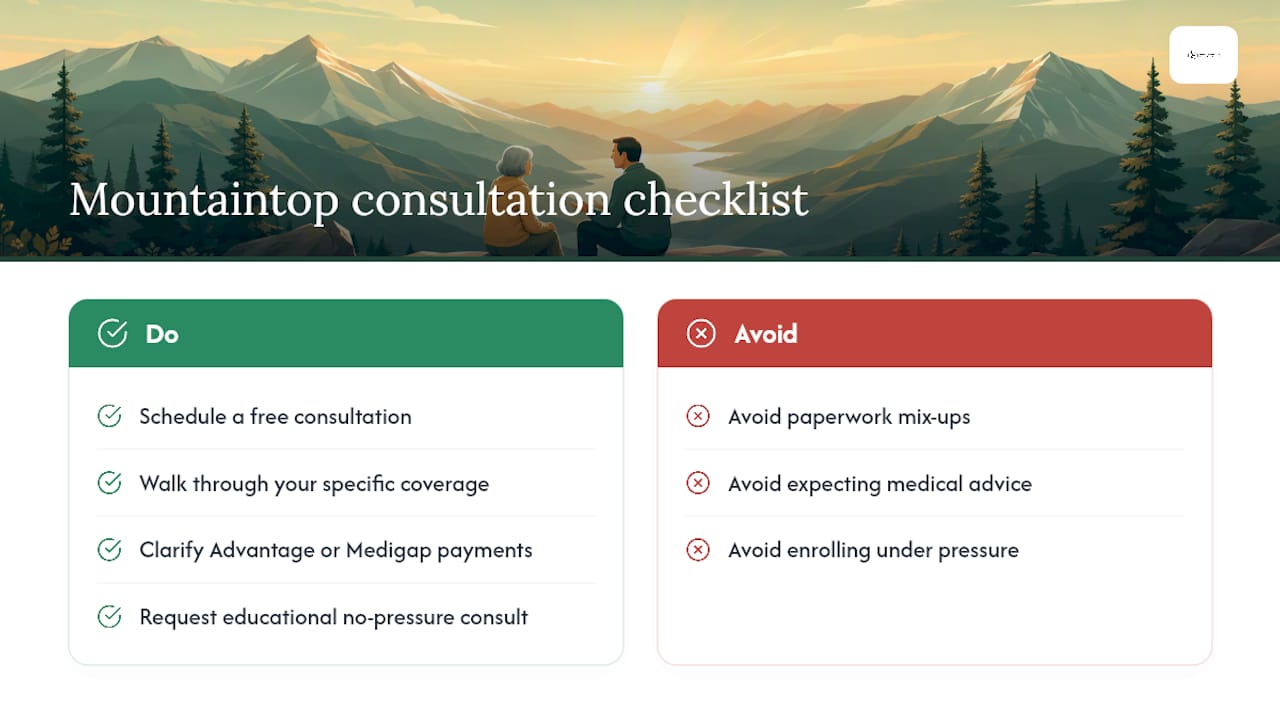
Understanding what your Medicare Part B plan covers shouldn’t require a law degree, and that’s exactly where Mountaintop Insurance steps in for Central Oregon residents. Before your next Annual Wellness Visit, a free consultation can walk you through your specific coverage, clarify what your Medicare Advantage or Medigap plan actually pays for, and help you avoid the paperwork mix-ups that lead to surprise bills. Mountaintop Insurance is an insurance agency, not a medical provider, and every consultation is educational, with zero pressure to enroll. If you’re in Bend or anywhere in Central Oregon and want a straight answer about your coverage before your next checkup, visit the Mountaintop Insurance Medicare services page and schedule a free consultation.
Where to Verify the Rules Yourself
- CMS Medicare wellness visits page: official coverage and eligibility rules
- Medicare: cost breakdown and what’s included
- Mayo Clinic Health System AWV explainer: clinical perspective on visit value
Check your specific Medicare Advantage plan documents for any variations, or call Mountaintop Insurance if something’s unclear.
Sources
- Medicare wellness visits — CMS
- Medicare
- Medicare Annual Wellness Visits explained — Mayo Clinic Health System
- What are Medicare annual wellness exams? — Medical News Today
FAQ
Is It Mandatory to Get a Medicare Wellness Visit?
No. CMS encourages providers to offer the AWV, but beneficiaries aren’t required to schedule one.
Does the Wellness Visit Have to Be Exactly 365 Days Apart?
It needs to be at least 12 months, or roughly a full calendar year, since your last AWV or Welcome to Medicare visit. Most providers track this using the prior visit’s date rather than counting exact days.
What Are the CMS Guidelines for the Annual Wellness Visit?
CMS requires a Health Risk Assessment covering demographics, health status, psychosocial and behavioral risks, and daily functioning, plus a written Personalized Prevention Plan, billed using G0438 or G0439.
What Are Three Words People Use for the Medicare Wellness Visit?
Beneficiaries commonly hear it called the “annual wellness visit,” “Medicare check-up,” or “wellness exam,” though all three refer to the same Part B preventive benefit.
Can a Nurse Practitioner Perform My Wellness Visit?
Yes. CMS allows physicians, physician assistants, nurse practitioners, and clinical nurse specialists to conduct the AWV, and Mayo Clinic notes it’s routinely handled by a nurse or nurse practitioner rather than your primary doctor.
Recommended
Disclaimer: This article is for general educational purposes only and does not constitute personalized advice. Medicare rules and plan details change frequently.
Discuss Your Situation With Us