Medigap Guaranteed Issue Rights: What You Need to Know

Medigap guaranteed issue rights let certain Medicare beneficiaries buy a Medicare supplement plan without medical underwriting when they lose or change other coverage. That means the insurer must sell you a policy, must cover your pre-existing conditions, and cannot charge you more because of your health history. These protections only apply in specific situations, and the window to act is short.
What guaranteed issue rights protect you from:
- Medical screening or health questionnaires that could disqualify you
- Denial of coverage based on pre-existing conditions
- Higher premiums charged because of past or current health problems
The deadlines that matter most:
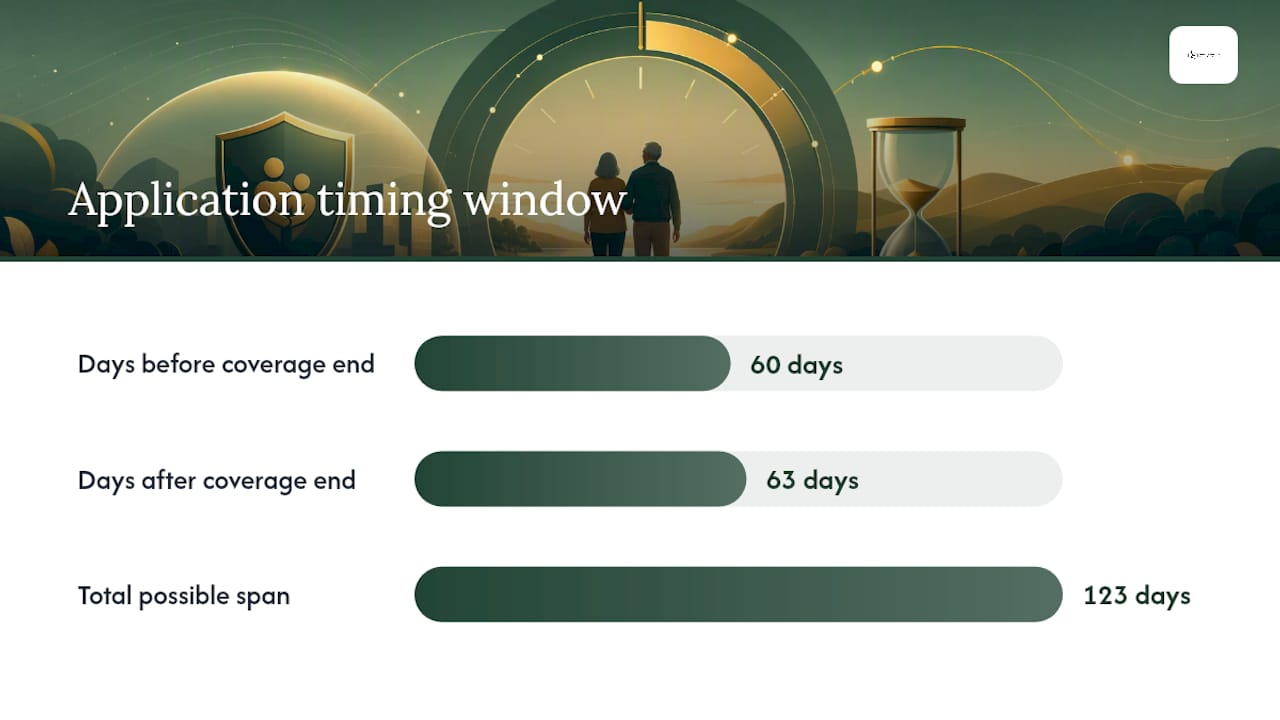
You can generally apply as early as 60 days before your current coverage ends. After coverage ends, you have a firm deadline of about two months to submit your application. Miss that window, and insurers generally don’t have to sell you a policy unless you have another qualifying event.
Your immediate next steps if you think you qualify:
- Locate and save any termination letters, denial notices, or plan-change notifications
- Record the exact date your current coverage ends or ended
- Contact your State Health Insurance Assistance Program (SHIP) at Shiphelp or your State Insurance Department
- Consider reaching out to a local licensed agent like Mountaintop Insurance for help with paperwork and deadlines
Key Takeaways
Medigap guaranteed issue rights require you to act within 63 calendar days of losing qualifying coverage, assert the right explicitly on your application, and submit documented proof of the triggering event.
| Point | Details |
|---|---|
| 63-day hard deadline | Apply no later than 63 days after coverage ends; some events allow applying 60 days before. |
| Three insurer obligations | Must sell, must cover pre-existing conditions, cannot charge more for health. |
| Plans C and F restricted | Post-2020 Medicare enrollees cannot buy Plans C or F; Plan D or G are the standard alternatives. |
| Assert the right explicitly | Write “applying under guaranteed issue right” on the application and attach proof documents. |
| Mountaintop Insurance | Offers free consultations in Central Oregon to verify eligibility and prepare guaranteed issue applications. |
Table of Contents
- What Medigap guaranteed issue rights actually mean for you
- Every situation that triggers your guaranteed issue rights
- Exact timing rules and how to calculate your deadline
- Which Medigap plans you can buy under guaranteed issue
- How to exercise your guaranteed issue rights: a step-by-step checklist
- If an insurer refuses or charges you more
- State differences and extra protections worth knowing
- Why acting fast and documenting everything is the only real strategy
- Mountaintop Insurance can help you get this right
- Sources
- FAQ
What Medigap guaranteed issue rights actually mean for you
Guaranteed issue rights, sometimes called Medigap protections, are a set of federal legal protections that apply in specific circumstances. When they apply, insurers selling Medigap policies in your state face three hard obligations:
- Must sell you a policy. The insurer cannot turn you away based on health.
- Must cover pre-existing conditions. No waiting periods, no exclusions for conditions you already have.
- Cannot charge you more for health. Your premium must be the same as it would be for a healthy applicant of the same age.
Outside of these rights, Medigap underwriting is the norm. Insurers can ask detailed health questions and decline applicants or charge more based on the answers. According to Medicare.gov, the situations where an insurer cannot deny you a Medigap policy are specifically defined, which is why knowing whether you qualify matters so much.
Federal rules set the floor. State law can raise it. Your state insurance department (often called the Department of Insurance, or DOI) and the National Association of Insurance Commissioners (NAIC) directory are the right places to check for state-specific additions. The State Health Insurance Assistance Program (SHIP) offers free one-on-one counseling and can walk you through both federal and state rules for your situation.
Every situation that triggers your guaranteed issue rights
Federal law recognizes a specific set of qualifying events. Each one comes with its own timing note.
-
Your Medicare Advantage plan stops offering coverage in your area. The plan exits your county or service area entirely. You have a limited time after coverage ends to apply for Medigap.
-
Your Medicare Advantage plan’s contract with Medicare is terminated. The plan loses its Medicare contract. You have a limited time after coverage ends to apply for Medigap.
-
You move out of your Medicare Advantage plan’s service area. Relocation outside the plan’s geographic coverage area qualifies. You have a limited time after the move or coverage end to apply for Medigap.
-
Your Medicare Advantage plan significantly reduces benefits or provider networks. A material reduction in what the plan covers or who it covers can trigger the right. You have a limited time from the effective date of the change to apply.
-
You lose employer-sponsored retiree coverage involuntarily. Your former employer terminates or significantly reduces the retiree health plan you were enrolled in. You can often apply starting a short time before coverage ends and must apply no long after.
-
You lose COBRA coverage involuntarily. COBRA exhaustion or involuntary termination counts. You have a limited time after COBRA ends to apply.
-
Your Medigap insurer goes bankrupt or leaves your state. If your existing Medigap policy ends because the insurer becomes insolvent or stops selling in your state, you have a guaranteed issue right to buy a new policy.
-
Your plan misrepresented its coverage to you. If you enrolled in a Medicare Advantage or Medigap plan based on material misrepresentation, you may have a right to switch.
-
You are in your trial right period after joining Medicare Advantage for the first time. This one works differently from the others. If you dropped Original Medicare and a Medigap policy to join a Medicare Advantage or PACE plan for the first time, you have up to 12 months to return to Original Medicare and buy a Medigap policy. The insurer must sell you the same plan you had before, or a comparable one if that plan is no longer available.
-
You joined Medicare Advantage or PACE when you first became eligible for Medicare Part A at 65. If you enrolled in MA or PACE within the first year of Medicare eligibility and decide to switch back to Original Medicare, you have a special trial right to buy a Medigap policy.
The Choosing a Medigap Policy publication from Medicare covers each of these events in detail, including documentation expectations for each.
Exact timing rules and how to calculate your deadline
The general rule is straightforward: you can apply as early as 60 days before your coverage ends, and no later than about two months after the date your coverage ends, the date on a termination notice, or the date of a claim denial confirming your coverage ended. Whichever of those dates is earliest starts the clock.
The 63-day window is firm at the federal level. There is no grace period built in for slow mail or delayed paperwork. Some states extend the window under certain circumstances, but you cannot count on that unless you have confirmed it with your state DOI or SHIP.
Deadline checklist to complete right now:
- Write down the exact date your current coverage ends (check your termination letter or plan notice)
- Count forward 63 calendar days from that date and mark it on your calendar
- Note whether you received a termination notice with a specific date, since that date may start the clock separately
- Check whether you qualify for the 60-days-before window and whether you can start the application process now
- Contact SHIP or your state DOI to confirm whether your state offers any extended windows
Pro Tip: Keep the original envelope from any termination or denial letter. The postmark is evidence of when the notice was sent, which can matter if there is a dispute about when your window opened.
For readers who want a deeper look at how enrollment windows interact with guaranteed issue timing, the key enrollment windows guide at Mountaintop Insurance covers the full picture.
Which Medigap plans you can buy under guaranteed issue
Federal guaranteed issue rights do not give you access to every Medigap plan letter. The plans typically available under these rights are Plans A, B, D, G, K, and N. In some situations, you may also have access to Plans C and F, but with an important restriction.
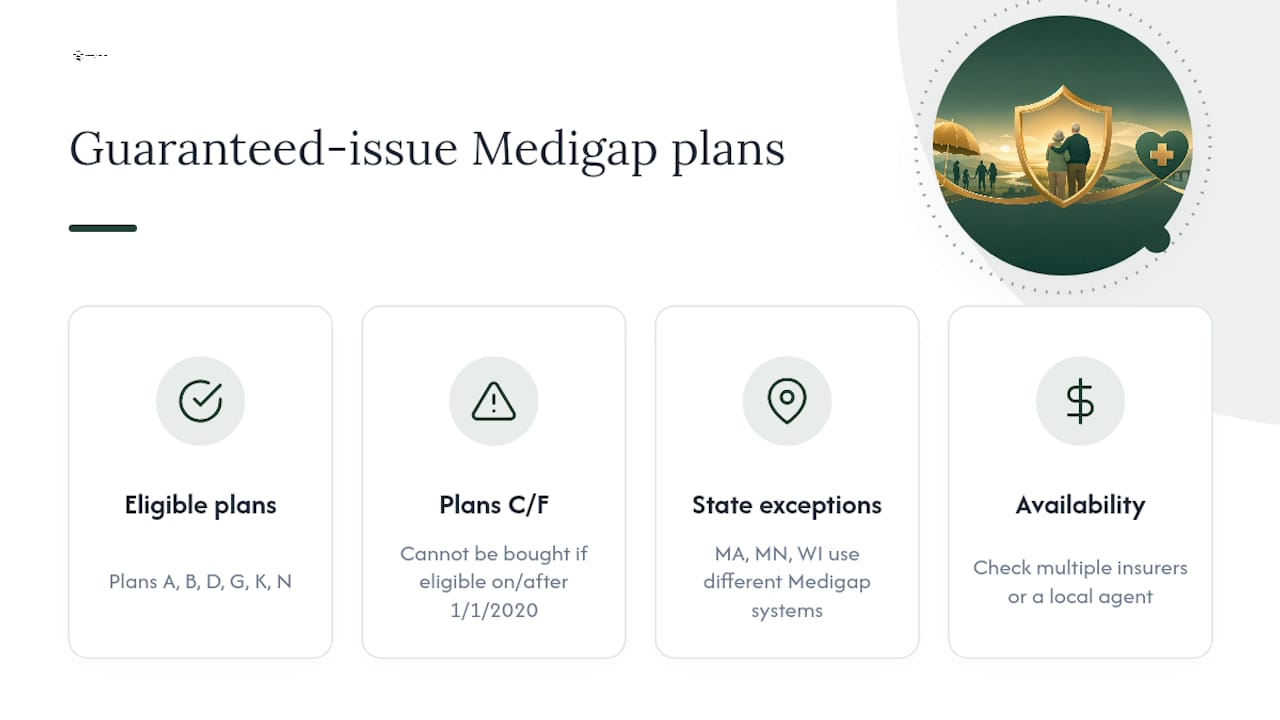
The 2020 rule on Plans C and F: Anyone who became eligible for Medicare on or after January 1, 2020, cannot buy Plan C or Plan F. These plans covered the Medicare Part B deductible, and federal law eliminated that option for new enrollees. If you were eligible for Medicare before January 1, 2020, you may still be able to buy Plan C or F in some circumstances. For most people new to Medicare, Plan D or Plan G are the closest alternatives.
Even with guaranteed issue rights, not every insurer in your state sells every plan letter. Insurers choose which standardized plans to offer, and availability varies by company and by state. That means you might have the legal right to buy Plan G but find only two or three insurers in your area actually selling it.
Massachusetts, Minnesota, and Wisconsin use different Medigap frameworks entirely. If you live in one of those states, the standard lettered plan system does not apply. Check your state DOI or SHIP for the plan options available to you.
Even when you have guaranteed issue rights, checking multiple insurers or working with a local agent can uncover meaningful price differences between companies offering the same plan letter.
How to exercise your guaranteed issue rights: a step-by-step checklist
Guaranteed issue rights are not automatic. You must actively assert them and submit proof. An insurer that receives an application without clear documentation of the qualifying event may treat it as a standard submission and apply full underwriting.
-
Gather your proof documents. Collect the termination letter, denial notice, or plan-change notification. If your employer plan is ending, get written confirmation from your HR department or benefits administrator. Keep originals and make copies.
-
Contact SHIP first if you are unsure. SHIP counselors are free, unbiased, and trained specifically for situations like this. They can confirm whether your event qualifies and walk you through the application process. Find your local SHIP at Shiphelp.
-
Identify which Medigap plans are available in your state. Call two or three insurers or work with a licensed local agent to compare Plan G or Plan D options and premiums.
-
Complete the application carefully. Medicare’s guidance on buying a Medigap policy stresses filling out the application accurately and attaching proof of the qualifying event. Write clearly on the application: “I am applying under my guaranteed issue right.” Include the specific event (e.g., “involuntary loss of employer retiree coverage effective [date]”).
-
Attach copies of all proof documents. Do not send originals. Attach a copy of the termination letter, the original envelope with the postmark, and any denial notices.
-
Send by certified mail with return receipt. This creates a dated record of submission. Keep the tracking number and the green return-receipt card.
-
Follow up within 10 business days. Call the insurer to confirm receipt. Note the name of the representative and the date of the call.
Sample cover note language:
For additional enrollment tips and paperwork checklists, the Medicare insurance enrollment tips resource offers a practical companion checklist.
Pro Tip: Never assume the insurer knows you have a guaranteed issue right. State it explicitly on the application and in any cover letter. Failure to label the application correctly is the most common reason a valid guaranteed issue claim gets treated as a standard underwriting submission.
If an insurer refuses or charges you more
A denial or a higher-than-standard premium when you have a valid guaranteed issue right is not the end of the road. Here is the sequence to follow.
Step 1: Respond to the insurer in writing. Send a written letter to the insurer’s compliance or appeals department. Include your application, the proof of qualifying event, and a clear statement that you are asserting your guaranteed issue right under federal law. Send it certified mail.
Step 2: File a complaint with your State Insurance Department. Your state DOI enforces state insurance laws and has authority to investigate insurer violations. Medicare guidance identifies the State DOI as the primary local resource for complaints. To find your state’s department, use the NAIC consumer information directory at Naic.
Step 3: Contact your local SHIP. SHIP counselors can help you document the complaint, draft letters, and understand your rights under both federal and state law. They cannot enforce the law themselves, but they can guide you to the right channels and help you build a stronger case.
Step 4: Contact CMS if the issue involves Medicare-level rules. For disputes that involve federal Medicare rules specifically, you can contact CMS through 1-800-MEDICARE (1-800-633-4227).
What each office can do:
- State DOI: Investigates insurer violations, can fine or sanction insurers, and can order corrective action
- SHIP: Provides free counseling, helps you document and escalate complaints, and connects you with legal aid if needed
- CMS / Medicare: Handles federal Medicare rule disputes and can escalate to the Office of Inspector General for fraud
What to include in every complaint:
- Your name, Medicare number, and contact information
- The insurer’s name and the policy or application number
- A clear description of the qualifying event and the date it occurred
- Copies of all correspondence, including the denial letter and your original application
- A timeline of events in chronological order
State differences and extra protections worth knowing
Federal law sets the minimum. Several states go further, and the differences can be significant.
Massachusetts, Minnesota, and Wisconsin do not use the standard lettered Medigap plan system. Each state has its own set of standardized plans with different benefit structures. If you live in one of these states, the federal plan letters (A, B, D, G, etc.) do not apply to you. Contact your state DOI or SHIP for the specific plans available and the guaranteed issue rules that govern them.
Beyond those three states, many others have added protections such as:
- Extended application windows beyond the federal 63-day rule
- Annual or birthday-rule enrollment periods that let you switch Medigap plans without underwriting (Oregon, for example, has a birthday rule that Mountaintop Insurance can explain in detail for Central Oregon residents)
- Broader plan availability under guaranteed issue than federal law requires
- Additional consumer protections for beneficiaries who were misled by an insurer
To find your state’s specific rules, go to your state insurance department’s website. The NAIC maintains a directory of all state insurance departments at naic.org. Your local SHIP can also walk you through state-specific rules at no cost. Find your SHIP contact at shiphelp.org.
Why acting fast and documenting everything is the only real strategy
Most people who miss their guaranteed issue window do not miss it because they forgot. They miss it because they waited for someone else to tell them the clock was running.
Insurers are not required to remind you that you have a guaranteed issue right. Plan termination notices often arrive with little explanation of what your next steps are. By the time a beneficiary figures out what happened, a week or two of the 63-day window is already gone. Start collecting proof the moment you learn your coverage is changing or ending, not after you have confirmed all the details.
The other mistake I see repeatedly: submitting an application without explicitly stating the guaranteed issue right on the form. An insurer’s underwriting department processes applications by default. If nothing on the form signals a guaranteed issue situation, the application goes through standard review. That is not the insurer acting in bad faith. It is a process gap that the beneficiary can close with four words: “applying under guaranteed issue right.”
SHIP is genuinely underused. It is free, it is staffed by trained counselors, and it exists specifically for situations like this. Most beneficiaries call their insurer first and SHIP last, when it should be the other way around. A SHIP counselor can confirm your qualifying event, review your documentation, and help you draft the application before you send it.
Mountaintop Insurance can help you get this right
Sorting out a guaranteed issue application under a deadline is exactly the kind of situation where having a local, licensed agent makes a concrete difference. Mountaintop Insurance, based in Bend, Oregon, offers free consultations for Medicare beneficiaries across Central Oregon who need help verifying eligibility, preparing application paperwork, and communicating with insurers or the state DOI.
Three specific ways Mountaintop Insurance can help: confirming whether your qualifying event meets federal or Oregon state standards, organizing and reviewing your proof documents before submission, and following up with the insurer on your behalf if a response is delayed or a denial arrives. Consultations are free, and the agency is commission-based, meaning you pay nothing out of pocket for the guidance.
If you are approaching a 63-day deadline or want to get ahead of a coverage change, schedule a free consultation through Mountaintop Insurance’s Medicare services page or visit Mountaintopins to get started.
Sources
This article is general information, not a substitute for advice from a qualified lawyer. Consult a qualified legal professional about your own circumstances before acting on anything here.
FAQ
What states have guaranteed issue rights for Medigap?
All states except Massachusetts, Minnesota, and Wisconsin must follow federal guaranteed issue rules, but those three operate under different Medigap frameworks with their own plan structures and protections. Many other states have added extra rights beyond the federal minimum, so checking your state DOI or SHIP is the reliable way to know what applies to you.
What qualifies as a guaranteed issue right for Medigap?
Federal law recognizes specific triggering events, including your Medicare Advantage plan exiting your area, involuntary loss of employer retiree coverage, COBRA exhaustion, insurer bankruptcy, and the trial right when returning from Medicare Advantage within the first 12 months. Voluntary plan changes generally do not qualify, so documenting the involuntary nature of your coverage loss is critical.
What states let you change Medicare supplement plans without underwriting?
A handful of states have birthday rules or anniversary rules that allow beneficiaries to switch Medigap plans annually without medical underwriting. Oregon is one example, with a birthday rule that opens a window each year around your birthday. California and Missouri have similar provisions. Your state DOI or SHIP can confirm whether your state offers this protection.
What should I do if a Medigap insurer denies my guaranteed issue application?
Respond in writing to the insurer with your proof of qualifying event, then file a complaint with your State Insurance Department using the NAIC directory at naic.org. Contact your local SHIP for free help building the complaint, and reach out to CMS at 1-800-MEDICARE if the dispute involves federal Medicare rules.
Recommended
Disclaimer: This article is for general educational purposes only and does not constitute personalized advice. Medicare rules and plan details change frequently.
Discuss Your Situation With Us