Medigap Plan G vs Plan N: Which One Fits You?

TL;DR:
- Medigap Plan G offers seniors full cost predictability by covering Part B excess charges, unlike Plan N.
- Plan N saves money through lower premiums but involves copays and potential exposure to excess charges if providers do not accept Medicare assignment.
If you want the short answer: Plan G is the better fit for seniors who want predictable annual costs and see doctors regularly. Plan N makes sense if you are in good health, visit the doctor infrequently, and want to keep monthly premiums lower in exchange for small per-visit copays.
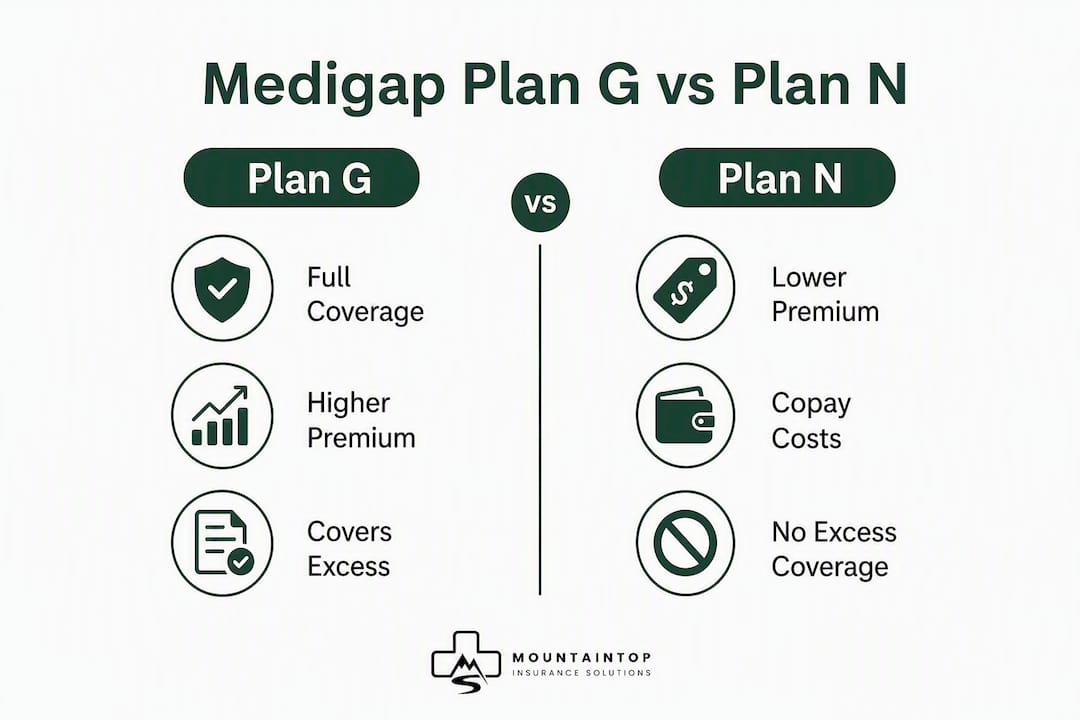
The two plans are nearly identical in coverage. The differences come down to three things:
- Plan G covers Part B excess charges; Plan N does not.
- Plan N charges up to $20 per covered office visit and up to $50 for emergency room visits that do not result in admission.
- Neither plan covers the Part B annual deductible, which is set annually by Medicare.
The core trade-off: Plan G trades a higher monthly premium for complete cost predictability. Plan N trades that predictability for $30–$50 in monthly savings, with small copays and a slim but real exposure to excess charges.
CMS / Medicare.gov standardizes every lettered Medigap plan, so the benefits described here apply regardless of which insurance carrier you buy from.
Table of Contents
- How do Plan G and Plan N compare side by side?
- What exactly differs between Plan G and Plan N?
- How do you compare the real annual cost of each plan?
- Which plan is right for you?
- When can you enroll, and what happens if you want to switch later?
- Worked examples: does Plan N’s premium savings actually add up?
- Key Takeaways
- What most seniors get wrong when choosing between these plans
- Mountaintop Insurance can run your numbers for free
- FAQ
How do Plan G and Plan N compare side by side?
The table below maps every major coverage dimension for both plans. Benefits are federally standardized, so these apply to every carrier.

| Coverage dimension | Medigap Plan G | Medigap Plan N |
|---|---|---|
| Part A hospital coinsurance | Covered 100% | Covered 100% |
| Part A deductible | Covered 100% | Covered 100% |
| Skilled nursing facility coinsurance | Covered 100% | Covered 100% |
| Part B coinsurance or copayment | Covered 100% | Covered (with copays — see below) |
| Part B deductible ($283 in 2026) | Not covered | Not covered |
| Part B excess charges | Covered 100% | Not covered |
| Office visit copay | None | Up to $20 |
| ER visit copay (no admission) | None | Up to $50 |
| Foreign travel emergency | Covered | Covered |
| Predictability of annual costs | High | Moderate |
| Best for | Frequent visitors, chronic conditions | Healthy, low-utilizers |
Two differences that actually matter in practice:
- Part B excess charges occur when a provider does not accept Medicare assignment and bills up to 15% above the Medicare-approved amount. Plan G absorbs that charge entirely. Plan N enrollees pay it out of pocket. Excess charges affect fewer than 1% of Medicare claims nationally, and eight states (Connecticut, Massachusetts, Minnesota, New York, Ohio, Pennsylvania, Rhode Island, and Vermont) restrict or ban them outright. If you live in one of those states, this distinction largely disappears.
- Plan N copays apply to covered outpatient office visits and to ER visits when you are treated and released. If an ER visit leads to inpatient admission, the $50 copay is waived.
What exactly differs between Plan G and Plan N?
Part B excess charges explained
A Part B excess charge happens when your doctor is a “non-participating provider” — meaning they accept Medicare but do not agree to Medicare’s approved payment rate. They are legally allowed to charge up to 15% above that rate.
Here is a simple example. Say Medicare’s approved amount for a specialist visit is $200. A non-participating provider can bill $230. Under Plan G, your plan pays that extra $30. Under Plan N, you pay it yourself.
Only Plan F and Plan G cover Part B excess charges. Plan F is no longer available to anyone who became Medicare-eligible on or after January 1, 2020, which makes Plan G the most comprehensive option for new beneficiaries who want that protection.
Plan N copays: when they apply and when they don’t
Plan N charges up to $20 for covered office visits and up to $50 for ER visits that do not result in admission. A few clarifications worth knowing:
- The copay applies to covered outpatient visits billed under Part B. Preventive visits that Medicare covers at 100% are typically exempt.
- The ER copay is waived if you are admitted as an inpatient.
- Copays are fixed maximums, not percentages, so they do not increase with the cost of the visit.
The Part B deductible: both plans leave it with you
Neither Plan G nor Plan N covers the Part B deductible. In 2026, that deductible is $283. You pay it once per year before either plan kicks in for outpatient services. Budget for it regardless of which plan you choose, as the deductible amount may vary yearly.
Pro Tip: Go to Medicare.gov’s provider directory and search for your regular doctors to confirm they accept Medicare assignment. If they do, excess charges are not a factor for you — and that removes one of Plan G’s main advantages over Plan N.
How do you compare the real annual cost of each plan?
Plan N’s lower premium looks attractive on paper. Whether it actually saves you money depends on how many times you use it.

Plan N typically costs $30–$50 less per month than Plan G, producing roughly $400–$800 in annual premium savings depending on your state, age, and carrier. But every office visit under Plan N costs up to $20, and an ER visit without admission costs up to $50.
The formula to compare your true annual cost:
Plan G annual cost = (monthly premium × 12) + $283 Part B deductible
Plan N annual cost = (monthly premium × 12) + $283 Part B deductible + ($20 × number of office visits) + ($50 × number of non-admission ER visits) + any excess charges
Break-even calculations show Plan N is cheaper when you have a limited number of office visits per year, depending on the actual premium gap in your state. If your premium difference is $40/month ($480/year), and you pay $20 per visit, you break even at 24 visits. Beyond that, Plan G is cheaper.
What to check when you request carrier quotes
Medigap plan benefits are standardized by federal rules, so Plan G from one carrier covers exactly the same benefits as Plan G from another. The only variable is price and underwriting policy. When comparing quotes, look at:
- Issue-age vs. attained-age pricing: Issue-age plans lock your rate to your age at enrollment; attained-age plans increase as you get older.
- State and zip code: Premiums vary significantly by location.
- Gender and tobacco status: Both affect pricing in most states.
- Carrier rate history: Some carriers raise premiums aggressively after year one. Ask about historical rate increases.
Warning: If you start with Plan N and later want to switch to Plan G, you will likely face medical underwriting. If your health has changed, you could be denied or charged a higher rate. The plan you choose now may be the plan you keep for years.
Which plan is right for you?
Choose Plan G if:
- You want to know your maximum annual out-of-pocket cost before the year starts.
- You have a chronic condition or see specialists regularly.
- Some of your doctors are non-participating providers (or you are not sure).
- You travel frequently and want to avoid surprise bills from out-of-network providers.
- You value simplicity: pay the bill, plan pays the rest.
Choose Plan N if:
- You are in good health and see the doctor fewer than 15–20 times per year.
- All your regular doctors accept Medicare assignment.
- You live in one of the eight states that restrict excess charges.
- The monthly premium savings matter to your budget and you are comfortable tracking copays.
- You are enrolling during your initial open enrollment window, when underwriting does not apply, and you can switch later if health needs change (though switching later carries underwriting risk).
A quick decision test: if you had 20 office visits last year, the $20 copays under Plan N would total $400. If the premium gap between Plan G and Plan N is less than $400 per year in your area, Plan G is already cheaper on a total-cost basis. If the gap is larger, Plan N still wins.
For seniors on a fixed income who rarely see doctors, Plan N’s savings are real and meaningful. For anyone managing diabetes, heart disease, or another condition requiring regular care, Plan G’s predictability is usually worth the extra premium.
When can you enroll, and what happens if you want to switch later?
The open enrollment window
Your Medigap open enrollment window is six months long. It starts the month you are both age 65 and enrolled in Medicare Part B. During this window, insurers cannot deny you coverage or charge you more based on health history. This is your strongest protection.
If you miss this window, you can still apply for Medigap, but insurers in most states can ask health questions and decline your application.
Guaranteed-issue situations
Outside open enrollment, a few specific situations trigger guaranteed-issue rights, meaning insurers must accept you without underwriting. Common examples include losing employer coverage, moving out of a plan’s service area, or your current plan leaving the market. These windows are narrow, typically 63 days.
State exceptions worth knowing
A handful of states offer stronger protections. Oregon, for example, has a Birthday Rule: during a 30-day window around your birthday each year, you can switch to a plan with equal or lesser benefits without underwriting. This is a meaningful advantage for Oregon residents who start with Plan N and later want to move to Plan G, though the Birthday Rule applies to plans of equal or lesser benefit, so a Plan N to Plan G switch may still require underwriting in some cases. Confirm the current rules with a licensed agent.
The practical implication: most people who choose Plan N at 65 and develop a chronic condition at 72 cannot easily upgrade to Plan G. The initial choice carries real long-term weight. Choosing Plan G from the start removes that risk entirely.
Switching from Plan N to Plan G after the initial enrollment period usually requires medical underwriting and may be denied or result in higher premiums if your health has changed.
Worked examples: does Plan N’s premium savings actually add up?
Example A: Healthy, low-visit beneficiary (Plan N wins)
Maria is 65, non-smoker, in good health. She sees her primary care doctor four times a year and has no specialist visits. All her doctors accept Medicare assignment.
| Item | Plan G | Plan N |
|---|---|---|
| Part B deductible | $283 | $283 |
| Total annual cost | $2,143 | — |
Plan N saves Maria $436 per year in this scenario.
Example B: Chronic-care beneficiary (Plan G wins)
Robert is 67, manages Type 2 diabetes and hypertension, and sees his primary care doctor and two specialists a combined 22 times per year. One specialist is a non-participating provider.
| Item | Plan G | Plan N |
|---|---|---|
| Part B deductible | $283 | $283 |
| Total annual cost | $2,143 | — |
At 22 visits with excess charges, the plans are nearly identical in total cost. Add a few more visits or a higher excess charge, and Plan G pulls ahead. Robert also gains predictability: his annual cost is fixed at $2,143 regardless of how many times he needs care.
Your fill-in formula:
Plan N annual cost = (your Plan N premium × 12) + $283 + ($20 × your expected office visits) + ($50 × expected non-admission ER visits) + estimated excess charges
Compare that number to: (your Plan G premium × 12) + $283
Whichever is lower is your better deal, assuming your health stays consistent. Remember that premiums vary significantly by state — a 65-year-old non-smoker’s Plan G vs. Plan N gap can range from $30 to $70 per month depending on location.
Results depend on local carrier premiums, your actual visit frequency, and whether your providers accept Medicare assignment. Run quotes with your specific zip code and age for accurate numbers.
Key Takeaways
Plan G is the stronger choice for predictable annual costs; Plan N saves money only when your visit count stays below the break-even threshold of roughly 15–26 office visits per year.
| Point | Details |
|---|---|
| Core verdict | Plan G offers full cost predictability; Plan N saves $400–$800/year in premiums if visits stay low. |
| The decisive difference | Plan G covers Part B excess charges; Plan N does not, though excess charges affect under 1% of claims nationally. |
| Break-even threshold | Plan N’s copays erase its premium savings at roughly 15–26 office visits per year, depending on your premium gap. |
| Enrollment timing risk | Switching from Plan N to Plan G after open enrollment usually requires medical underwriting and may be denied. |
| Mountaintop Insurance | Mountaintop Insurance offers free consultations to run your specific numbers and explain Oregon’s Birthday Rule and other state-specific switching rights. |
What most seniors get wrong when choosing between these plans
The conventional wisdom is simple: healthy people pick Plan N, everyone else picks Plan G. That framing is not wrong, but it misses the part that actually trips people up.
Most seniors underestimate how many doctor visits they have in a year. When you count primary care, specialists, follow-ups, and lab visits that require a separate office charge, 15 visits per year is not a high bar. It is closer to average for someone managing even one chronic condition. Running the break-even math with an honest visit count changes the outcome for a lot of people.
The second mistake is treating the excess charge risk as theoretical. In most of the country, it is. But the risk is not evenly distributed. If you live in a rural area, see specialists in a small practice, or plan to travel and use providers outside your usual network, the probability of hitting a non-participating provider is higher than the national average suggests. Plan G removes that variable entirely.
The third mistake, and the one with the longest consequences, is assuming you can switch later. The guaranteed-issue window at 65 is the one moment when your health history is irrelevant. Choosing Plan N at 65 because you are healthy is reasonable. Assuming you can upgrade to Plan G at 70 when your needs change is the part that often does not work out.
Oregon residents have more flexibility than most, thanks to the Birthday Rule. But even that protection has limits, and it does not apply in every switching scenario. Knowing exactly what it covers before you decide is worth a conversation with a licensed agent.
Mountaintop Insurance can run your numbers for free
Picking between Plan G and Plan N is not a one-size-fits-all decision. It depends on your zip code, your doctors, your visit history, and the carrier options available in your area. Mountaintop Insurance is a local agency in Bend, Oregon, that does exactly this work at no cost to you.
The agency compares Medigap quotes across carriers, explains how Oregon’s Birthday Rule affects your switching options, and walks you through enrollment timing so you do not miss a guaranteed-issue window. No pressure, no call-center script. Bring your zip code, your list of current doctors, and a rough sense of how often you see them.
Schedule a free consultation with Mountaintop Insurance to get Plan G and Plan N quotes side by side for your specific situation.
Sources and further reading
- Compare Medigap Plan Benefits — Medicare.gov: Official CMS chart of standardized benefits for every lettered Medigap plan.
- Medigap Basics — Medicare.gov: Plain-language overview of how Medigap works, enrollment windows, and guaranteed-issue rights.
- Medigap Plan G vs. Plan N — Cover Forge USA: Premium ranges, state sample data, and break-even analysis.
- Mountaintop Insurance — Medicare Services: Local Medigap quoting, enrollment assistance, and free consultations for Central Oregon residents.
FAQ
Should I get Plan G or Plan N?
Plan G is the better fit if you see doctors regularly or want predictable annual costs. Plan N makes sense if you are healthy, visit the doctor fewer than 15–20 times per year, and all your providers accept Medicare assignment.
What are the disadvantages of Plan N?
Plan N charges up to $20 per covered office visit and up to $50 for ER visits that do not result in admission. It also does not cover Part B excess charges, which can add up to 15% above the Medicare-approved amount when you see a non-participating provider.
Can I switch from Plan N to Plan G later?
You can apply, but outside your initial six-month open enrollment window, most states allow insurers to require medical underwriting. If your health has changed, your application may be denied or priced higher. Oregon’s Birthday Rule offers some additional flexibility, but it has limits.
How much cheaper is Plan N than Plan G?
Plan N typically costs $30–$50 less per month than Plan G, producing roughly $400–$800 in annual premium savings depending on your state, age, and carrier. That gap narrows or disappears once you factor in Plan N’s per-visit copays.
Recommended
Disclaimer: This article is for general educational purposes only and does not constitute personalized advice. Medicare rules and plan details change frequently.
Discuss Your Situation With Us