2026 Medicare Part B Premium: What Seniors Must Know

The 2026 standard Medicare Part B premium is $202.90 per month, up from $185.00 in 2025, a jump of $17.90. The annual deductible rises to $283. Those are the numbers confirmed by the Centers for Medicare & Medicaid Services. Most beneficiaries pay the standard rate, but if your 2024 modified adjusted gross income (MAGI) exceeded certain thresholds, the Income-Related Monthly Adjustment Amount (IRMAA) pushes your total monthly premium higher, ranging from $284.10 to $689.90. Check your 2024 IRS return now. If your income dropped due to retirement, a spouse’s death, or another qualifying event, call the Social Security Administration (SSA) at 1-800-772-1213 to request a new determination before you overpay for months.
Key Takeaways
The 2026 standard Part B premium of $202.90 is $17.90 higher than 2025, and high-income enrollees subject to IRMAA can pay up to $689.90 per month based on their 2024 MAGI.
| Point | Details |
|---|---|
| 2026 standard premium | $202.90/month, up $17.90 from the 2025 rate of $185.00. |
| Annual deductible | $283 in 2026 |
| IRMAA lookback rule | Your 2024 MAGI determines 2026 IRMAA; call SSA to appeal after any life-changing event. |
| Cost-reduction options | MSPs, Medicaid, Medigap, and Medicare Advantage buy-downs can all lower net Part B exposure. |
| Mountaintop Insurance | Offers free consultations in Central Oregon to help compare Medigap, Medicare Advantage, and enrollment options. |
Table of Contents
- How the 2026 Part B numbers compare to 2025
- Why the 2026 premium increased: actuarial rates and spending drivers
- IRMAA in 2026: income brackets, the two-year lookback, and how to appeal
- Practical ways to manage or lower your Part B costs in 2026
- Special situations that change what you pay
- Your step-by-step checklist for managing 2026 Part B costs
- The real cost of waiting to review your coverage
- Mountaintop Insurance helps you make sense of the 2026 changes
- Sources
- FAQ
How the 2026 Part B numbers compare to 2025
The dollar increase is the sharpest in recent memory for many enrollees.
The immunosuppressive-drug-only premium of $121.60 applies to a narrow group: kidney transplant recipients who lost broader Medicare eligibility but retained this specific drug benefit. The Federal Register notice and Medicare both confirm the standard figures above.
Why the 2026 premium increased: actuarial rates and spending drivers
Part B premiums are not arbitrary. By law, enrollee premiums are designed to cover roughly 25% of projected average Part B costs, with the federal government funding the remaining 75%. The monthly actuarial rate for aged enrollees in 2026 is $405.40, per the Federal Register. The standard premium of $202.90 is approximately half that actuarial rate, which is how the 25% share works in practice.
Two main forces drove the 2026 increase: projected price changes across physician and outpatient services, and higher utilization. The Federal Register notice also calls out spending on physician-administered drugs and skin substitutes as notable program items factored into the actuarial calculation. Across all roughly 65 million enrollees, the total estimated premium revenue increase is approximately $14.0 billion.
One nuance worth knowing: beneficiaries who pay IRMAA are not protected by the “hold harmless” provision. That provision prevents Social Security payments from declining when premium increases outpace the annual cost-of-living adjustment (COLA). IRMAA payers can see their net Social Security check shrink if premiums rise faster than COLA.
IRMAA in 2026: income brackets, the two-year lookback, and how to appeal
IRMAA is calculated from your MAGI on your 2024 federal tax return, not your current income. That two-year lookback catches many retirees off guard, especially those who sold a home, took a large IRA distribution, or had a one-time income spike. SSA regulations confirm that your total Part B premium equals the standard monthly premium plus any applicable increases plus the IRMAA surcharge.
Source: SSA Medicare Premiums page
About 8% of enrollees pay IRMAA. A separate, parallel IRMAA table applies to the immunosuppressive-drug-only premium, with the same income thresholds but lower dollar amounts.
How to request a new determination after a life-changing event:
- Gather documentation for the qualifying event: death certificate (death of spouse), divorce decree, letter from employer confirming retirement or work reduction, or amended tax return.
- Call SSA at 1-800-772-1213 or visit your local SSA office.
- Request Form SSA-44 (Medicare Income-Related Monthly Adjustment Amount — Life-Changing Event).
- Submit the form with supporting documents. SSA will use your more recent income estimate to recalculate IRMAA.
- File as soon as the event occurs. SSA can adjust prospectively, but refunds for past months paid are not guaranteed.
Pro Tip: SSA accepts estimates of your current-year income when a life-changing event has occurred. You do not need to wait for a new tax return. Bring a pay stub, pension letter, or Social Security award letter showing the income change.
Practical ways to manage or lower your Part B costs in 2026
Several programs and plan structures can reduce what you actually pay.
1. Medicare Savings Programs (MSPs) State-administered programs pay the Part B premium for qualifying low-income beneficiaries. Four tiers exist: Qualified Medicare Beneficiary (QMB), Specified Low-Income Medicare Beneficiary (SLMB), Qualifying Individual (QI), and Qualified Disabled and Working Individual (QDWI). Contact your state Medicaid office or call 1-800-MEDICARE to check eligibility. Income and asset limits vary by state.
2. Medicaid dual eligibility If you qualify for both Medicare and Medicaid, your state may pay your Part B premium directly. This is confirmed in the CMS CY 2026 update. Enrollment through your state Medicaid agency is the first step.
3. Medigap (Medicare Supplement) Medigap plans cover cost-sharing under Original Medicare, including the $283 deductible and 20% coinsurance. They do not reduce the Part B premium itself, but they cap your total out-of-pocket exposure. Oregon residents benefit from the Oregon Birthday Rule, which lets you switch Medigap plans annually without medical underwriting.

4. Medicare Advantage with a Part B buy-down Some Medicare Advantage plans offer a Part B premium reduction, sometimes called a “give-back” benefit, which credits part of your $202.90 premium back to your Social Security check. Always model the net cost: subtract the buy-down, then add any plan-specific copays, deductibles, and network restrictions. A $50 monthly credit means little if the plan’s specialist copays cost more.
Pro Tip: Ask any Medicare Advantage plan representative directly: “Does this plan offer a Part B premium reduction, and what is the exact monthly credit?” Then compare plan trade-offs against Original Medicare plus a Medigap policy before deciding.
5. Employer or retiree coverage If you or your spouse still has employer-sponsored retiree coverage, it may coordinate with Medicare and reduce net costs. Confirm with your benefits administrator whether Part B enrollment is required and how the two plans interact.
Documents to gather before evaluating any option: 2024 federal tax return (for MAGI), SSA award letter, current Medicare card, employer retiree plan summary, and recent Social Security statement.
Special situations that change what you pay
Late-enrollment penalties apply when you delay Part B enrollment past your Initial Enrollment Period without qualifying coverage elsewhere. The penalty is 10% of the standard premium for each full 12-month period you were eligible but not enrolled. That penalty is permanent and calculated against the standard premium each year. Add any IRMAA surcharge on top. For 2026, a two-year delay means a 20% penalty, putting your base premium at roughly $243.48 before IRMAA.
Direct billing applies when your Part B premium is not deducted from a Social Security or Railroad Retirement Board payment. New enrollees who have not yet started receiving Social Security benefits, and those whose Social Security payment is too small to cover the premium, receive quarterly bills from Medicare. The CMS CY 2026 update details pro-rata first-month amounts for mid-month enrollment starts.
Medicaid-paid premiums cover dually eligible beneficiaries, meaning Medicaid pays the $202.90 on their behalf. These enrollees do not receive a bill.
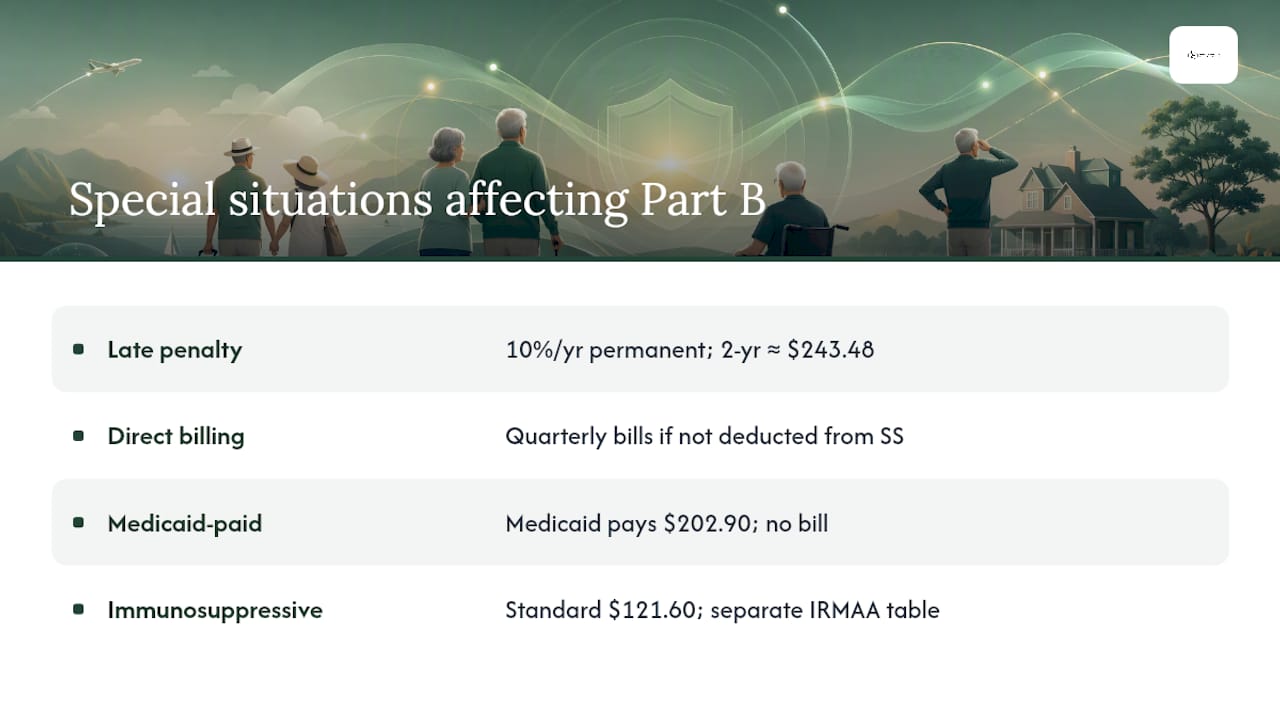
Immunosuppressive-drug-only coverage carries its own $121.60 standard premium and a separate IRMAA table. Billing questions for this population go to SSA at 1-800-772-1213.
Your step-by-step checklist for managing 2026 Part B costs
- Pull your 2024 federal tax return and locate your MAGI (line 11 of Form 1040 plus any tax-exempt interest). Compare it to the IRMAA thresholds above.
- Check your SSA notice. SSA mails an IRMAA determination letter each fall. If you did not receive one, your 2026 premium is the standard $202.90.
- Confirm deduction method. If Social Security deducts your premium automatically, verify the amount on your December 2025 or January 2026 benefit statement.
- Call SSA (1-800-772-1213) if your income dropped due to retirement, divorce, death of a spouse, or work reduction. Request Form SSA-44 and file promptly.
- Review key enrollment windows. Medicare Open Enrollment runs October 15 through December 7 each year. Changes take effect January 1.
- Compare Medigap vs. Medicare Advantage with a licensed agent before the enrollment window closes. Net cost, not headline premium, is the right comparison point.
- Schedule a free consultation with Mountaintop Insurance if you need help reading your SSA notice, estimating net costs, or comparing plan options in Central Oregon.
Pro Tip: Set a calendar reminder for October 1 each year. That is when Medicare publishes the following year’s plan details, giving you six weeks to compare before Open Enrollment opens on October 15.
The real cost of waiting to review your coverage
Most people glance at their SSA notice, see the new premium, and move on. That is a mistake. The gap between the standard $202.90 and the top IRMAA tier of $689.90 is nearly $500 per month. A single overlooked life-changing event, or a plan that looked good last year but now has a worse formulary, can cost thousands over a year.
The Part B buy-down conversation is one most seniors never have because they do not know to ask. Some Medicare Advantage plans credit $50 to $100 per month back against the Part B premium. That is real money, but only if the plan’s network and cost-sharing actually fit your situation. Comparing headline premiums without modeling total out-of-pocket cost is how people end up worse off after switching.
The hold-harmless rule is another blind spot. If you pay IRMAA, that protection does not apply to you. A year where Social Security’s COLA is modest and Part B premiums jump sharply can leave IRMAA payers with a smaller net check than the year before.
Mountaintop Insurance helps you make sense of the 2026 changes
Reading an SSA notice or comparing a Medigap plan against a Medicare Advantage buy-down takes time, and the stakes are high enough that guessing is not a strategy. Mountaintop Insurance, based in Bend, Oregon, offers free, no-pressure consultations for Central Oregon seniors and caregivers who want a clear picture of their 2026 costs before committing to a plan.
The agency covers Medicare Parts A, B, C, and D, Medigap options including Oregon’s Birthday Rule, and Medicare Advantage comparisons. There is no cost to consult, and no obligation to enroll. If you received an IRMAA notice, want to know whether a Part B buy-down makes sense for your situation, or simply need help reading your options before Open Enrollment closes, schedule a free Medicare consultation with Mountaintop Insurance today.
Sources
- 2026 Medicare Parts A & B Premiums and Deductibles | CMS
- Medicare Program; Medicare Part B Monthly Actuarial Rates, Premium Rates, and Annual Deductible Beginning January 1, 2026 | Federal Register
- Medicare
- Medicare Part B premium payment basics | MedPAC
- § 418.1125 How will the income-related monthly adjustment amount affect your total Medicare Part B premium? | SSA CFR
Call SSA at 1-800-772-1213 for a personal premium estimate. For plan comparisons and enrollment help in Central Oregon, contact Mountaintop Insurance.
This article provides general information about Medicare costs and is not a substitute for professional advice. Confirm current figures and eligibility rules with SSA, CMS, or a licensed insurance agent.
FAQ
What is the standard Part B premium for 2026?
The 2026 standard monthly Medicare Part B premium is $202.90, confirmed by CMS. The annual deductible is $283.
Who pays more than the standard Part B rate in 2026?
Beneficiaries whose 2024 MAGI exceeded $106,000 (individual) or $212,000 (joint) pay IRMAA surcharges, bringing total monthly premiums from $284.10 up to $689.90.
How do I appeal my 2026 IRMAA if my income dropped?
Call the Social Security Administration to request Form SSA-44 if you need to update your income information due to a life-changing event… SSA allows a new income determination after qualifying life-changing events such as retirement, divorce, or death of a spouse.
When does the 2026 Part B premium take effect?
The new $202.90 premium takes effect January 1, 2026, for all Part B enrollees. SSA deducts it automatically from Social Security payments for most beneficiaries.
Can Mountaintop Insurance help me compare 2026 Medicare plan options?
Yes. Mountaintop Insurance offers free consultations in Central Oregon to help seniors and caregivers compare Medigap, Medicare Advantage, and enrollment options with no obligation to enroll.
Recommended
Disclaimer: This article is for general educational purposes only and does not constitute personalized advice. Medicare rules and plan details change frequently.
Discuss Your Situation With Us