Avoid A 12 Month Dental Waiting Period for U.S. Buyers

A dental waiting period is the stretch of time between your policy’s effective date and the day your plan will actually pay for a given service. Preventive care like cleanings and exams is almost always covered from day one. Basic work often waits several months, and major work like crowns or dentures can take more than half a year. So the real question isn’t whether you’re covered, it’s when.
TL;DR:
- Preventive care like cleanings and X-rays are almost always covered immediately, regardless of plan tier or carrier, with no waiting period.
- Major procedures such as crowns, dentures, and implants typically have waiting periods of at least six months, with orthodontics often waiting a year or more.
- Waiting periods are plan-specific; employer group plans often waive them, while individual plans usually enforce them unless you have continuous prior coverage.
- Documentation proving prior coverage can usually shorten or waive waiting periods, especially if submitted promptly during enrollment.
- Reviewing the Summary of Benefits and Coverage and consulting with local experts can help clarify exact wait times and prevent surprises when needing dental work.
Table of Contents
- How Dental Waiting Periods Work by Service Tier
- What’s Covered Right Away, and What Isn’t
- Why Do Dental Plans Have Waiting Periods?
- How to Get Your Waiting Period Waived or Reduced
- Where to Find Waiting Period Details in Your Plan
- What Can You Do for Dental Care While You Wait?
- Understanding the Wait
- How Mountaintop Insurance Helps You Skip the Guesswork
- Sources
- FAQ
How Dental Waiting Periods Work by Service Tier
Insurers don’t apply one blanket wait to your whole plan. They sort procedures into tiers, and each tier gets its own clock. Understanding which bucket your needed procedure falls into tells you almost everything about how long you’ll wait.
- Preventive: cleanings, exams, X-rays. Typically zero waiting period.
- Basic: fillings, simple extractions, periodontal treatment. Often several months.
- Major: crowns, bridges, dentures, and often dental implants. Usually at least half a year.
- Orthodontics: braces and aligners. Often a year or more, when covered at all.
These ranges hold up across most individual dental plans, though carrier-published breakdowns confirm the same three-tier pattern with some variation by state and product line. The bigger split isn’t tier by tier, it’s plan type. Employer group plans frequently waive waiting periods entirely, especially for larger companies negotiating group rates, while individual and family plans purchased directly from a carrier commonly keep them. Exceptions exist for accidental injury (an emergency crown after a fall usually isn’t subject to the major services wait) and for people who can document continuous prior coverage.
What’s Covered Right Away, and What Isn’t
Preventive and diagnostic care is the one category nearly every dental plan covers immediately, no matter the carrier or plan tier. That’s intentional. Insurers want you in the chair for cleanings and X-rays because catching problems early costs the plan less than treating a full-blown infection later, and Humana’s plan guidance confirms preventive visits typically start on day one.
Where plans get restrictive is around pre-existing conditions and missing teeth. A “missing tooth clause” means a plan won’t pay to replace a tooth that was already gone before your coverage started, even after your waiting period ends. Some plans apply similar exclusions to a pre-existing periodontal condition.
- Preventive cleanings, exams, and X-rays: usually immediate.
- Missing tooth clauses can block coverage for pre-loss replacements indefinitely, not just during the wait.
- Annual maximums apply even after waits end, capping what the plan pays in a benefit year regardless of treatment amount.
Why Do Dental Plans Have Waiting Periods?
Waiting periods exist because of a problem insurers call adverse selection. Picture someone who knows they need a $3,000 crown, signs up for dental insurance the week before the appointment, gets the work done, then cancels the policy. If enough people did that, premiums would spiral for everyone else. Waiting periods close that loophole by requiring you to pay in before you can cash out.
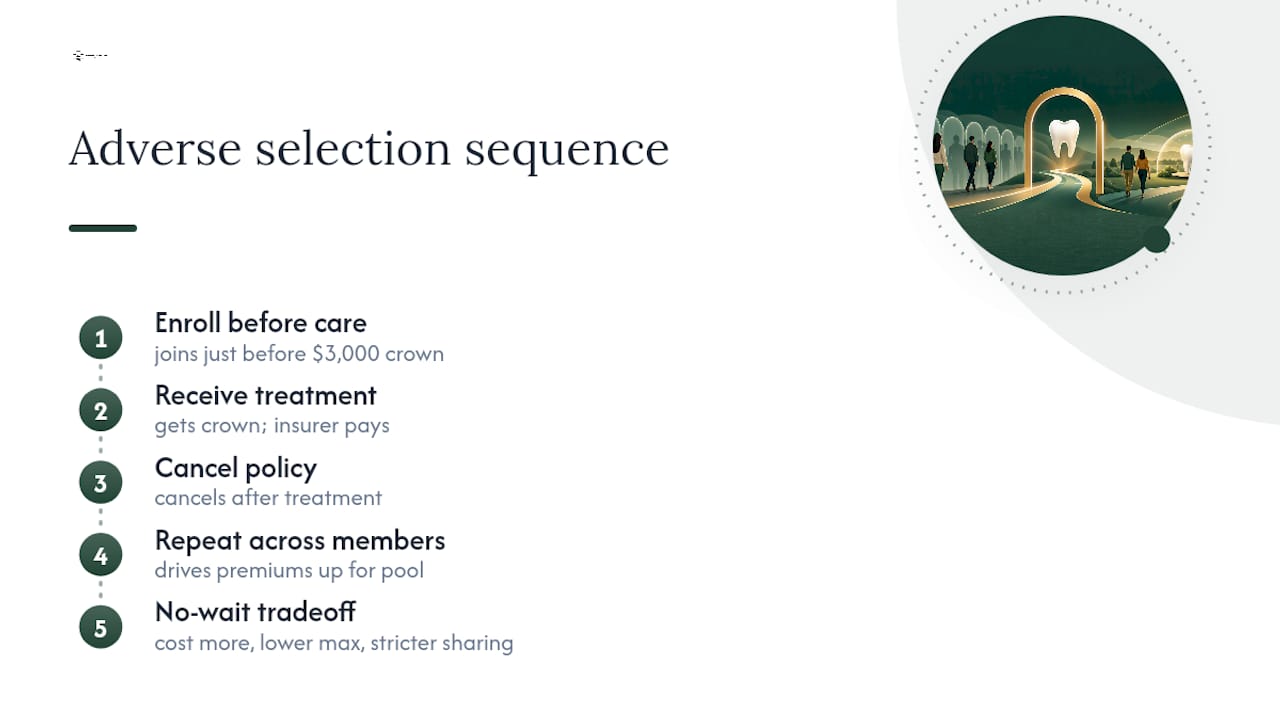
Peer-reviewed research on insurance risk pools lays out the same mechanism across health coverage broadly: without some barrier to opportunistic enrollment, insurers can’t price risk accurately, and the whole pool pays more. That’s also why “no waiting period” dental plans exist but tend to cost more, or come with lower annual maximums and stricter cost sharing. You’re paying for immediacy one way or another.
How to Get Your Waiting Period Waived or Reduced
You are not always stuck waiting out the clock. Carriers routinely waive or shorten waiting periods when you can prove you had comparable coverage right before enrolling, a concept called creditable coverage.
- Check the gap. Most carriers want no more than a 30 to 63 day break between your old plan ending and the new one starting to count prior coverage.
- Request your Certificate of Creditable Coverage from your previous carrier as soon as you know you’re switching. This document is what proves continuous coverage.
- Submit it during enrollment, not after. Waiting until a claim gets denied is the wrong time to discover you needed paperwork.
- Confirm the match. Some carriers only credit you for the same benefit category, so prior basic coverage might not offset a major services wait.
Employer-sponsored plans handle this differently than marketplace or individually purchased plans. Group coverage often waives waits automatically for employees who enroll during initial eligibility, while individual carriers almost always require documentation.
Pro Tip: Ask for your Certificate of Creditable Coverage the same day you give notice you’re leaving a plan. Carriers can take weeks to issue it, and a late document is useless if your new plan’s enrollment window has already closed.
Where to Find Waiting Period Details in Your Plan
Every plan spells out its waiting periods in writing, you just have to know where to look. The Summary of Benefits and Coverage, commonly called the SBC, lists them alongside the “Limitations and Exclusions” section of your policy documents. Delta Dental’s own plan guidance points to the SBC as the definitive source for exact wait lengths by service category, and that’s the document to pull before you enroll anywhere.
If the SBC language is vague, call customer service or your HR benefits contact and ask directly. A few questions get you a real answer fast:
- “What is the exact waiting period for major services under this plan?”
- “Does this plan credit prior coverage, and what documentation do you need?”
- “Is the wait calculated from my enrollment date or my effective date?”
That last question matters more than people realize. Some carriers start the clock on the date you sign up; others use the date your coverage actually kicks in. Ask for the answer in writing, by email, so you have a record if a claim gets disputed later.
What Can You Do for Dental Care While You Wait?
Waiting six months for a crown doesn’t mean you’re stuck paying full price or ignoring the problem. A few practical bridges exist, and the right one depends on how urgent your dental need is.
- Dental discount plans aren’t insurance. You pay an annual fee, often under $200, for a percentage discount, typically 10% to 60% off, at participating dentists, with no waiting period at all.
- DHMO plans sometimes skip waiting periods entirely since they operate on negotiated flat fees with in-network dentists, though your dentist choice is more limited.
- HSA and FSA funds can be used for qualified dental expenses under IRS rules, so if you have either account, you can pay out of pocket now and use pre-tax dollars to soften the cost.
- Emergency and palliative care is often billed and covered differently than scheduled major work, so a genuine dental emergency during your waiting period may not be subject to the same delay.
Before switching to a plan advertised as having no waiting period, run the math. Those plans commonly carry higher premiums or lower annual maximums, so a short-term discount plan paired with your existing HSA might cost less overall than jumping to pricier no-wait coverage for a single procedure.
Understanding the Wait
Waiting periods trip up more people than they should, mostly because plan documents bury the details in language nobody reads until a claim gets denied. Local insurance agents can assist residents in reviewing these documents before enrollment, not after. This includes verifying creditable coverage, comparing no-wait options against standard plans’ actual costs, and confirming the Summary of Benefits and Coverage details for specific procedures. If you’re weighing dental coverage that pairs with Medicare, that verification step matters even more.
— Jesse Zimmerman
How Mountaintop Insurance Helps You Skip the Guesswork
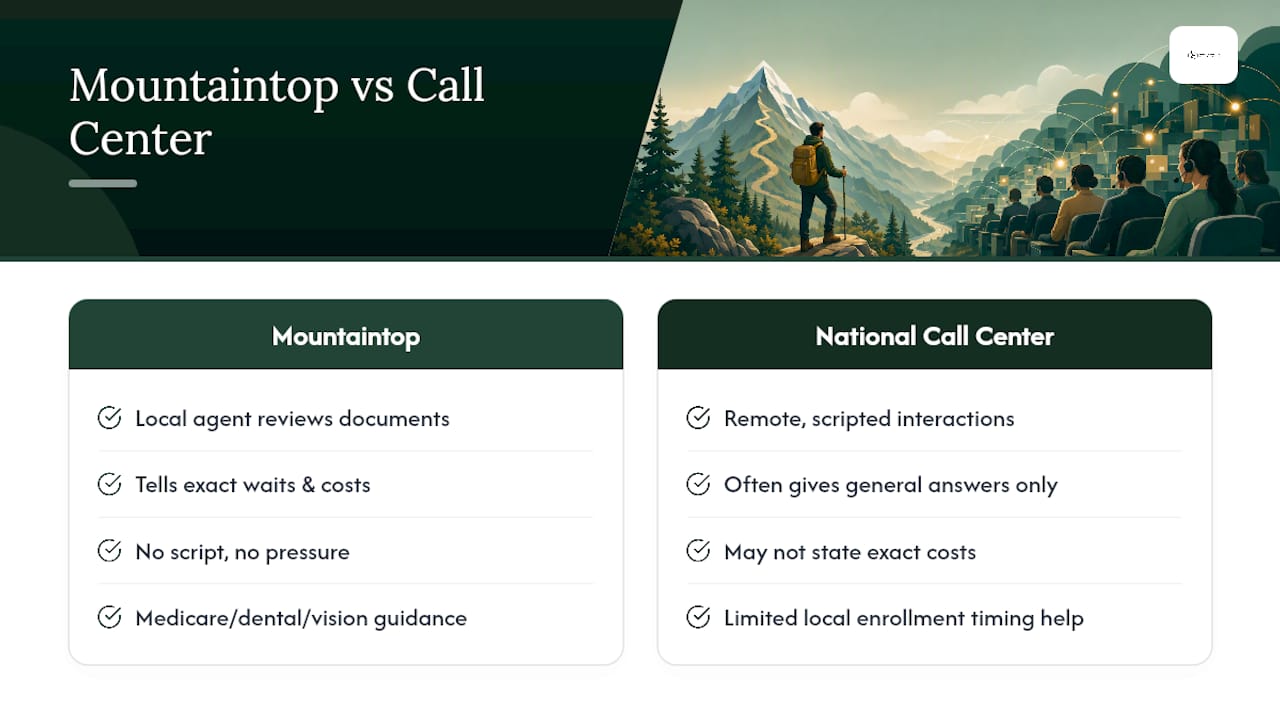
Mountaintop Insurance gives you what a national call center usually won’t: someone local who sits down with your plan documents and tells you exactly what’s waived, what’s waiting, and what it’ll cost you either way. That’s the real advantage here, no pressure, no script, just a straight answer about your coverage timeline before you sign anything.
Our free consultations cover Medicare guidance, supplemental dental and vision plan comparisons, and enrollment support timed around your effective dates so you’re not caught off guard by a six-month wait you didn’t know existed. If you’re comparing plans for implant coverage or other major restorative work, we can walk through which carriers waive waits for continuous coverage and which don’t.
Schedule a free consultation with Mountaintop Insurance and bring your current plan documents. We’ll check your creditable coverage status and tell you exactly what to expect before your next enrollment deadline.
Sources
For deeper reading, review Healthcare and your own plan’s Summary of Benefits and Coverage, the single most reliable document for confirming your exact wait.
This article is general information, not a substitute for advice from a qualified financial advisor. Consult a qualified financial professional about your own circumstances before acting on anything here.
- Peer-reviewed discussion of adverse selection (PMC)
- Dentalist — dental insurance waiting periods explained
- Humana — dental insurance waiting period overview
FAQ
Why Is There a 12 Month Waiting Period for Dental Insurance?
A 12-month wait typically applies to major services like crowns, bridges, or dentures. Insurers use it to prevent people from enrolling only to get expensive work done and then dropping the plan, a pattern known as adverse selection.
What Is the “Dentist Two Year Rule”?
There’s no universal two-year rule, but some plans apply up to a 24-month wait specifically for orthodontic treatment like braces. Always check your plan’s SBC since ranges vary by carrier and product.
What Dental Coverage Has No Waiting Period?
Preventive care, including cleanings, exams, and X-rays, almost always starts immediately on nearly every plan. Beyond that, dental discount plans and some employer group plans offer no-wait access to basic and major services, though group waivers depend on your employer’s specific plan design.
Do Dentist Appointments Have to Be Six Months Apart for Insurance?
Most plans cover two preventive cleanings per year, commonly spaced roughly six months apart, but this is a benefit frequency limit, not a waiting period rule. Check your plan’s benefit summary for your specific frequency allowance, since some plans allow visits closer together with documented need.
Can Mountaintop Insurance Help Me Check My Waiting Period Before I Enroll?
Yes. Mountaintop Insurance offers free consultations to review your plan documents, verify creditable coverage, and compare dental and vision options before you commit to a policy.
Recommended
Disclaimer: This article is for general educational purposes only and does not constitute personalized advice. Medicare rules and plan details change frequently.
Discuss Your Situation With Us