High Deductible Plan G for Seniors: 2026 Guide

TL;DR:
- High Deductible Plan G offers the same benefits as standard Plan G but only after meeting a $2,950 annual deductible in 2026. It is available to Medicare-eligible individuals who became eligible on or after January 1, 2020, with benefits kicking in once the deductible is met. Smaller monthly premiums can benefit healthy beneficiaries willing to pay up to the deductible amount during bad years.
If you became eligible for Medicare on or after January 1, 2020, you can buy High Deductible Plan G. The 2026 annual deductible is $2,950, set by CMS using the Consumer Price Index for All Urban Consumers (CPI-U) formula prescribed in the Social Security Act. Once you hit that threshold, the plan covers 100% of your remaining Medicare-approved costs for the rest of the calendar year.
At a glance:
- Who qualifies: Anyone “new to Medicare” on or after January 1, 2020 (turning 65 on/after that date, or first eligible by disability or ESRD on/after that date)
- 2026 deductible: $2,950 in Medicare-approved out-of-pocket costs
- Next step: Contact a licensed Medicare agent to compare premiums in your state
Table of Contents
- What is High Deductible Plan G and how does it differ from standard Plan G?
- Who can buy High Deductible Plan G?
- How does the $2,950 deductible actually work?
- Is High Deductible Plan G worth it? Financial trade-offs explained
- When and how do you enroll in High Deductible Plan G?
- What to ask an agent before you decide
- Common misconceptions about High Deductible Plan G
- Key Takeaways
- A local perspective on advising Central Oregon seniors
- Mountaintop Insurance helps you compare your options at no cost
- Useful sources and further reading
- FAQ
What is High Deductible Plan G and how does it differ from standard Plan G?
High Deductible Plan G provides identical benefits to standard Plan G, but only after you’ve paid the annual Medicare-approved deductible amount in out-of-pocket costs. Before that threshold, you cover coinsurance, copayments, and deductibles yourself. After it, the supplement picks up 100% of covered costs through December 31.
Understanding how Medicare parts interact with Medigap helps here. Original Medicare pays its share first. Whatever Medicare-approved cost remains falls to you until you reach the deductible. Then the supplement steps in.
| Feature | Standard Plan G | High Deductible Plan G |
|---|---|---|
| Monthly premium | Higher | Lower |
| Annual Medigap deductible | None | $2,950 in 2026 |
| Part A coinsurance | Covered | Covered after deductible |
| Part B coinsurance | Covered | Covered after deductible |
| Part B deductible | Not covered | Counts toward HD deductible |
| Foreign travel emergency | Covered (coinsurance) | Separate deductible applies |
| Benefits once deductible met | Immediate | Same as standard Plan G |
One detail many people miss: Plan G does not cover the Part B deductible under either version. With the high-deductible option, though, that Part B deductible amount does count toward your deductible threshold.
Who can buy High Deductible Plan G?
The eligibility rule is straightforward: you must be “new to Medicare” on or after January 1, 2020. CMS defines this under the Social Security Act, and it applies to three groups:
- Seniors turning 65 on or after January 1, 2020
- People first eligible for Medicare due to disability on or after January 1, 2020
- People first eligible due to end-stage renal disease (ESRD) on or after January 1, 2020
If you became eligible before that date, High Deductible Plan G is not available to you. That cutoff also explains why High Deductible Plan F still exists for older beneficiaries while Plan G’s high-deductible version is reserved for newer enrollees.
State availability adds another layer. Not every insurer offers the high-deductible option in every state, and some states have additional protections or open enrollment windows. Oregon, for example, has a birthday rule that gives you a limited annual window to switch Medigap plans without medical underwriting. Check your state’s rules before assuming any plan is available to you.
How does the $2,950 deductible actually work?
The high-deductible amount covers Medicare-approved out-of-pocket costs only. Premiums do not count. Neither does the foreign travel emergency deductible, which sits separately.
the official annual deductible for High Deductible Plan G, per CMS’s announcement. CMS recalculates this figure each year using August CPI-U data from the Bureau of Labor Statistics, following the method in section 1882(p)(11)©(i) of the Social Security Act.
Here’s the payment sequence in plain terms:
- You receive Medicare-covered care
What counts toward the $2,950: Part A hospital deductible, Part A coinsurance, Part B coinsurance, Part B copayments, and the Part B deductible. What does not count: your monthly premiums, any non-Medicare-approved charges, and the foreign travel emergency deductible.
| Year | HD Plan G Deductible | Adjustment Basis |
|---|---|---|
| Latest year | $2,950 | CPI-U (BLS August data) |
Is High Deductible Plan G worth it? Financial trade-offs explained
HD Plan G reduces your monthly premium but raises your annual out-of-pocket ceiling. For generally healthy beneficiaries who can absorb $2,950 if a bad year hits, the math often favors the high-deductible version. For frequent users of healthcare, standard Plan G usually wins.
Three scenarios illustrate the range:
- Low-use beneficiary: — You see your primary care doctor a few times a year, no hospitalizations. Your Medicare cost-sharing stays well under $2,950. The premium savings you pocket each month add up to real money by December.
Sample calculation (directional only): If HD Plan G premiums run $60/month less than standard Plan G in your state, you save $720/year. Your worst-case additional exposure is $2,950. The break-even point is roughly four years of good health covering that premium gap. Your actual numbers will differ by state and insurer.
Pro Tip: Before choosing, check whether you have liquid savings or a Health Savings Account (HSA) to cover the deductible in a bad year. HD Plan G works best when you have a financial cushion ready, not just a hope that you’ll stay healthy.
Premium figures vary by insurer and state. Treat any example as directional, not a quote.
When and how do you enroll in High Deductible Plan G?
Timing matters more with Medigap than most people expect. Your best window is the six-month Medigap Open Enrollment Period that starts the month you’re both 65 and enrolled in Medicare Part B. During this window, insurers cannot use medical underwriting to deny you or charge more based on health history.
Outside that window, guaranteed-issue rights apply in specific situations: losing employer coverage, moving out of a plan’s service area, or your current plan leaving the market. Outside of those triggers, insurers in most states can ask health questions and decline your application.
Key enrollment windows are easy to miss when you’re managing multiple Medicare deadlines at once. Oregon’s birthday rule gives you an additional annual window each year around your birthday to switch plans without underwriting, which is a meaningful protection if your health changes later.
Steps to buy:
- Confirm you have Medicare Parts A and B active
- Complete the application with enrollment assistance if needed.
What to ask an agent before you decide
Bring your Medicare card, a current medications list, and a recent claims summary if you have one. Those three items let an agent give you an accurate picture fast.
Specific questions worth asking:
- What is the monthly premium difference between standard Plan G and High Deductible Plan G in my zip code?
- Does either version cover the Part B deductible? (Neither does, but confirm it.)
- What is my worst-case annual out-of-pocket under each option?
- Will I need to answer health questions, or do I qualify for guaranteed-issue rights?
- Are there state-specific enrollment windows I should know about, including Oregon’s birthday rule?
Pro Tip: Ask your agent to run a 12-month best-case and worst-case cost comparison using your expected care patterns. A good agent models both scenarios side by side so you can see the actual dollar difference, not just the premium.
A comparison checklist can help you stay organized across multiple quotes.
Common misconceptions about High Deductible Plan G
The biggest one: people assume the deductible works like a monthly cap. It does not. The $2,950 is an annual cumulative threshold, not a monthly limit. You could hit it in February after a hospital stay, or never hit it in a healthy year.
A few other corrections worth knowing:
- “Premiums are federally set.” — They are not. CMS standardizes the benefits, but each insurer sets its own premiums. Rates vary significantly by state, age, and carrier.
Medicare.gov’s plan comparison tool is the authoritative source for confirming standardized benefits across all Medigap plans.
Key Takeaways
High Deductible Plan G is a strong fit for healthy seniors new to Medicare who can absorb $2,950 in a bad year and want to reduce monthly costs.
| Point | Details |
|---|---|
| Eligibility requirement | You must be new to Medicare on or after January 1, 2020. |
| 2026 deductible | $2,950 in Medicare-approved out-of-pocket costs before the plan pays. |
| What counts toward deductible | Part A and B cost-sharing counts; premiums and foreign travel emergency deductible do not. |
| Best-fit scenario | Generally healthy beneficiaries with liquid savings to cover the deductible if needed. |
| Mountaintop Insurance | Offers no-cost consultations in Central Oregon to compare HD Plan G against standard Plan G side by side. |
A local perspective on advising Central Oregon seniors
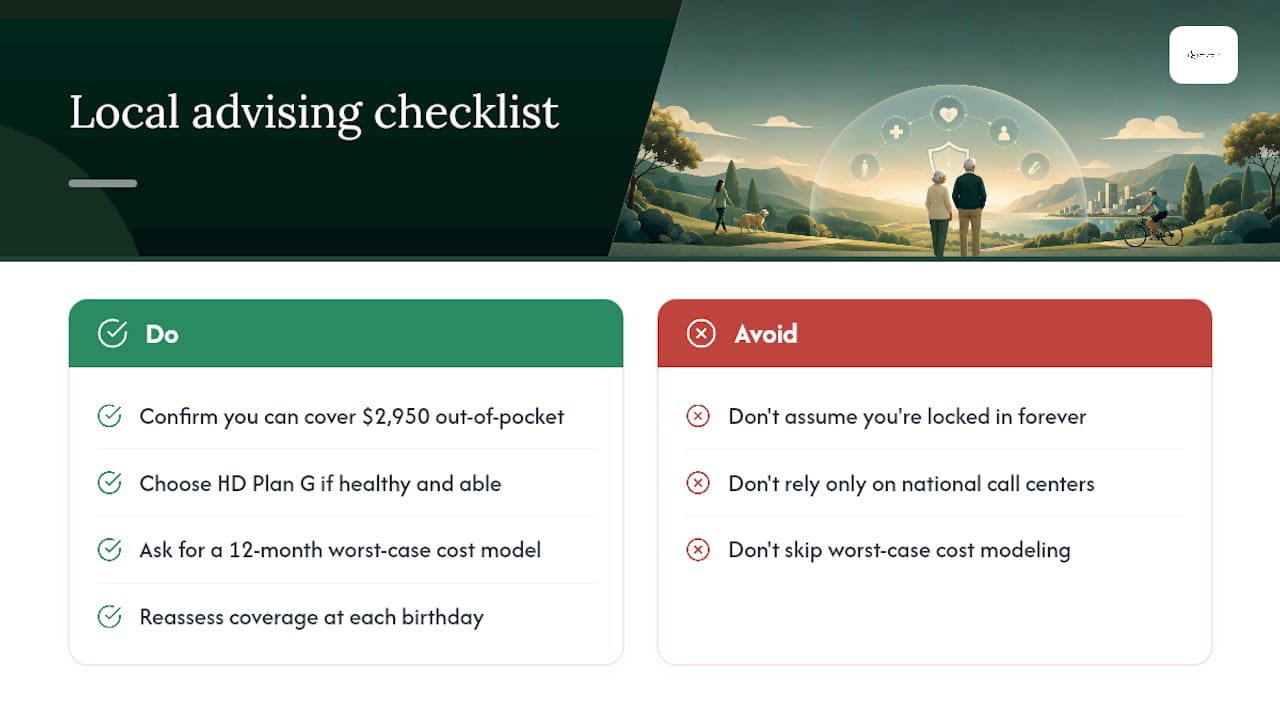
For most of the seniors I work with in Central Oregon, the HD Plan G conversation comes down to one question: can you comfortably cover $2,950 out of pocket if a bad year hits? If the answer is yes, and you’re in reasonably good health, the premium savings are real and worth taking seriously.
Oregon’s birthday rule changes the calculus a bit. Because you get an annual window to switch plans without underwriting, locking into standard Plan G now doesn’t mean you’re stuck forever. Some clients start with HD Plan G while they’re healthy, then reassess each birthday. That flexibility is genuinely useful, and it’s something national call centers rarely explain clearly.
What I model for every client is a 12-month scenario: premiums plus expected Medicare cost-sharing under each option, with a worst-case column. Most people find that seeing the actual dollar difference in a table makes the decision obvious. The free consultation at Mountaintop Insurance is exactly that exercise, done with your real numbers.
Mountaintop Insurance helps you compare your options at no cost
For seniors in Central Oregon weighing HD Plan G against standard Plan G, Mountaintop Insurance offers something the online calculators can’t: a licensed local agent who knows Oregon’s rules, runs your actual numbers, and answers questions without a sales script.
A free consultation covers your Medicare Parts A and B status, available plans in your zip code, a side-by-side premium and deductible comparison, and Oregon-specific enrollment windows including the birthday rule. No pressure, no obligation. You leave with a clear picture of what each option costs you in the best and worst case.
Schedule your no-cost consultation at Mountaintop Insurance’s Medicare services page or visit mountaintopins.com to get started.
Useful sources and further reading
- F, G & J Deductible Announcements | CMS
- Compare Medigap Plan Benefits | Medicare
- High-Deductible Medigap Plan G: 2026 Costs & Coverage - MedicareGuide.com
- Mountaintop Insurance Solutions
FAQ
Who qualifies for High Deductible Plan G?
You qualify if you became eligible for Medicare on or after January 1, 2020, either by turning 65 or by qualifying through disability or ESRD on or after that date.
What is the High Deductible Plan G deductible for 2026?
The 2026 deductible is $2,950 in Medicare-approved out-of-pocket costs, set by CMS using the CPI-U formula under the Social Security Act.
Does the Part B deductible count toward the HD Plan G deductible?
Yes. The Part B annual deductible counts toward your $2,950 threshold, even though Plan G does not cover it directly.
Is High Deductible Plan G available in Oregon?
High Deductible Plan G is generally available in Oregon for eligible beneficiaries, and Oregon’s birthday rule gives enrollees an annual window to switch Medigap plans without medical underwriting. Availability by insurer varies, so confirm with a licensed agent.
When does High Deductible Plan G start paying?
Once your cumulative Medicare-approved out-of-pocket costs reach $2,950 in a calendar year, the plan covers 100% of Medicare-approved costs for the rest of that year.
Recommended
Disclaimer: This article is for general educational purposes only and does not constitute personalized advice. Medicare rules and plan details change frequently.
Discuss Your Situation With Us