Medicare and COBRA: What People Turning 65 Need to Know

TL;DR:
- Medicare is usually the primary payer when combined with COBRA coverage, influencing your enrollment decisions. Enrolling in Medicare Part A and B during your seven-month initial period prevents penalties and ensures coverage, as COBRA alone does not qualify for delaying Medicare. Coordination typically has Medicare paying first, with COBRA acting as secondary, but exceptions like ESRD require careful timing and understanding of plan specifics.
Medicare is generally the primary payer when you have both Medicare and COBRA coverage. That single rule drives every decision you need to make. Enroll in Medicare Part A and Part B during your Initial Enrollment Period (IEP) to avoid lifetime penalties and uncovered claims.
Three immediate actions to take:
- Enroll in Medicare Part A and Part B during your 7-month IEP (the three months before your 65th birthday, your birthday month, and three months after). Do not wait for COBRA to expire.
- Contact your COBRA plan administrator and ask specifically how the plan coordinates with Medicare, and whether it treats Medicare as if you had enrolled even if you haven’t.
- Call the Social Security Administration (SSA) at 1-800-772-1213 to start your Medicare enrollment, and reach your State Health Insurance Assistance Program (SHIP) for free, unbiased counseling.
Table of Contents
- How do Medicare and COBRA coordinate when you have both?
- What happens in common Medicare and COBRA scenarios?
- When do enrollment windows open and close?
- What will Medicare and COBRA actually cost you?
- Common mistakes to avoid and a practical checklist
- How a local Medicare agent can help you sort this out
- Who should you call, and in what order?
- A timeline of the COBRA and Medicare coordination period
- How to handle coverage gaps and overlapping periods
- Does COBRA affect Medicare Advantage or Medigap plans?
- How COBRA continuation affects Medicaid eligibility
- Key Takeaways
- The timing mistake that costs people the most
- Free Medicare consultation for Central Oregon residents
- Useful sources
- FAQ
How do Medicare and COBRA coordinate when you have both?
When you carry both coverages, Medicare pays first on most claims. COBRA then acts as a secondary payer, potentially covering some of the remaining costs, such as coinsurance or deductibles, depending on what your specific plan’s Summary Plan Description (SPD) allows.
“Primary payer” simply means that insurer processes the claim first and pays its share. The secondary payer gets the bill next and may cover some or all of what’s left. In practice, if Medicare approves a $1,000 outpatient procedure and pays 80% after your deductible, your COBRA plan may cover some portion of the remaining $200, but only if the plan’s SPD permits it.
Key rule from CMS: For most beneficiaries, Medicare pays primary to COBRA. The major exception is End-Stage Renal Disease (ESRD): if you qualify for Medicare due to ESRD, COBRA can be primary for up to 30 months before Medicare takes over. Outside of ESRD, assume Medicare leads.
One critical nuance: COBRA is not considered active employer coverage for the purpose of delaying Part B enrollment. Only coverage through a current employer (yours or a spouse’s) qualifies you to delay Part B without penalty. COBRA does not.
For Part D, the coordination follows the same logic. Medicare Part D generally pays before COBRA for people 65 and older. If your COBRA plan includes creditable drug coverage, you may qualify for a Special Enrollment Period (SEP) to join Part D when COBRA ends, avoiding the late-enrollment penalty.
What happens in common Medicare and COBRA scenarios?
Scenario A: You have COBRA first, then turn 65
You lose your job at 63, elect COBRA, and turn 65 two years later. At 65, you become Medicare-eligible. Medicare does not automatically enroll you in Part B (though Part A enrollment may be automatic if you’re already receiving Social Security). You must actively enroll in Part B during your IEP. Once enrolled, Medicare becomes primary and COBRA becomes secondary. If you miss your IEP and don’t enroll in Part B, your COBRA plan may pay only a small portion of your costs, leaving you with large out-of-pocket balances.

Scenario B: You have Medicare first, then lose your job
You retire at 65 with Medicare already active, then your former employer offers COBRA. You can elect COBRA, but Medicare remains primary. COBRA adds secondary coverage, which can reduce your cost-sharing. Whether it’s worth the premium depends on your health needs and what the plan covers beyond Medicare’s gaps.
Dependent and spouse differences
Dependents’ COBRA rights are independent of the employee’s Medicare status. A spouse or dependent child may qualify for up to 36 months of COBRA in certain qualifying events (such as the employee becoming Medicare-eligible), even when the employee’s own COBRA eligibility is shorter.
| Situation | Who pays first | Who pays second | Key risk |
|---|---|---|---|
| Medicare-eligible, enrolled in both | Medicare | COBRA (if SPD allows) | Minimal, if enrolled on time |
| Medicare-eligible, enrolled in COBRA only | Medicare (treated as if enrolled) | COBRA pays remainder, possibly nothing | Large unpaid balances |
| ESRD, within 30-month coordination period | COBRA | Medicare | Missing the 30-month switchover |
| Dependent on COBRA, employee on Medicare | Medicare (for employee) | COBRA (for dependent) | Dependent may keep COBRA up to 36 months |
Pro Tip: Ask your COBRA administrator directly: “Does your plan’s SPD treat Medicare as if I had enrolled, even if I haven’t?” Some plans do, which means COBRA may deny claims for the portion Medicare would have covered, even when you’re not actually enrolled in Medicare.
When do enrollment windows open and close?
The Initial Enrollment Period
Your IEP is a 7-month window: it starts three months before the month you turn 65, includes your birthday month, and runs three months after. Missing this window without qualifying coverage in place triggers a permanent Part B late-enrollment penalty: your premium increases 10% for each full 12-month period you were eligible but didn’t enroll.
The Special Enrollment Period
If you had active employer coverage (through a current job, not COBRA) when you turned 65, you qualify for an 8-month SEP to enroll in Part B after that coverage ends. COBRA does not trigger this SEP. The 8-month SEP begins when active employer coverage ends, not when COBRA ends. Electing COBRA after losing employer coverage does not restart or extend that window.
Key enrollment sequence to understand:
- Month 0: Active employer coverage ends. Your 8-month SEP begins immediately.
- Month 1–2: You elect COBRA within the 60-day election window. The SEP clock keeps running.
- Month 3–7: Enroll in Part B using the SEP before it closes. Do not wait for COBRA to expire.
- Month 8: SEP closes. Any Part B enrollment after this point triggers a late penalty.
For Part D: if your COBRA plan includes creditable drug coverage, you can delay Part D enrollment without penalty. When COBRA ends, you get a 63-day SEP to join a Part D plan.
Pro Tip: Use the key enrollment windows guide from Mountaintop Insurance to map your specific IEP and SEP dates before you call SSA.
What will Medicare and COBRA actually cost you?
Medicare Part A is premium-free for most people who worked at least 40 quarters. Part B carries a standard monthly premium (set annually by CMS). COBRA premiums are a different story: you pay the full premium, including the portion your employer used to cover, plus an administrative fee of up to 2%. For many people, that’s a significant jump from what they paid as an active employee.
Here’s how a typical outpatient claim flows when Medicare is primary and COBRA is secondary:
| Cost component | Who pays | Notes |
|---|---|---|
| Medicare Part B deductible | You (until met) | Annual deductible set by CMS each year |
| 80% of approved amount | Medicare Part B | After deductible is met |
| Remaining coinsurance | COBRA (if SPD allows) | Plan may cover all, part, or none |
| Non-covered services | You | Neither plan covers services Medicare excludes |
| COBRA monthly premium | You | Full employer + employee premium plus up to 2% admin fee |
The financial risk of skipping Part B is real. If you’re Medicare-eligible but only enrolled in COBRA, your COBRA plan may treat Medicare as primary regardless, paying only what Medicare would not have covered. Since you’re not actually enrolled in Medicare, no one pays the primary share. You absorb it.
Common mistakes to avoid and a practical checklist
Documents to gather first
- COBRA election notice (shows your election deadline and premium amounts)
- Employer plan SPD (explains coordination-of-benefits rules)
- Medicare eligibility date (from SSA or your Social Security statement)
- SSA contact information and your local SHIP office number
Actions to take
- Call SSA to enroll in Medicare Part A and Part B during your IEP.
- Ask your COBRA administrator whether the plan’s SPD treats Medicare as if you had enrolled.
- Confirm whether your COBRA drug coverage is creditable for Part D purposes.
- Request written confirmation of your COBRA premium amounts and payment deadlines.
- Contact your SHIP counselor to review Medigap guaranteed-issue rights in your state.
Pitfalls that cause real problems
- Assuming COBRA equals active coverage. It does not. COBRA is not active employer coverage for Part B delay purposes.
- Missing the 7-month IEP. The penalty is permanent: your Part B premium increases by a lasting percentage for every year you delayed enrollment without qualifying coverage.
- Confusing COBRA election deadlines with premium payment deadlines. You have 60 days to elect COBRA, but premiums are due retroactively. Missing a payment terminates coverage.
- Waiting for COBRA to expire before enrolling in Part B. By then, your SEP may already be closed.
How a local Medicare agent can help you sort this out
The coordination rules between COBRA and Medicare are genuinely complex. A licensed local agent can map your specific IEP and SEP dates, review your employer’s SPD for coordination language, and flag whether your COBRA drug coverage qualifies as creditable for Part D.
Mountaintop Insurance offers free consultations for Central Oregon residents, covering:
- IEP and SEP timing specific to your situation
- SPD review to identify how your COBRA plan coordinates with Medicare
- Medigap guaranteed-issue rights, including Oregon’s Birthday Rule
- Part D creditable coverage status and enrollment options
- Enrollment support for Parts A, B, C, and D
Pro Tip: Bring your COBRA election notice, your employer’s SPD, and any recent Explanation of Benefits (EOB) statements to your consultation. That paperwork lets an agent give you concrete answers instead of general guidance.
Who should you call, and in what order?
Most people need to contact three places, in roughly this sequence:
- Social Security Administration (SSA): — Call 1-800-772-1213 or visit SSA.gov to enroll in Medicare Parts A and B. Do this first, during your IEP.
For disputes about COBRA coverage or questions about public-employer plans, contact the Department of Labor’s Employee Benefits Security Administration (EBSA) at 1-866-444-3272 or dol.gov/agencies/ebsa.
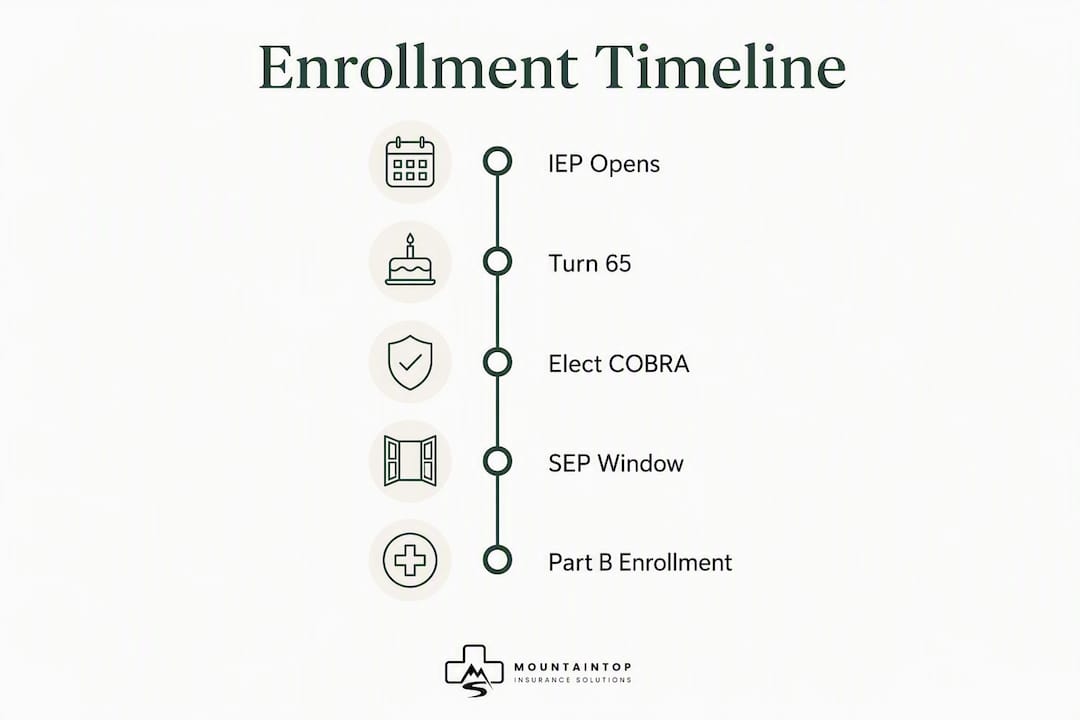
A timeline of the COBRA and Medicare coordination period
Understanding the sequence of events prevents most enrollment mistakes. Here’s how the coordination period typically unfolds:
Before age 65: You’re on active employer coverage. No Medicare enrollment required yet.
3 months before your 65th birthday: Your IEP opens. You can enroll in Medicare Parts A and B now, even if you plan to keep COBRA temporarily.
Your 65th birthday month: IEP continues. If you haven’t enrolled yet, do it now. Part B coverage can be backdated to the first of your birthday month if you enroll in the first three months of your IEP.
Within 60 days of losing employer coverage: Your COBRA election window opens. Electing COBRA simultaneously starts your 8-month SEP for Part B if you had active employer coverage before.
Month 1–8 after employer coverage ends: Your SEP is open. Enroll in Part B within this window. COBRA continues running in parallel. COBRA coverage lasts for limited durations depending on qualifying events. When COBRA ends, if your drug coverage is creditable, you get a SEP to join a Part D plan without penalty.
How to handle coverage gaps and overlapping periods
Gaps happen when someone loses employer coverage, delays Medicare enrollment assuming COBRA will cover everything, and then finds that COBRA pays little or nothing because Medicare is treated as primary. The fix is straightforward: enroll in Medicare during your IEP, then let COBRA serve as secondary coverage for the overlap period.
Overlapping coverage, by contrast, is usually beneficial. If you’re enrolled in both Medicare and COBRA simultaneously, Medicare handles the primary claim and COBRA may reduce your out-of-pocket costs. The overlap period typically lasts until COBRA expires or you choose to drop it.
To minimize costs during any transition:
- Enroll in Medicare Part A immediately (it’s usually premium-free and there’s no reason to delay)
Does COBRA affect Medicare Advantage or Medigap plans?
If you want to enroll in a Medicare Advantage (Part C) plan, you generally cannot use COBRA as a substitute for Medicare. Medicare Advantage requires enrollment in both Parts A and B first. COBRA does not satisfy that requirement.
For Medigap (Medicare Supplement) plans, timing matters considerably. Guaranteed-issue rights, which let you buy a Medigap plan without medical underwriting, apply during specific windows, most notably the 6-month open enrollment period that starts when you’re both 65 and enrolled in Part B. In Oregon, the Birthday Rule gives you an additional annual window to switch Medigap plans. When COBRA ends, that event may trigger a guaranteed-issue right in some states, but not all. Confirm your state’s rules with a SHIP counselor or a local agent before COBRA lapses.
How COBRA continuation affects Medicaid eligibility
COBRA coverage counts as health insurance for most purposes, which can affect Medicaid eligibility. If you’re enrolled in COBRA, your household’s coverage status may reduce or eliminate Medicaid eligibility, depending on your state’s income and asset rules.
When you transition from COBRA to Medicare, Medicaid can serve as a secondary payer for people who qualify for both programs (called “dual eligibles”). Medicare pays primary, Medicaid may cover remaining cost-sharing. If you think you might qualify for Medicaid or a Medicare Savings Program (which helps pay Part B premiums and cost-sharing), contact your state Medicaid office or SHIP counselor before dropping COBRA. The income thresholds and asset rules vary by state.
Key Takeaways
Medicare is generally the primary payer when you have both Medicare and COBRA, and enrolling in Part B during your 7-month IEP is the single most important action to prevent lifetime penalties.
| Point | Details |
|---|---|
| Medicare pays first | For most people, Medicare is primary to COBRA; COBRA may cover remaining cost-sharing if the plan allows. |
| COBRA is not active coverage | COBRA does not qualify you to delay Part B enrollment; missing your IEP triggers a permanent 10% penalty per year delayed. |
| IEP and SEP windows are fixed | Your IEP is 7 months around your 65th birthday; the Part B SEP is 8 months after active employer coverage ends, not when COBRA ends. |
| Ask about your plan’s SPD | Some COBRA plans treat Medicare as if you had enrolled, meaning they may deny claims even when you’re not actually on Medicare. |
| Mountaintop Insurance | Offers free consultations in Central Oregon to review your IEP/SEP timing, SPD coordination rules, and Medigap options. |
The timing mistake that costs people the most
The conventional wisdom around COBRA is that it buys you time. And it does, but only for the right things. People assume COBRA buys them time before Medicare. It doesn’t. What COBRA actually buys you is continued access to the same network and drug formulary you had as an employee, which can be genuinely useful during a transition. The mistake is treating that network continuity as a reason to skip Part B enrollment.
The permanent Part B late-enrollment penalty is a lasting financial penalty. Delaying enrollment without qualifying coverage increases your Part B premium permanently, compounding the longer you wait. No COBRA plan is worth the trade.
What most articles miss is the SPD trap. Even if you intend to enroll in Medicare, there’s a window between losing employer coverage and your Medicare effective date where your COBRA plan may already be treating Medicare as primary. If a claim lands in that window and you’re not yet enrolled in Part B, neither payer covers the primary share. That’s not a gap you can fix retroactively.
The practical answer is to overlap intentionally: enroll in Medicare as soon as your IEP opens, keep COBRA as secondary if the cost makes sense for your situation, and confirm in writing how your COBRA plan coordinates. That sequence eliminates most of the risk.
Free Medicare consultation for Central Oregon residents
Sorting out the coordination between COBRA and Medicare on your own means reading plan documents written by lawyers, calling federal agencies with long hold times, and hoping you don’t miss a deadline that costs you money permanently. Mountaintop Insurance gives Central Oregon residents a faster path: a free, no-pressure consultation that covers exactly what you need before you make any enrollment decisions.
A consultation with Mountaintop Insurance includes a review of your IEP and SEP timing, a plain-language read of your COBRA plan’s coordination rules, guidance on Medigap guaranteed-issue rights (including Oregon’s Birthday Rule), and Part D creditable coverage confirmation. Bring your COBRA election notice, your employer’s SPD, and any recent EOBs, and you’ll leave with a clear, personalized action plan.
Book a free consultation through the Medicare services page or visit mountaintopins.com to find contact and scheduling options.
Useful sources
Official government and nonprofit resources on COBRA and Medicare coordination:
- COBRA Coverage | Medicare.gov — Medicare’s own guidance on how COBRA interacts with enrollment periods and payer order.
- Coordination of Benefits Workbook | CMS — The CMS training workbook covering primary/secondary payer rules, ESRD exceptions, and Part D coordination.
- A Worker’s Guide to Health Benefits Under COBRA | DOL/EBSA — The Department of Labor’s plain-language guide to COBRA rights, premiums, and coordination rules.
For personalized help, contact your state SHIP (find it at medicare.gov/find-resources) or call SSA at 1-800-772-1213.
FAQ
Can you be on COBRA if you already have Medicare?
Yes. You can elect COBRA even after enrolling in Medicare, but Medicare will be primary and COBRA will act as secondary coverage, often providing limited additional benefit depending on your plan’s SPD.
Is Medicare always primary to COBRA?
For most beneficiaries, yes. The exception is End-Stage Renal Disease (ESRD): COBRA can be primary for up to 30 months during the Medicare ESRD coordination period before Medicare takes over.
Can I take COBRA if I’m over 65?
Yes, COBRA eligibility is not age-restricted. However, if you’re 65 or older and Medicare-eligible, enrolling in COBRA without also enrolling in Medicare Part B puts you at serious financial risk, since COBRA may treat Medicare as primary and deny the portion Medicare would have covered.
Will COBRA pay while Medicare Part B is processing?
Yes. COBRA coverage continues while Part B is being processed, and adding Part B while on COBRA does not affect COBRA coverage for any other qualified beneficiaries on the plan.
What documents should I bring to a Medicare consultation?
Bring your COBRA election notice, your employer’s Summary Plan Description (SPD), and recent Explanation of Benefits (EOB) statements. Mountaintop Insurance’s free consultations use these documents to give you specific, actionable guidance on enrollment timing and coordination rules.
Recommended
Disclaimer: This article is for general educational purposes only and does not constitute personalized advice. Medicare rules and plan details change frequently.
Discuss Your Situation With Us