Medicare Assignment: 5 Min Check to Avoid Surprise Bills in Central OR

Accepting Medicare assignment means a provider agrees to accept the Medicare-approved amount as full payment for covered Part A and Part B services. Before you book an appointment, confirm the provider still accepts assignment. Offices change billing status, and one phone call saves you a surprise invoice later.
TL;DR:
- Providers who accept Medicare assignment are legally bound to bill only the Medicare-approved amount, preventing them from charging extra fees or billing the difference.
- Participating providers consistently accept assignment, while non-participating ones can skip it and charge up to 15% more through limiting charges.
- Confirm a provider’s assignment status via Medicare.gov, calling the office directly, and asking specific questions to avoid unexpected bills.
- Non-assigned claims can result in higher out-of-pocket costs due to additional limiting charges, which some Medigap policies may cover, depending on the plan.
- Always verify assignment for each provider visit because billing status can change, and offices may differ in their billing practices.
Table of Contents
- What Does Accepting Medicare Assignment Actually Mean?
- Participating vs. Non-Participating vs. Opt-Out: What’s the Real Difference?
- How Assignment Changes What Comes Out of Your Pocket
- How to Find and Verify a Provider Who Accepts Assignment
- What to Do When a Provider Won’t Accept Assignment
- State Protections, Opt-Out Rules, and Other Fine Print
- How Mountaintop Insurance Helps You Sort Through Provider Status
- What Most Guides Get Wrong About Assignment
- Get Help Making Sense of Your Medicare Costs
- Sources
- FAQ
What Does Accepting Medicare Assignment Actually Mean?
When a provider accepts Medicare assignment, they’re agreeing to treat the Medicare-approved amount as full payment for that service, not a starting point for negotiation. The provider bills Medicare directly instead of asking you to pay upfront and chase reimbursement yourself.
Here’s how the money actually moves once a provider signs on:
- The provider submits the claim to Medicare on your behalf.
- Medicare pays its share directly to the provider, typically 80% of the approved amount.
- You owe the remainder: your deductible (if unmet) plus the 20% coinsurance.
- The provider cannot charge you a claim-filing fee.
- The provider cannot bill you for the difference between their normal rate and the Medicare-approved amount.
That last point is the one people miss. A provider who accepts assignment is legally bound to that approved figure. They can’t quietly add a “facility fee” or bill you the gap between what they’d normally charge and what Medicare paid. If they do, that’s a billing violation you can report to Medicare directly.
Participating vs. Non-Participating vs. Opt-Out: What’s the Real Difference?
Not every provider who takes Medicare patients handles billing the same way, and the label on the door matters more than most people realize.
- Participating providers sign an agreement to accept assignment on every Medicare claim, every time. They cannot charge above the Medicare-allowed amount except for your deductible and coinsurance. This is the most predictable, lowest-cost arrangement for you.
- Non-participating providers decide claim by claim. They can accept assignment on one visit and skip it on the next. When they skip it, they’re allowed to charge a “limiting charge” of up to a legally capped amount above the Medicare-approved amount, on top of your usual coinsurance.
- Opt-out providers step outside the Medicare payment system entirely. You sign a private contract, and Medicare generally won’t pay anything toward that care except in emergencies.
Here’s what that looks like in dollars with an example. Say the Medicare-approved amount for a service is about $200. With a non-assigned claim from a non-participating provider charging the maximum limiting charge, the billable amount and your share can be noticeably higher. Same service, different bottom line.
How Assignment Changes What Comes Out of Your Pocket
The billing category attached to your visit determines your bill more than almost anything else about the care itself.
On an assigned claim, Medicare covers roughly 80% of the approved amount once you’ve met your Part B deductible, and you cover the remaining 20% coinsurance. That’s the whole math. No hidden layer, no markup.
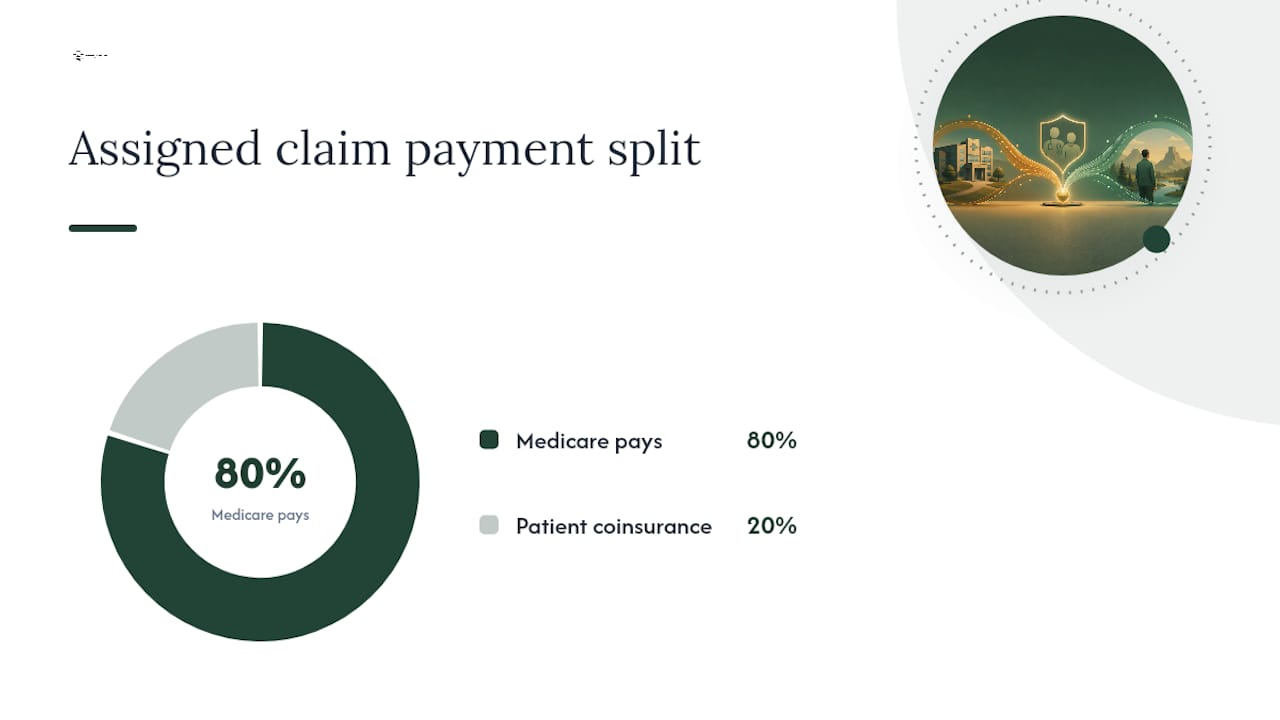
Non-assigned claims work differently. You’re still on the hook for the 20% coinsurance, but a non-participating provider can tack on the limiting charge, up to 15% above the approved amount. Stack those together and your share of the bill can run noticeably higher than an assigned claim for the identical service.
Statistic Callout: AARP notes that Medigap policies may cover these excess charges, but not all of them do. Plan G, still sold to new enrollees, covers the Part B excess charge in full. Plan F, which covered the same gap, is no longer available to people who became eligible for Medicare on or after January 1, 2020. If you already had Plan F before that date, you can keep it.
- Confirm with your Medigap carrier whether “Part B excess charges” appear on your benefits chart.
- Some states cap or ban excess charges outright, which can matter more than your Medigap plan does.
If you want a deeper breakdown of how these charges stack, Mountaintop Insurance’s guide to excess charges walks through the numbers by plan letter.
How to Find and Verify a Provider Who Accepts Assignment
Confirming assignment status takes about five minutes, but skipping this step is how people end up with bills they didn’t expect.
- Start with Medicare.gov’s Care Compare tool and search by location and specialty. Look for the label indicating the provider “charges the Medicare-approved amount,” which signals they accept assignment.
- Call the office directly and ask this exact question: “Do you accept Medicare assignment for Part B services, and are you currently accepting new Medicare patients?” Two questions, one call, no ambiguity.
- If the front desk seems unsure or gives a vague answer, call 1-800-MEDICARE for confirmation before you schedule anything.
The pitfall almost everyone hits: Care Compare tells you about billing status, not appointment availability. A provider might accept assignment and still have a closed patient panel. The listing won’t tell you that.
Pro Tip: Ask the billing question before the scheduling question. If the receptionist has to transfer you to billing to answer it, that’s a sign worth noting, and worth writing down who you spoke with and when.
What to Do When a Provider Won’t Accept Assignment
You have more leverage here than most patients assume. Start by asking the office if they’ll accept assignment for this specific visit, even if it’s not their standard policy. Some non-participating providers say yes when asked directly.
If you end up paying out of pocket, get an itemized bill before you leave and submit a claim to Medicare yourself for reimbursement. Keep copies of everything; the process has deadlines and specific forms, and reimbursement claims require careful recordkeeping to avoid delays.
- Check your Medigap policy for excess-charge coverage before you assume you’ll eat the difference.
- If a provider refuses to file any claim at all, that’s worth a call to 1-800-MEDICARE, since providers are generally required to submit claims regardless of assignment status.
- Ask whether the visit falls under a private contract; if so, Medicare typically won’t reimburse anything.
State Protections, Opt-Out Rules, and Other Fine Print
A handful of details trip people up more than the basic assignment rules do.
Opting out of Medicare isn’t a one-visit decision for a provider. It requires a signed private contract with the patient, and the opt-out period lasts a minimum of two years once filed. You can check whether a specific provider has filed an opt-out affidavit through CMS’s public lookup tool.
- Emergency care is the exception that swallows the rule: even opt-out providers generally must bill Medicare for emergency services.
- A few states, including Massachusetts, New York, and Ohio, limit or prohibit excess charges beyond what federal rules allow, so check your state’s consumer protection office.
- If a provider accepts assignment after you’ve already prepaid, they’re required to refund the difference. Assignment cannot be reversed once a claim has processed.
How Mountaintop Insurance Helps You Sort Through Provider Status
Figuring out whether a specific cardiologist or physical therapist in Central Oregon accepts assignment, and whether your Medigap plan covers the gap if they don’t, is exactly the kind of question Mountaintop Insurance fields every week. The agency is based in Bend, Oregon, and focuses on education over sales, which means a consultation is about walking through your specific situation, not pushing a policy.
Insurance agents help break down the parts of Medicare that confuse most people, including how Parts A, B, C, and D interact with your provider choices and enrollment deadlines, through consultations. That guidance extends to how Medicare interacts with an HSA if you’re weighing savings strategies alongside coverage decisions.
Before a consultation, it helps to bring:
- A list of your current providers and whether you know their assignment status
- Any Medigap or supplemental policy documents you already hold
- Recent Medicare Summary Notices, if you have questions about a specific bill
The agency can also help you verify a provider’s participation status and check whether your Medigap coverage actually closes the excess-charge gap, rather than leaving you to guess.
What Most Guides Get Wrong About Assignment
Most explainers on this topic treat assignment like a footnote buried in Medicare paperwork. It isn’t. It’s the single biggest variable in what a covered service actually costs you, and it’s decided office by office, sometimes visit by visit.
The conventional advice, “check if your doctor takes Medicare,” isn’t specific enough. A provider can take Medicare patients generally and still decline assignment on a given claim. That distinction is exactly why the phone script matters more than any website search. Ask about assignment by name, not about whether they “take Medicare.”
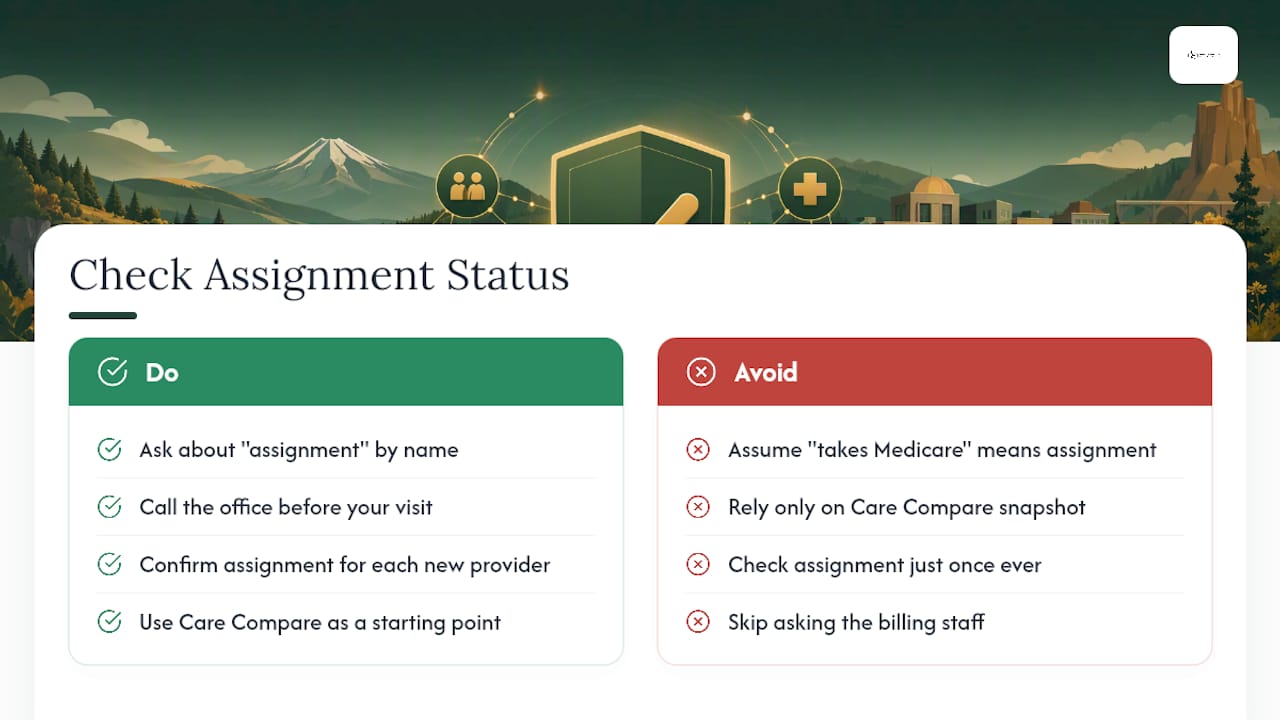
Where I think readers get tripped up is assuming Care Compare is the final word. It’s a strong starting point, but it’s a snapshot of billing status, not a live confirmation of what will happen at your specific appointment. The call to the office isn’t a backup step. It’s the actual verification.
If you take one thing from this: assignment status is worth confirming before every new provider relationship, not just once when you first enroll in Medicare. Offices change their participation status, and your bill is the thing that finds out first if you don’t.
— Jesse Zimmerman
Get Help Making Sense of Your Medicare Costs
Local insurance agencies give residents an alternative to figuring out assignment rules, Medigap gaps, and provider billing status alone. Consultations help walk through actual providers, plans, and budgets, often with no pressure to enroll.
The agency’s free consultations cover Medicare enrollment and provider verification, including how to interpret assignment status before you book care and whether a Medigap plan would close any excess-charge gaps you’re currently exposed to. If you’re weighing supplemental coverage that fills in where Medicare stops, that same conversation can extend into life insurance options worth understanding at the same time.
If you’re heading into a new plan year, or you’ve just gotten a confusing Medicare Summary Notice, reach out to Mountaintop Insurance to schedule a free consultation and get a straight answer about what your coverage actually pays for.
This article is general information, not a substitute for advice from a qualified financial advisor. Consult a qualified financial professional about your own circumstances before acting on anything here.
Sources
- Does your provider accept Medicare as full payment? | Medicare
- What Is Medicare Assignment and How Does It Affect You? | AARP
FAQ
What Happens if My Doctor Doesn’t Accept Medicare Assignment?
Ask the office directly whether they’ll accept assignment for your specific visit.
What Is the Difference Between Medicare and Medicare Assignment?
Medicare is the federal health insurance program itself; assignment is a billing agreement a provider makes to accept the Medicare-approved amount as full payment for covered services. A provider can accept Medicare patients without accepting assignment on every claim.
How Many Doctors Don’t Accept Medicare Assignment?
Most Medicare-billing providers choose participating status because it simplifies billing and payment, so providers who decline assignment are the exception rather than the norm. Exact figures vary by specialty and region, so verifying with Care Compare or a direct call remains the most reliable check.
What Does Accepting Medicare Assignment Mean for My Bill?
The provider cannot bill you for the gap between that approved amount and what they’d normally charge.
Can Mountaintop Insurance Help Me Check a Provider’s Assignment Status?
Yes. Mountaintop Insurance offers free consultations for Central Oregon residents to help verify provider billing status, review Medigap coverage for excess charges, and prepare questions before an appointment.
Recommended
Disclaimer: This article is for general educational purposes only and does not constitute personalized advice. Medicare rules and plan details change frequently.
Discuss Your Situation With Us