20 Employee Rule at 65: Medicare While Working in Oregon

If you’re still working at 65 and covered by a group health plan through an employer with 20 or more employees, you can generally delay Medicare Part B without a penalty and use an 8-month Special Enrollment Period once that job coverage ends. Most people in this position sign up for premium-free Part A right away, but that choice carries a catch if you contribute to an HSA. Before you decide anything, ask HR two questions: is this a group health plan, and how many employees the company has. Write down the answers.
TL;DR:
- Employer plans with 20 or more employees pay first, so delaying Medicare Part B is generally safe if still working at 65; smaller companies might require enrollment.
- The 8-month Special Enrollment Period begins the month after employment or coverage ends, and missing it could lead to late-enrollment penalties.
- Retroactive Medicare Part A enrollment can disqualify HSA contributions made during that period, creating tax risks if not timed carefully.
- Union or multi-employer plans may fall into different coordination rules, so verify plan classification and employer size in writing before deciding.
- COBRA and retiree coverage typically do not extend the SEP window and can trigger late penalties if not properly timed with Medicare enrollment.
Table of Contents
- Who Pays First: The 20-Employee Rule and Employer-Size Tests
- Special Enrollment Period: The 8-Month Window and How to Avoid Penalties
- How Parts A, B, D, and Medigap Interact With Employer Coverage
- COBRA, Retiree Plans, and Gaps in Coverage
- HSAs and Medicare: Timing, Excess Contributions, and Tax Risk
- How to Sign Up: Forms, Timelines, and a Step-by-Step Example
- Practical Checklist and Exact Questions to Ask HR or Benefits
- How Mountaintop Insurance Helps Local Clients Navigate This
- Differences in Coverage Options for Union vs Non-Union Employees
- Effect of Medicare Enrollment on Disability Benefits If Working
- How Continuing to Work Affects Medicare Advantage and Part D Choices
- Editorial Take: What Actually Matters in This Decision
- Get Local Help Before You File Anything
- Sources
- FAQ
Who Pays First: The 20-Employee Rule and Employer-Size Tests
The single most important fact in this entire decision is employer size, because it decides who pays your medical bills first. If your employer has 20 or more employees, the group health plan pays first and Medicare pays second, according to Medicare’s coordination guidance. If your employer has fewer than 20 employees, Medicare usually pays first, and your employer plan may pay very little unless you’re enrolled in both Part A and Part B.
Counting employees isn’t as simple as looking at your own office roster. The count applies company-wide, not location-by-location, and it can pull in parent companies, subsidiaries, and affiliated entities under common ownership. Multi-employer plans complicate things further: even if your specific employer has fewer than 20 workers, the working-aged coordination rules can still apply if the plan covers employees from a larger combined group.
There’s also a lesser-known escape valve for small employers: the Small Employer Exception (SEE). A group health plan sponsored by an employer with fewer than 20 employees can request this exception, which shifts Medicare back to primary payer status even for people who’d otherwise expect employer coverage to lead. It’s rare, but it happens, and it changes the math on whether delaying Part B makes sense.
Before you make any enrollment decision, get these answers from HR in writing:
- How many employees does the company have, counting all locations and affiliated entities?
- Is this plan classified as a group health plan (GHP) under federal coordination rules?
- Has the employer requested or received a Small Employer Exception?
- Does the plan require Medicare enrollment at 65 regardless of employment status?
Get the answer in an email, not a hallway conversation. You’ll want that paper trail if a claim gets denied later or if you need to prove creditable coverage during enrollment.
Special Enrollment Period: The 8-Month Window and How to Avoid Penalties
The Special Enrollment Period for the working aged is the mechanism that lets you delay Medicare without punishment, but it only works if you understand when the clock starts. The SEP for people with employer coverage lets you enroll anytime while still covered by the employer plan, or during an 8-month window that begins the month after either your employment ends or your group coverage ends, whichever comes first.
That clock doesn’t wait for you to notice it started. Miss the 8 months, and you’re looking at the general enrollment period instead, with a real chance of a late-enrollment penalty attached to Part B for as long as you have it.
Here’s how to move through the SEP cleanly:
- Confirm the exact date your employer coverage or employment ends, and get it in writing from HR.
- Apply for Part B during the SEP using the SSA’s online sign-up channel or in person at a Social Security office.
- Submit CMS-L564 (Request for Employment Information), which your employer completes to verify your coverage dates.
- If needed, file CMS-18-F-5 (Medicare Part B application) alongside it, per CMS enrollment guidance.
- Keep copies of everything, including pay stubs or benefits letters showing continuous coverage through your employment.
One wrinkle: if you enroll in Part A retroactively (Medicare allows up to 6 months of retroactive Part A coverage for people over 65), that retroactive date can quietly disqualify HSA contributions you made during those months. That’s a tax problem worth understanding before you file anything, and it’s covered in detail below.
How Parts A, B, D, and Medigap Interact With Employer Coverage
Most working 65 year olds take a hybrid approach: sign up for premium-free Part A because it costs nothing for most people, while delaying Part B because the employer plan already covers outpatient care and Part B carries a monthly premium. This works well for people with large-employer coverage, but it’s not automatic. It’s a decision, not a default.
Retiree coverage and employer coverage don’t behave the same way once Medicare enters the picture. Coordination depends heavily on plan design:
- Active employer coverage from a 20+ employee company generally pays first, with Medicare as secondary.
- Retiree coverage almost always pays secondary to Medicare, regardless of employer size, so delaying Part B while on a retiree plan can leave real gaps.
- Medigap guaranteed-issue rights kick in once your employer coverage ends and you enroll in Part B, but the window to use them is time-limited, typically 63 days.
- Missing that guaranteed-issue window means insurers can medically underwrite you, and in some states that means denial or higher premiums.
Part D deserves its own callout because employer prescription plans vary widely in whether they qualify as creditable coverage. If your employer’s drug coverage is creditable, you can delay Part D without penalty. If it isn’t, and you don’t sign up for Part D or a Medicare Advantage plan with drug coverage when first eligible, you’ll owe a permanent late penalty once you do enroll. Your employer is required to send you an annual notice stating whether your coverage is creditable. Don’t lose that letter. You’ll need it as proof if you enroll in Part D later and someone questions the delay.
COBRA, Retiree Plans, and Gaps in Coverage
COBRA feels like insurance, but Medicare treats it very differently once you’re eligible. COBRA is considered secondary to Medicare, not a substitute for it, which trips up a lot of people who assume electing COBRA after a layoff buys them more time before enrolling.
A few rules matter here more than people expect:
- If you become Medicare-eligible while already on COBRA, your COBRA coverage typically ends or becomes secondary, and it does not count as employer coverage for SEP purposes.
- Retiree health coverage doesn’t extend your SEP either. If your employment ends and you move to a retiree plan instead of active group coverage, your 8-month SEP clock starts the same month, whether you realize it or not.
- Signing up late because you assumed COBRA or retiree coverage counted as creditable, active-employer coverage is one of the most common ways people trigger a Part B late-enrollment penalty.
- Timing your Medicare enrollment correctly also protects your Medigap guaranteed-issue window, which closes fast once employer coverage ends.
If you’re navigating a COBRA decision around age 65, read the specific timing rules before electing it. Mountaintop Insurance’s guide to Medicare and COBRA walks through exactly when COBRA still makes sense and when it creates a trap.
HSAs and Medicare: Timing, Excess Contributions, and Tax Risk
Enrolling in Medicare, even just Part A, immediately ends your eligibility to contribute to a Health Savings Account. That’s a hard IRS rule, not a guideline, according to IRS Publication 969. The complication is retroactivity: Medicare can back-date your Part A enrollment up to six months, and any HSA contributions made during that retroactive window become excess contributions after the fact, even though they were legal when you made them.
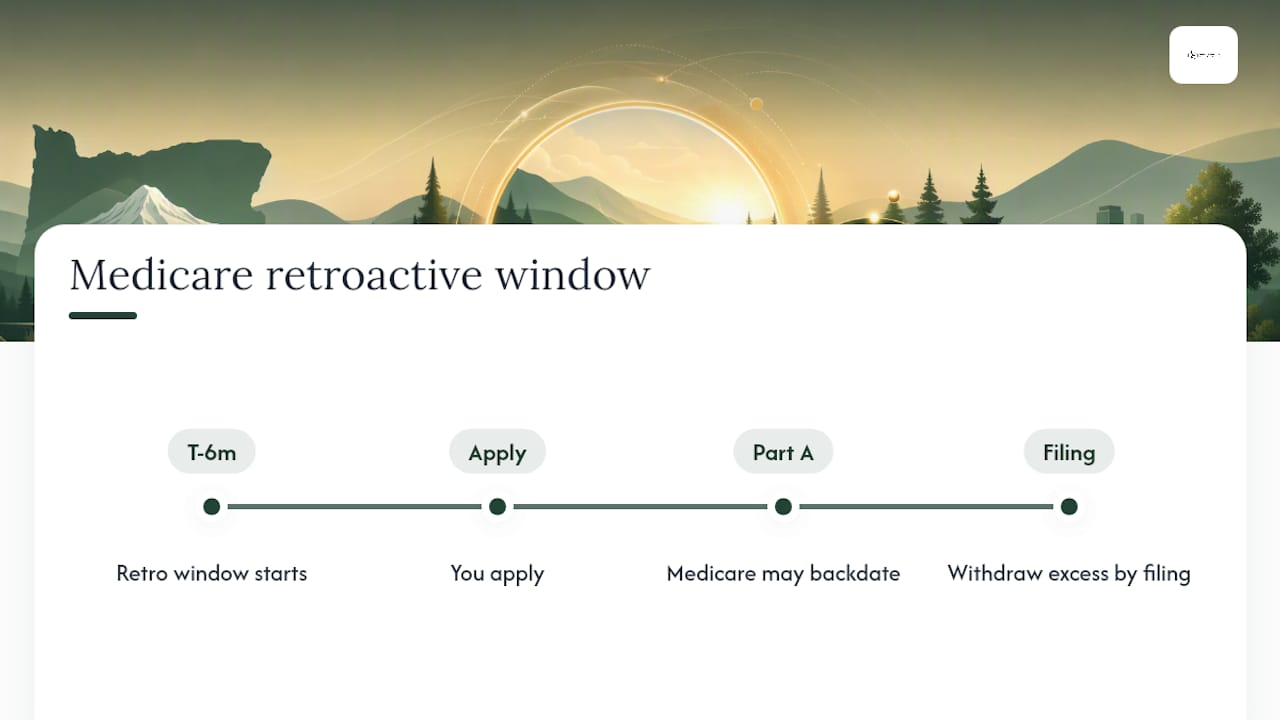
The fix is usually to withdraw the excess amount, plus any earnings on it, before your tax filing deadline for that year.
Pro Tip: Stop HSA contributions at least six months before you plan to enroll in Medicare, not the month you actually apply. Because Part A enrollment can retroactively reach back six months, contributing right up until your application date is one of the most common ways people accidentally trigger the excise tax.
Practitioner guidance from Medicare Interactive echoes this same six-month buffer, especially for people who also plan to claim Social Security around the same time, since claiming Social Security automatically enrolls you in Part A. If you’re contributing to an HSA and thinking about either move, talk to your payroll department about contribution timing and loop in a tax advisor before, not after, you file the paperwork.
How to Sign Up: Forms, Timelines, and a Step-by-Step Example
Enrolling during your SEP is straightforward once you know which forms go where. You can apply online through the Social Security Administration’s Medicare sign-up portal, by phone, or in person at a local Social Security office.
- Gather proof of employer coverage: your HR-completed CMS-L564, pay stubs, and any benefits enrollment letters.
- Submit your application roughly 30 days before your employer coverage actually ends, which gives Social Security time to process it without leaving a coverage gap.
- If applying for Part B specifically through the SEP, pair your CMS-L564 with CMS-18-F-5, the Medicare Part B enrollment application.
- After submitting, expect a confirmation notice with your effective date. Save it alongside your other documentation.
- If anything looks off, like an incorrect effective date, contact Social Security immediately rather than waiting for the next enrollment window.
Building in that 30-day cushion matters more than it sounds. Processing delays happen, and a gap in coverage between your job plan ending and Medicare starting is the kind of mistake that’s expensive to fix after the fact. For a broader look at how enrollment periods interact, Mountaintop Insurance’s enrollment periods guide breaks down each window side by side.
Practical Checklist and Exact Questions to Ask HR or Benefits
Before you sign anything, confirm these four items with your benefits department and get the answers in writing:
- Employer size, counted across all locations and affiliated entities.
- Whether your plan qualifies as a group health plan (GHP) under federal coordination rules.
- Whether COBRA or retiree coverage is available, and how it’s classified relative to Medicare.
- Whether your prescription drug coverage is creditable for Part D purposes.
A useful script: “Can you confirm in writing whether our group health plan is a GHP under Medicare’s coordination rules, and how many employees the company has company-wide?” Keep every reply, whether it’s an email, a benefits summary, or a signed CMS-L564, in one folder. You’ll reference this paperwork again during enrollment, and possibly again if a claim ever gets disputed.
How Mountaintop Insurance Helps Local Clients Navigate This
Picture a typical case: a 66-year-old still working full-time at a Bend company with 45 employees. The right sequence is usually to keep premium-free Part A, delay Part B during active employment, stop HSA contributions six months out, and enroll during the SEP once the job ends. Getting that sequence wrong, in either direction, tends to cost real money.
A local agent’s job is to confirm the plan type with HR, help complete the CMS-L564 and CMS-18-F-5 forms correctly, and coordinate the HSA and Social Security timing so nothing triggers a penalty. Mountaintop Insurance provides exactly this kind of hands-on enrollment assistance for Central Oregon residents, at no cost for the consultation itself.
Differences in Coverage Options for Union vs Non-Union Employees
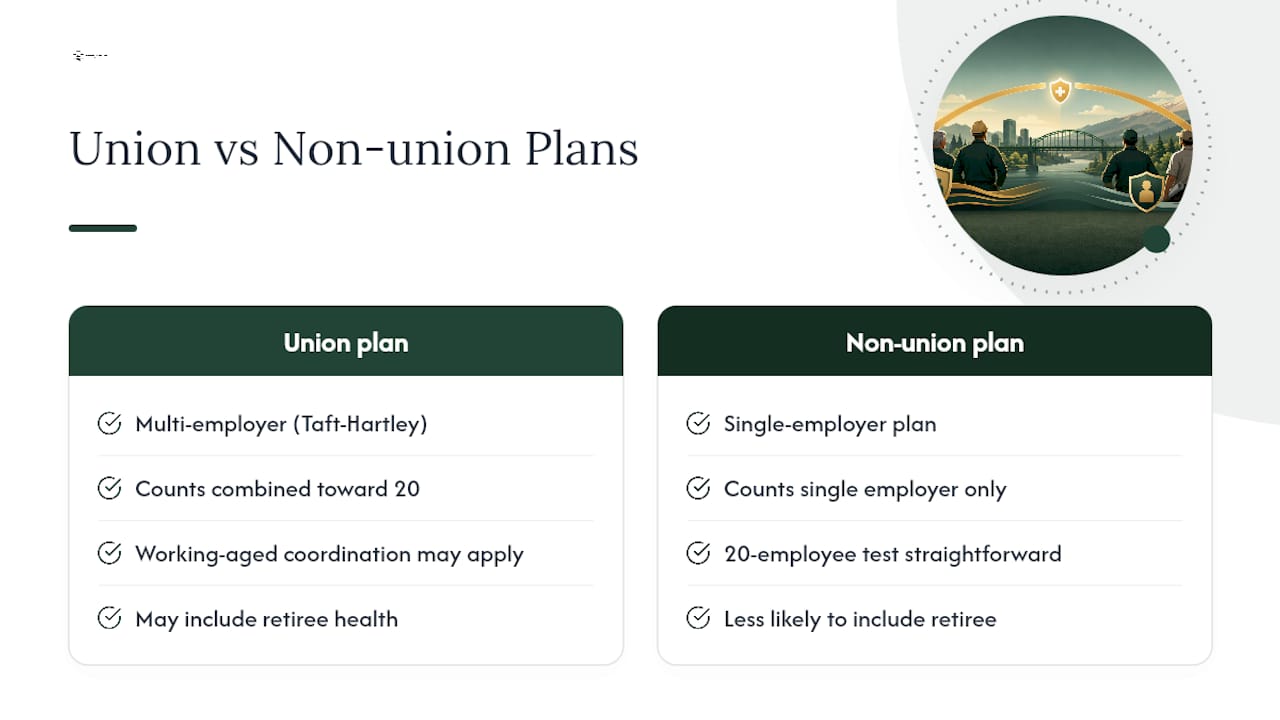
Union health plans often work differently than standard employer coverage, and that difference matters for your Medicare timing. Many union plans are structured as multi-employer or Taft-Hartley trust plans, which pool contributions from several participating employers. Under the CMS employer-size guidelines, these multi-employer arrangements can trigger working-aged coordination rules even when your specific individual employer has fewer than 20 workers, because the combined group counts toward the threshold.
Retiree provisions also differ. Some union contracts include retiree health benefits that continue after you stop working, but as covered earlier, retiree coverage almost always pays secondary to Medicare regardless of how generous the plan looks on paper. Non-union employer plans, by contrast, are usually tied to a single employer’s headcount, making the 20-employee test more straightforward to apply.
If you’re in a union plan, don’t assume the standard rules apply cleanly. Ask your union benefits office specifically whether your plan is a multi-employer trust and how it’s classified for Medicare coordination purposes. The answer changes whether you’re required to enroll in Part B at 65 or can safely delay it, and getting this wrong inside a union plan is just as costly as getting it wrong with a standard employer plan.
Effect of Medicare Enrollment on Disability Benefits If Working
If you’re receiving Social Security Disability Insurance (SSDI) and still working, Medicare eligibility usually starts automatically after 24 months of receiving disability benefits, regardless of your age. That creates a scenario distinct from the standard 65-and-working situation: you may become Medicare-eligible well before 65 while still holding a job and employer coverage.
The same employer-size and coordination-of-benefits rules apply here. If your employer has 20 or more employees, your group health plan generally still pays first and Medicare pays second, the same structure covered earlier for age-based enrollees. The complication with disability cases is that some people attempt substantial work while on SSDI under Social Security’s trial work period rules, and continuing to work can affect your disability payment status even though it typically does not strip away your Medicare Part A eligibility once it’s established.
If you’re on SSDI, working, and approaching decisions about Part B or supplemental coverage, treat this as a three-way conversation between HR, Social Security, and a benefits advisor familiar with disability rules specifically, since disability coordination has enough edge cases that generic Medicare guidance won’t cover every scenario.
How Continuing to Work Affects Medicare Advantage and Part D Choices
Working past 65 doesn’t lock you out of Medicare Advantage or Part D, but it does change when and why you’d choose them. If you’re still covered by a large-employer group plan, most people delay both Medicare Advantage and standalone Part D enrollment, since the employer plan is usually paying primary and often includes drug coverage that qualifies as creditable.
The moment that changes is when employer coverage ends. At that point, you enter your SEP and gain access to Medicare Advantage and Part D enrollment without penalty, provided you act within the window. If your employer drug coverage was not creditable and you delayed Part D anyway, expect a permanent late-enrollment penalty once you do sign up, calculated based on how many months you went without creditable coverage.
One detail people miss: if you’re still working and considering Medicare Advantage instead of sticking with original Medicare plus a Medigap policy, understand that switching later, after you’ve fully retired, can be harder. Medigap guaranteed-issue protections are strongest right when your employer coverage first ends. If you pick Medicare Advantage during that window and want to switch to Medigap years later, you may face medical underwriting depending on your state’s rules.
Editorial Take: What Actually Matters in This Decision
Most guidance on this topic treats employer size as a formality, a box to check before moving on to the interesting stuff. That’s backwards. The 20-employee threshold is the single fact that determines almost everything downstream, from whether you owe a penalty to whether your HSA contributions are safe. Get that number wrong and every other decision built on top of it is wrong too.
The conventional advice also underplays the HSA timing risk, which is particularly important in chronic condition management under Medicare. Retroactive Part A enrollment reaching back six months is a genuine trap, and most people don’t learn about it until they’re already facing an excise tax notice. If you take one thing from this guide, verify your employer’s exact headcount and plan classification in writing, then build your HSA and enrollment timeline backward from that answer. Everything else, Medigap timing, Part D creditability, COBRA sequencing, follows from getting that foundation right.
The reader’s job is to resolve these questions with HR, payroll, and a tax advisor before applying anywhere. No article, including this one, replaces that conversation.
— Jesse Zimmerman
Get Local Help Before You File Anything
Mountaintop Insurance is the alternative to guessing your way through HR paperwork and IRS rules alone. As a local Bend, Oregon agency, we sit down with Central Oregon clients for free, no-pressure consultations that walk through your specific employer plan, your HSA timing, and exactly which CMS forms you need, before you file anything with Social Security. We’re not a call center reading from a script. We’re the people who confirm your employer’s headcount, help you time your Part B enrollment to avoid penalties, and coordinate Medigap and Part D decisions so you don’t lose guaranteed-issue rights by accident.
If you’re within a few months of a coverage change, whether that’s retiring, losing employer coverage, or just turning 65 while still working, schedule a free consultation with Mountaintop Insurance and get your specific timeline mapped out before a deadline sneaks up on you.
Sources
- Working past 65 | Medicare
- Who pays first? | Medicare
- Original Medicare enrollment (Part A and Part B) | CMS
- Publication 969 (Health Savings Accounts and Other Tax-Favored Health Plans) | IRS
FAQ
Should I Enroll in Medicare While Still Working?
If your employer has 20 or more employees and offers a group health plan, you can generally delay Part B without penalty, though most people still enroll in premium-free Part A unless they’re actively contributing to an HSA.
Can I Drop My Employer Health Insurance and Go on Medicare?
Yes, you can drop employer coverage and enroll in Medicare at any point after turning 65, and doing so opens a Special Enrollment Period if you haven’t already signed up for Part B.
How Much Will Medicare Cost Me If I Am Still Working?
Part A is premium-free for most people who’ve worked and paid Medicare taxes long enough, while Part B carries a monthly premium you can delay penalty-free if you have qualifying employer coverage from a large employer.
Am I Eligible for Medicare If I’m Working?
Yes, working does not affect your Medicare eligibility. You become eligible at 65 regardless of employment status, though whether you should enroll immediately depends on your employer’s size and plan type.
What Happens If I Miss My Special Enrollment Period?
Missing the 8-month SEP pushes you into the general enrollment period, and you risk a permanent late-enrollment penalty on Part B for as long as you have it, per CMS enrollment rules.
Disclaimer: This article is for general educational purposes only and does not constitute personalized advice. Medicare rules and plan details change frequently.
Discuss Your Situation With Us