Central Oregon Medigap: Use Oregon Birthday Rule 60 Day Window

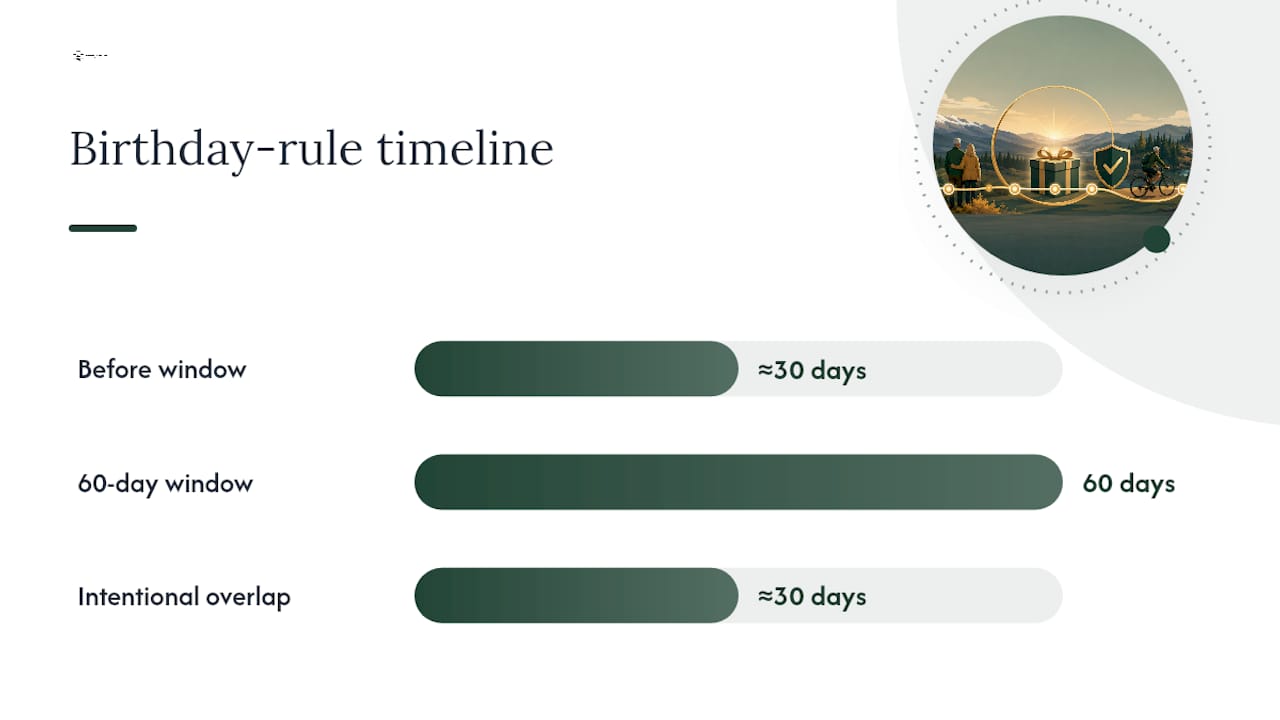
Oregon law gives Medigap policyholders a guaranteed-issue window that opens 30 days before your birthday and closes 30 days after it. During that stretch, you can switch to a new Medigap policy with the same or lesser benefits, no medical questions asked. The one thing to remember: never cancel your current policy until the new one is officially issued, or you risk a gap in coverage.
TL;DR:
- The Oregon birthday rule offers a guaranteed-issue window of 60 days around your birthday each year to switch to a similar or lesser-benefit Medigap plan without medical questions.
- You can only move between identical plan letters or to plans with fewer benefits, and the rule does not apply to employer-sponsored group Medigap plans or policies issued before 1990.
- To avoid coverage gaps, apply early within the window, gather all policy details beforehand, and wait for written confirmation of your new policy before canceling the old one.
- Comparing plans requires attention to premium costs, rating methods, deductibles, and guarantee-issue confirmation; always request written quotes and details from carriers.
- Using a local expert or insurance advisor can help navigate timing, prevent mistakes, and ensure proper coordination of effective dates during the annual switch period.
Table of Contents
- What Is the Oregon Birthday Rule and Why Does It Matter?
- Who Qualifies and What Changes Are Actually Allowed?
- How Do You Use the Birthday Rule Without Creating a Coverage Gap?
- What Exceptions and Pitfalls Should You Watch For?
- How Do You Compare Medigap Offers During Your Window?
- Why Local Guidance Beats Guesswork on Timing
- Where This Information Comes From
- Why the Birthday Rule Deserves More Attention Than It Gets
- Get Help Using Your Birthday Rule Window This Year
- Sources
- FAQ
What Is the Oregon Birthday Rule and Why Does It Matter?
The Oregon Birthday Rule is a state consumer protection, not a federal Medicare feature. It is written directly into Oregon Administrative Rule 836-052-0143, which grants Medigap policyholders an annual opportunity to select another Medicare Supplement policy starting on their birthday and continuing for 30 days after. The rule also bars insurers from denying coverage or charging more based on health status during that window.
Here’s why that protection actually saves people money. Medigap plans are federally standardized. A Plan G from one carrier covers exactly the same benefits as a Plan G from another, according to CMS guidance on Medigap standardization. That means shopping around during your birthday window rarely changes what’s covered. It changes what you pay.
A few things make this rule genuinely useful rather than just a bureaucratic footnote:
- It creates real price competition among carriers selling identical benefit packages.
- It lets you switch without answering health questions, something you normally can’t do outside a guaranteed-issue period.
- It runs every single year, not just once when you first enroll in Medicare.
That last point trips people up. Oregon’s SHIBA birthday rule fact sheet confirms this is an annual right, not a one-time perk. If your premium crept up again this year, you get another shot.
Who Qualifies and What Changes Are Actually Allowed?
You qualify if you already hold an individual Medigap policy in Oregon. This is not for people shopping for their first supplement plan. It is a shopping window for existing policyholders who want a better rate on similar coverage.
What you can actually do inside the window is narrower than many people assume. You can move to:
- The same plan letter with a different carrier (Plan N to Plan N, for instance).
- A plan with fewer benefits than your current one, following the state’s replacement matrix.
You cannot use the birthday rule to upgrade to richer benefits. Wanting to move from a Plan N to a Plan G, for example, falls outside guaranteed issue and would typically require medical underwriting.
A few categories get special treatment, and this is where people get tripped up:
- Policies issued before January 1, 1990 follow different replacement rules than newer standardized plans, so check the Division of Financial Regulation’s replacement matrix before assuming your policy maps cleanly to a current plan letter.
- Innovative Plan variants carry their own comparison logic and may not line up one-to-one with standard letters.
- Self-funded, employer-sponsored group Medigap plans are excluded entirely. If your supplement coverage comes through a former employer’s group plan, the birthday rule doesn’t apply to it.
Oregon’s initial six-month Medigap open enrollment period, the one that starts when you first become eligible, remains separate from this annual window and offers broader guaranteed-issue protection. The birthday rule doesn’t replace that; it’s a recurring, narrower version that kicks in every year afterward.
How Do You Use the Birthday Rule Without Creating a Coverage Gap?
The window is exactly 60 days: about a month before your birthdate and about a month after. If your birthday falls on June 15, your window opens around May 16 and closes around July 15. Miss it, and you wait until next year.
Here’s the sequence that keeps you protected the whole way through:
- Gather your current policy details. Know your plan letter, premium, carrier, and effective date before you start comparing anything.
- Get quotes from multiple carriers for the same plan letter or a lesser-benefit option. Ask each one to confirm the offer qualifies under guaranteed issue.
- Submit your application inside the 60-day window. Applying even a few days late can push you into next year’s cycle.
- Wait for written confirmation that the new policy is issued before you cancel the old one. This is the step people rush, and it’s the one that causes the most trouble.
New coverage typically starts the first of the month following your application, though the Division of Financial Regulation notes that carriers can adjust that date. If you apply on June 20, expect an effective date of July 1, not June 21. Mid-month effective dates are generally discouraged and can create administrative headaches on both ends.
Budget for the possibility of paying two premiums for one month while your old and new policies briefly overlap. That overlap is intentional. It’s the safety net that prevents a coverage gap if paperwork gets delayed.
Pro Tip: Apply in the first two weeks of your window instead of waiting until the last few days. Insurers sometimes take longer than expected to process guaranteed-issue applications, and starting early gives you a buffer if something needs correcting.
What Exceptions and Pitfalls Should You Watch For?
The biggest one: self-funded employer-sponsored group Medigap plans don’t qualify for birthday rule protection at all. If your supplement coverage runs through a former employer, switching out of it during your birthday window isn’t guaranteed issue, and depending on your employer’s plan rules, you may not be able to return to that group coverage later. Check your plan’s terms before making any move.
Other pitfalls worth knowing about before you shop:
- Pre-1990 policies and Innovative Plan variants don’t always map cleanly onto current standardized letters, so lean on the state’s replacement matrix rather than assuming equivalence.
- High-deductible Plan F deductibles typically restart when you switch carriers. If you’ve already paid toward this year’s deductible with your current carrier, that progress usually doesn’t carry over. Ask directly whether any payment already made will transfer.
- Timing mistakes are the most common failure point. Document every call and email with an insurer, and ask for written confirmation of your guaranteed-issue eligibility and effective date. If a dispute comes up later, that paper trail is what protects you.
How Do You Compare Medigap Offers During Your Window?
Comparing plans on price alone is a mistake if you skip the fine print on rating method and deductible treatment. Build your comparison around these factors:
- Plan letter — confirm it’s identical or a documented lesser-benefit option.
- Premium — get the exact monthly figure in writing, not a verbal estimate.
- Rating method — attained-age, issue-age, or community-rated pricing behaves very differently over time.
- Deductible — especially relevant if you’re comparing high-deductible Plan F or Plan G options.
- Waiting periods or look-backs — even under guaranteed issue, some plans specify pre-existing condition waiting periods.
- Effective date options — confirm what date the carrier will actually offer.
- Guaranteed-issue confirmation — get this in writing, every time.
When you’re on the phone with a carrier or comparing questions to ask an agent, a few direct questions cut through the sales pitch fast: “Does my deductible restart if I switch to your policy?” “What effective date can you guarantee, and can you confirm that in writing?” “How long will it take to issue my new policy after I apply?” “Can you confirm in writing that this qualifies under Oregon’s birthday rule guaranteed-issue protection?”
Pro Tip: Never accept a verbal quote as final. Ask every carrier to email you a written quote that includes the plan letter, premium, rating method, and a guaranteed-issue confirmation statement. It’s your proof if something changes later.
Why Local Guidance Beats Guesswork on Timing
Rate-setting methods and carrier pricing trends, more than coverage differences, are usually what decide whether switching actually saves you money. That’s a data point most people never think to check, and it’s exactly where a local advisor earns their keep.

Mountaintop Insurance, based in Bend, offers free consultations for Central Oregon residents navigating exactly this kind of decision. The value isn’t just finding a lower quote. It’s confirming your guaranteed-issue eligibility before you apply, coordinating effective dates so you’re never paying for two overlapping policies longer than necessary, and flagging deductible restart issues before they surprise you in January.
Paperwork errors and missed deadlines are the two things most likely to derail a birthday rule switch, and both are avoidable with someone who handles this daily. If you want a second set of eyes on your Medicare Supplement options before your window closes, scheduling a conversation with Mountaintop Insurance’s Medicare team costs nothing and can save you from a costly timing mistake.
Where This Information Comes From
This guide draws on the state’s own rule text and consumer guidance rather than secondhand summaries. The legal foundation sits in Oregon Administrative Rule 836-052-0143, which established the annual guaranteed-issue right. Oregon’s SHIBA birthday rule fact sheet translates that rule into plain-language guidance for beneficiaries, and the Division of Financial Regulation’s replacement matrix spells out exactly which plan-to-plan switches qualify.
For federal context on how state rules like this one fit into the bigger Medigap picture, Medicare and CMS’s Medigap standardization guidance are worth bookmarking. Between those four sources, you have everything a caseworker or insurance regulator would point you toward if you called with questions. Mountaintop Insurance’s team references these same sources when walking Central Oregon clients through their annual options, and can help you determine Medicare eligibility if you’re new to the program entirely.
Why the Birthday Rule Deserves More Attention Than It Gets
Most Medicare guidance treats guaranteed-issue rights as something you use once, during your initial enrollment period, and then forget. That framing undersells what Oregon actually built here. This is a recurring right. It shows up every single year, whether or not you remember it exists, and insurers have no obligation to remind you.
The conventional wisdom says switching Medigap carriers is risky because you might lose coverage for pre-existing conditions. That’s true outside a guaranteed-issue window. It’s simply not true inside one, and Oregon’s birthday rule is specifically designed to eliminate that risk for a full 60 days every year. People who assume Medigap shopping always means medical underwriting are working from outdated information, or information that applies to other states without a birthday rule at all.
What actually stops people from using this right isn’t confusion about the law. It’s the operational stuff: not knowing the exact 60-day window, not realizing self-funded employer plans are excluded, or canceling a policy too early out of eagerness to lock in savings. Those are solvable problems with the right checklist and a little patience. The bigger risk isn’t the switch itself. It’s sitting on the same premium for years because nobody flagged that you had an annual chance to shop, standardized benefits and all, without a single health question asked.
— Jesse Zimmerman
Get Help Using Your Birthday Rule Window This Year
Shopping Medigap quotes on your own during a 60-day window is doable, but it’s also where most timing mistakes happen. Mountaintop Insurance is the direct alternative to guessing your way through carrier calls and fine print. As a local Bend agency, it offers free consultations built specifically around Oregon’s birthday rule, confirming your guaranteed-issue eligibility, comparing rating methods across carriers, and coordinating effective dates so you’re never left without coverage.
This fits you well if you’re a Central Oregon Medigap policyholder who wants a second opinion before signing anything, or who simply doesn’t want to track deadlines and paperwork alone. Visit Mountaintop Insurance to schedule a free consultation before your window closes this year.
This article is general information, not a substitute for advice from a qualified financial advisor. Consult a qualified financial professional about your own circumstances before acting on anything here.
Sources
- When can you switch Medigap plans Birthday rule fact sheet (SHIBA, Oregon)
- Division of Financial Regulation — Medicare Supplement replacement matrix and guidance (Oregon)
- Medigap (CMS)
- Medicare
FAQ
What Is the Oregon Birthday Rule?
It’s a state guaranteed-issue right letting existing Medigap policyholders switch to a same-or-lesser-benefit plan during a 60-day window: 30 days before their birthday through 30 days after, with no medical underwriting required.
Which States Have a Birthday Rule Similar to Oregon’s?
Birthday rule provisions vary by state in both timing and scope, and Oregon’s own version is defined in OAR 836-052-0143. Beneficiaries outside Oregon should check their own state insurance division rather than assume identical terms apply.
Can You Collect Medicare at Age 62?
No. Medicare eligibility generally begins at the usual age for enrollment, though some people qualify earlier due to disability. Standard eligibility rules are outlined on Medicare.gov.
Do I Need to Cancel My Old Medigap Policy Right Away?
No, and you shouldn’t. Wait until your new policy is officially issued and confirmed in writing before canceling the old one, even if that means paying two premiums for one month.
Does the Birthday Rule Apply to Employer-Sponsored Medigap Plans?
No. Self-funded, employer-sponsored group Medigap plans are excluded from Oregon’s birthday rule entirely, according to the Division of Financial Regulation’s guidance. Check your employer plan’s specific rules before considering a switch.
Recommended
Disclaimer: This article is for general educational purposes only and does not constitute personalized advice. Medicare rules and plan details change frequently.
Discuss Your Situation With Us