Medicare Part D Deductible 2026: What Enrollees Must Know

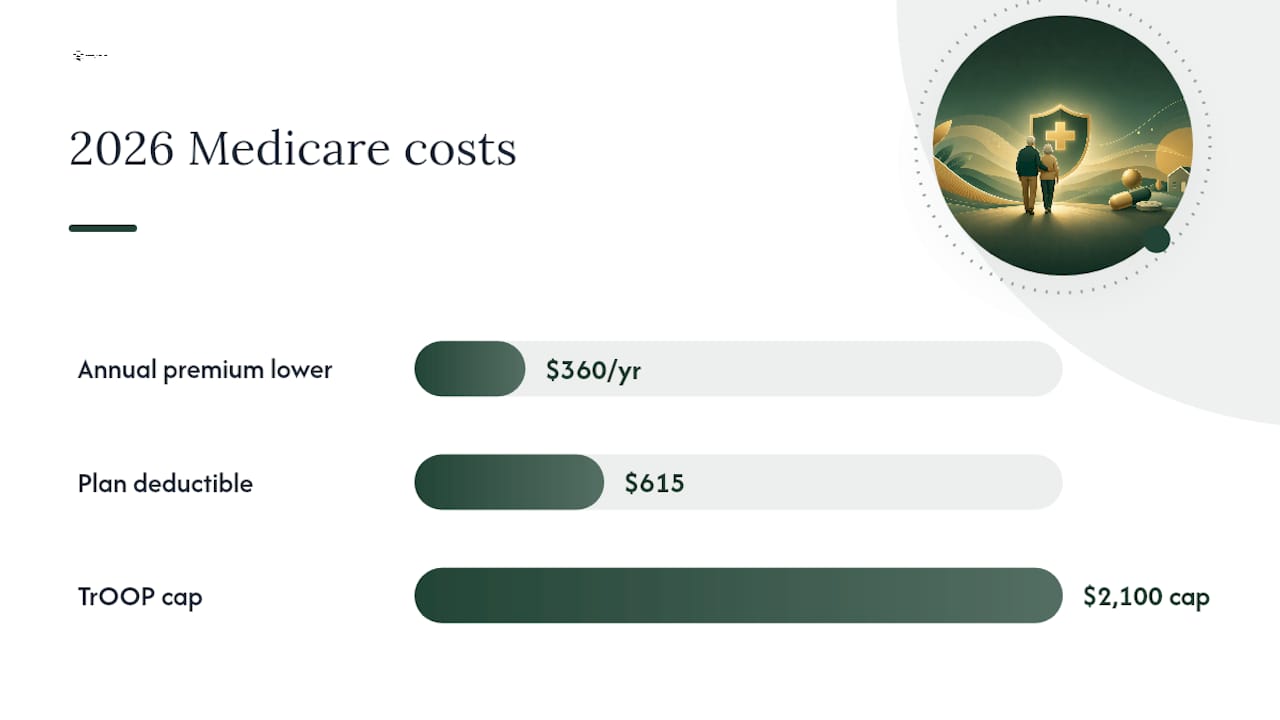
The 2026 standard maximum Part D deductible is $615, set by the Centers for Medicare & Medicaid Services. That is the ceiling. Many plans charge less, and some charge nothing at all. Once your out-of-pocket drug spending reaches $2,100 in 2026, catastrophic coverage kicks in and your cost-sharing drops sharply for the rest of the year.
Three things to do right now:
- Check your plan’s actual deductible. It may be well below $615 or zero.
- Estimate your 2026 drug spend. Run the numbers against your plan’s formulary before January 1.
- Call a counselor or local agent if your drug list is complex or your plan changed its deductible this year.
Key Takeaways
The 2026 Part D deductible caps at $615, and once your out-of-pocket spending reaches $2,100, catastrophic coverage applies for the rest of the year.
| Point | Details |
|---|---|
| 2026 deductible cap | No Part D plan may charge more than $615; many plans charge less or $0. |
| TrOOP threshold | Once you hit $2,100 in qualifying out-of-pocket costs, catastrophic coverage begins. |
| Plan variation is significant | 82% of MA-PD enrollees are now in plans that charge a deductible, up from 23% in 2024. |
| Extra Help is available | The federal Low-Income Subsidy can eliminate or sharply reduce deductibles and copays for qualifying beneficiaries. |
| Mountaintop Insurance | Free local consultations in Bend, Oregon, for personalized Part D plan comparisons and enrollment support. |
Table of Contents
- What does the Part D deductible actually mean for you?
- What changed in 2026 and what are the key numbers?
- Why do some plans charge $0 and others charge up to $615?
- How to estimate what you will actually pay in 2026
- Practical ways to lower your 2026 prescription costs
- Enrollment timing, the late-enrollment penalty, and when costs reset
- Are Part D premiums or deductibles tax-deductible?
- When does it make sense to get help from a Medicare advisor?
- A local advisor’s perspective on 2026 changes
- Mountaintop Insurance helps you find the right 2026 Part D plan
- Sources
- FAQ
What does the Part D deductible actually mean for you?
The deductible is the amount you pay out of pocket for covered prescription drugs before your plan starts sharing costs. Think of it as the entry fee before your plan’s coinsurance or copays apply. Once your True Out-Of-Pocket (TrOOP) spending hits $2,100, catastrophic coverage begins and your costs drop significantly for the rest of the calendar year.
Not every dollar you spend counts toward TrOOP. Retail drug costs and certain manufacturer discounts count. However, two categories are excluded from the deductible by federal law: insulin covered under Part D and vaccines recommended by the Advisory Committee on Immunization Practices (ACIP). Many plans also voluntarily exclude low-tier generics from the deductible, so you pay only a copay from day one on those drugs.
Key payments that typically count toward TrOOP:
- Your deductible payments
- Your coinsurance or copays during initial coverage
- Manufacturer discounts on brand-name drugs (for applicable drugs)
Pro Tip: Before your plan year starts, pull up your plan’s formulary online and search each of your drugs by name. The tier listed tells you whether that drug is subject to the deductible or whether a flat copay applies from day one. This five-minute check can save you real money.
What changed in 2026 and what are the key numbers?
The CMS Final CY 2026 Part D Redesign Program Instructions locked in two headline figures: a $615 standard deductible cap and a $2,100 TrOOP threshold. Once you hit $2,100 in qualifying out-of-pocket costs, catastrophic coverage applies for the remainder of the year.
The 2026 redesign also restructured how costs are shared across coverage phases. Plan sponsors, manufacturers participating in the Discount Program, and CMS subsidies each absorb a portion of remaining costs. The CMS program instructions PDF details the precise phase liabilities, including how manufacturer discounts on selected brand-name drugs factor into TrOOP accumulation.
| Coverage phase | Triggered when | Beneficiary pays |
|---|---|---|
| Deductible | Plan year starts | 100% of covered drug costs up to $615 |
| Initial coverage | After deductible is met | ~25% coinsurance on most covered drugs |
| Catastrophic | After $2,100 TrOOP | Significantly reduced cost-sharing |
The CMS Part D improvements overview traces how these redesign changes rolled out from 2023 through 2026, giving useful policy context for why the benefit structure looks different this year than it did just two years ago.
Why do some plans charge $0 and others charge up to $615?
Plan sponsors set their own deductible within the federal cap. A plan can choose a standard deductible (up to $615), a partial deductible (any amount below $615), or no deductible at all. The choice reflects how the plan balances its premium against out-of-pocket exposure for enrollees.
The shift in 2026 has been dramatic. KFF reports that 82% of Medicare Advantage Prescription Drug (MA-PD) enrollees are now in plans that charge a drug deductible, up from just 23% in 2024. If you were in an MA-PD plan with a $0 drug deductible two years ago, there is a real chance your plan changed. Stand-alone Prescription Drug Plans (PDPs) have historically been more likely to charge a deductible, but the gap between MA-PD and PDP designs narrowed sharply this year.
When comparing plans, check each of these:
- Formulary tier placement for each of your drugs. Tier 1 generics often bypass the deductible; Tier 3 and above usually do not.
- Prior authorization requirements. Some high-cost drugs require approval before the plan covers them.
- Step therapy rules. A plan may require you to try a cheaper drug before covering your preferred one.
- Preferred pharmacy network. Using a preferred pharmacy can cut your coinsurance significantly.
- Partial-deductible designs. Some plans apply the deductible only to certain tiers, not all covered drugs.
The Mountaintop Insurance plan comparison guide walks through the specific questions to ask when reviewing these details side by side.
How to estimate what you will actually pay in 2026
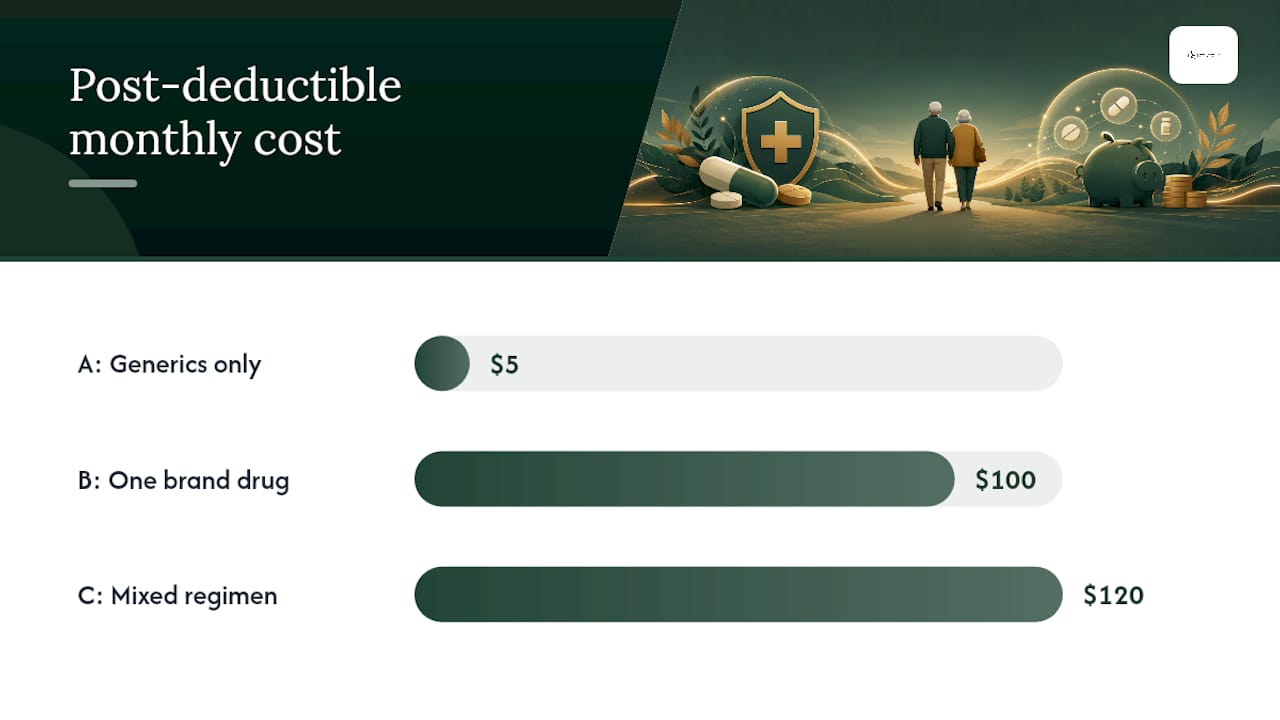
Three scenarios show how plan design and drug type interact to produce very different annual costs.
Scenario A: Generic-only user. You take two Tier 1 generics. Your plan applies no deductible to Tier 1 drugs. You pay a $5 copay per drug per fill. Annual cost: roughly $120. TrOOP accumulates slowly and you never approach $2,100.
Scenario B: Single high-cost brand-name drug. Your plan has a $615 deductible that applies to Tier 3 and above. Your brand-name drug has a retail price of $400 per month. You clear the deductible in two fills. Monthly cost post-deductible: $100. By month 8, your TrOOP hits $2,100 and catastrophic coverage applies for the final four months.
Scenario C: Multiple prescriptions, mixed tiers. You take one brand-name drug and three generics. The generics are deductible-exempt. The brand-name drug counts toward your $615 deductible. TrOOP accumulates from both the deductible payments and the coinsurance. Depending on the brand drug’s price, you may reach $2,100 by mid-year.
| Scenario | Deductible paid | Post-deductible monthly cost | Months to reach $2,100 TrOOP |
|---|---|---|---|
| A: Generics only | $0 | ~$5 | Does not reach $2,100 |
| B: One brand drug | $615 | ~$100 | ~Month 8 |
| C: Mixed regimen | $615 | ~$120 | ~Month 7 |
These examples assume retail pricing and that all payments count toward TrOOP as described in the CMS program instructions. Actual costs depend on your plan’s negotiated prices and tier structure.
Pro Tip: Medicare.gov’s Plan Finder tool lets you enter your exact drug list and preferred pharmacy to get a personalized 12-month cost estimate for any plan. Use it before the Annual Election Period closes on December 7.
Practical ways to lower your 2026 prescription costs
The fastest savings usually come from within your current plan, not from switching plans entirely.
- Ask about generic equivalents. A brand-name drug at Tier 3 subject to the deductible and 25% coinsurance can cost several times more than a generic equivalent at Tier 1 with a flat $5 copay.
- Use preferred pharmacies. Plans often charge lower coinsurance at preferred network pharmacies. The difference can be $20–$50 per fill on a mid-tier drug.
- Switch to mail order. Most plans offer a 90-day supply by mail for the price of two monthly fills, cutting annual costs by roughly one-third on maintenance medications.
- Apply for Extra Help (Low-Income Subsidy). The federal Extra Help program, also called the Low-Income Subsidy (LIS), reduces or eliminates premiums, deductibles, and copays for qualifying beneficiaries. Income and asset limits apply; the Social Security Administration handles applications.
- Check manufacturer assistance programs. Some pharmaceutical manufacturers offer patient assistance for high-cost drugs. Eligibility and how these payments interact with TrOOP vary, so confirm the details with your plan.
- Look into State Pharmaceutical Assistance Programs (SPAPs). Several states run their own programs that wrap around Part D to reduce costs further for low-income seniors.
Pro Tip: When comparing plans during open enrollment, calculate your estimated 12-month total drug cost, not just the monthly premium. A plan with a $0 premium and a $615 deductible can easily cost more annually than a plan with a $40 premium and a $0 deductible, depending on your drug list.
Enrollment timing, the late-enrollment penalty, and when costs reset
Missing your enrollment window costs you money every month, permanently. The key enrollment periods to know:
- Initial Enrollment Period (IEP): A 7-month window centered on your 65th birthday. Enroll in Part D here to avoid the penalty.
- Annual Election Period (AEP): October 15 through December 7 each year. Switch plans or enroll for the following year.
- Special Enrollment Periods (SEPs): Triggered by qualifying life events such as losing employer drug coverage, moving, or a plan leaving your area.
That percentage compounds and stays with you for as long as you have Part D. On a national base premium of roughly $36 in recent years, even 12 uncovered months adds a permanent surcharge.
Your deductible and TrOOP both reset to zero on January 1 each calendar year. If you hit catastrophic coverage in October, you start fresh in January, which is why high-cost drug users sometimes benefit from timing large fills before year-end.
Are Part D premiums or deductibles tax-deductible?
For most Medicare beneficiaries, the answer is no, at least not directly. NCOA confirms that Part D premiums and most out-of-pocket drug costs are generally not tax-deductible for ordinary filers. However, there are scenarios where deductibility applies:
- Itemized medical deductions. If you itemize deductions and your total unreimbursed medical expenses exceed 7.5% of your adjusted gross income, Part D premiums and out-of-pocket costs can count toward that threshold.
- Self-employed individuals. If you are self-employed and not eligible for employer-sponsored coverage, you may be able to deduct Medicare premiums, including Part D, as a business expense. Consult a tax professional.
- Extra Help recipients. If Extra Help pays your premium, you did not pay it, so there is nothing to deduct.
What to bring to a tax advisor if you want to explore deductibility:
- Total Part D premiums paid during the tax year
- Receipts or EOB statements for out-of-pocket drug costs
- Your filing status and adjusted gross income
- Documentation of any Extra Help or SPAP assistance received
This is general information, not tax advice. Confirm your specific situation with a qualified tax professional or the IRS.
When does it make sense to get help from a Medicare advisor?
A counselor or local agent earns their value when your situation has more than one moving part. If you take specialty drugs, use multiple pharmacies, or are switching from an MA-PD to a stand-alone PDP, the formulary and cost-sharing differences between plans can be significant enough that a wrong choice costs hundreds of dollars annually.
What a good advisor will do for you:
- Compare formularies across available plans for your specific drug list
- Run a personalized 12-month cost estimate, not just a premium comparison
- Explain whether you qualify for Extra Help and help you apply
- Identify Special Enrollment Period eligibility if your situation changed
- Walk you through the difference between MA-PD and PDP designs for your county
Free counseling is available through State Health Insurance Assistance Programs (SHIPs). Every state has one, and counselors are trained volunteers who do not sell plans. For beneficiaries who want in-person help and someone who knows the local plan landscape, a local Medicare agent in your area can often resolve complex questions faster than a national call center. Medicaid can help you locate state-level assistance programs and SHIP contacts.
A local advisor’s perspective on 2026 changes
The MA-PD deductible rate increased substantially in recent years. For beneficiaries in Central Oregon who were in MA-PD plans expecting $0 drug deductibles, 2026 arrived with a real financial surprise. Many of those plans quietly added a deductible during the Annual Election Period, and not everyone caught it.
What I see most often in consultations is that beneficiaries focus on the monthly premium and miss the deductible entirely. A plan that looks cheaper by $30 a month can cost $360 more annually before plan cost-sharing even begins, if it carries a $615 deductible and your previous plan had none. The math is not complicated, but you have to run it.
The $2,100 TrOOP cap is genuinely good news for people on expensive medications. Catastrophic coverage now provides meaningful protection, and the manufacturer discount program means brand-name drug costs accumulate toward TrOOP faster than they used to. For high-cost drug users, hitting the cap mid-year is now a realistic outcome rather than a theoretical one.
For Central Oregon beneficiaries, an in-person or phone consultation with a Bend-area agent who knows which plans are available in Deschutes County, and which pharmacies are preferred under each, is often faster and more accurate than navigating plan comparison tools alone. No-cost consultations are available, and there is no obligation to enroll.
Mountaintop Insurance helps you find the right 2026 Part D plan
Sorting through deductibles, formularies, and TrOOP calculations on your own takes time, and a wrong choice can mean hundreds of dollars in avoidable costs. Mountaintop Insurance, based in Bend, Oregon, offers free one-on-one consultations for Central Oregon residents who want a clear, pressure-free comparison of their 2026 Part D options.
The process is straightforward: bring your current medication list, your preferred pharmacy, and your existing plan information. An agent will run a personalized 12-month cost estimate across available plans in your area, explain how each plan’s deductible and formulary affect your specific drugs, and walk you through Extra Help eligibility if it applies. Consultations are available in person, by phone, or remotely.
Visit the Mountaintop Insurance Medicare services page to schedule a free consultation, or go to Mountaintopins for contact details and a full overview of services.
Sources
Use these primary sources to verify numbers and read full guidance:
- How much does Medicare drug coverage cost? | Medicare
- Final CY 2026 Part D Redesign Program Instructions | CMS
- Medicare Part D Enrollment, Premiums, and Cost Sharing in 2026 | KFF
- What Are the Medicare Out-of-Pocket Costs for 2026? | NCOA
Plan-level formulary details become available on Medicare.gov each October 1. That is the right time to run a full drug-by-drug comparison before the Annual Election Period closes December 7.
This article is general information, not a substitute for advice from a qualified financial advisor. Consult a qualified financial professional about your own circumstances before acting on anything here.
FAQ
What will the Medicare Part D deductible be in 2026?
The standard maximum Part D deductible for 2026 is $615, per CMS. Many plans set lower deductibles, and some charge $0.
What do most people pay for Medicare Part D?
Costs vary widely by plan and drug list.
Can I deduct Medicare Part D premiums on my taxes?
Generally no, not as an above-the-line deduction. Consult a tax professional for your specific situation.
What is the best Medicare Part D plan for 2026?
There is no single best plan. The right plan depends on your specific drugs, preferred pharmacy, and county. Mountaintop Insurance offers free personalized plan comparisons for Central Oregon residents to identify the lowest 12-month total cost option for your situation.
Recommended
Disclaimer: This article is for general educational purposes only and does not constitute personalized advice. Medicare rules and plan details change frequently.
Discuss Your Situation With Us