$30–$150/month: U.S. burial insurance costs, real funeral bills

Most burial insurance policies run between $30 and $150 a month, depending mostly on your age and how much coverage you buy. A $10,000 policy averages about $30 a month for a 50-year-old woman and $38 for a 50-year-old man, but that same $10,000 barely covers the median $8,300 burial or $6,280 cremation once you add a plot or vault. Start by pricing your actual funeral costs, then compare quotes from several carriers before picking a face amount.
TL;DR:
- Younger individuals, especially those in good health, can lock in significantly lower premiums by purchasing burial insurance before age 70.
- Funeral costs often exceed the median $8,300 for burial and $6,280 for cremation once cemetery fees and extras are included, making higher coverage advisable.
- Premiums increase rapidly with age, roughly doubling from age 50 to 70, and the steepest rise occurs after age 70, emphasizing the benefits of early buying.
- Women pay 15% to 25% less than men, and tobacco use can raise premiums by 40% to 80%, depending on the insurer and tobacco classification.
- Comparing multiple quotes, understanding policy types, and accurately estimating final costs are crucial steps to avoid overpaying or being underinsured.
Table of Contents
- Burial Insurance Cost by Age, Gender, and Coverage Amount
- What a Funeral Actually Costs Right Now
- What Actually Determines Your Premium
- Simplified Issue, Guaranteed Issue, or Graded Benefit: Which One Fits?
- How Much Coverage Do You Actually Need?
- How to Shop Smart and Avoid Costly Mistakes
- How Mountaintop Insurance Helps You Sort This Out
- A Straightforward Checklist Before You Buy
- Get a Free Final-Expense Quote Comparison
- Sources
- FAQ
Burial Insurance Cost by Age, Gender, and Coverage Amount
Age drives your premium more than any other factor. A 50-year-old and an 80-year-old buying the identical $10,000 policy can see monthly premiums three to four times apart, because final-expense insurance is priced on straight mortality risk with little room for other discounts. Gender matters too. Women generally pay less than men at every age band, reflecting longer average life expectancy.
Here’s roughly what you should expect to pay per month, based on typical rates for a healthy non-smoker:
These ranges come from MoneyGeek’s 2026 rate analysis of final-expense products, and actual quotes will shift based on your health class and the specific carrier’s underwriting appetite that year.
A few patterns worth noting:
- Premiums roughly double from age 50 to age 70 for the same coverage amount.
- Coverage cost scales almost linearly. Doubling your face amount roughly doubles your premium at any given age.
- The 70 to 80 jump is the steepest of all, which is exactly why buying earlier tends to lock in dramatically better pricing.
Pro Tip: If you’re 55 and healthy, buying now instead of waiting until 65 could cut your lifetime premium total substantially, since you’re locking in a lower age band for the life of the policy.
Picture two 60-year-old applicants shopping for the same $20,000 policy. One is a healthy non-smoker who qualifies for a preferred rate near $82 a month. The other used chewing tobacco within the past year and lands closer to $130 a month for identical coverage, purely because of the tobacco classification. Same age, same face amount, wildly different bill.
What a Funeral Actually Costs Right Now
The number that should really anchor your coverage decision isn’t the insurance premium. It’s the funeral bill itself. The National Funeral Directors Association’s General Price List study puts the median cost of a funeral with viewing and burial at $8,300 and a funeral with viewing and cremation at $6,280.
Those medians hide a lot of moving parts. A typical burial bill breaks down into:
- Basic services fee (funeral home overhead and staff time)
- Embalming and body preparation
- Casket, which alone often runs several thousand dollars
- Vault or grave liner, frequently required by cemeteries
- Transportation, viewing, and ceremony fees
- Cemetery plot and opening/closing fees, which are often billed separately from the funeral home total
That last point matters more than most people realize. The NFDA’s headline median often excludes the cemetery plot itself, the burial vault, and the opening and closing fee. Cemetery-related costs alone can add several thousand dollars on top of the funeral home’s bill, which is how a “median” $8,300 funeral turns into an $11,000 or $12,000 out-of-pocket reality in a lot of markets.
Cremation isn’t automatically the budget escape hatch it sounds like, either. Cremation rates keep climbing nationally, but families increasingly add viewings, urns, and memorial services on top of the direct cremation fee, which narrows the price gap with traditional burial more than the raw medians suggest.
What Actually Determines Your Premium
Underwriters look at a short list of factors, and each one moves your price in a predictable direction.
- Age. The single biggest lever. Every year you wait to buy pushes you into a higher-cost bracket.
- Gender. Women typically pay 15% to 25% less than men at comparable ages, reflecting mortality tables.
- Tobacco and nicotine use. Most carriers ask about tobacco use in the past 12 months, and that lookback window commonly counts vaping, cigars, and chewing tobacco right alongside cigarettes. Getting classified as a tobacco user can raise your premium by roughly 40% to 80%, depending on the carrier and your age band.
- Health history. Simplified-issue policies skip the medical exam and ask a handful of health questions instead, which speeds up approval but raises the price compared with fully underwritten coverage. Conditions like recent cancer treatment, COPD, or a recent hospitalization tend to push applicants toward higher-rated classes or guaranteed-issue products.
- Coverage amount and state. Larger face amounts cost proportionally more, and availability of certain policy forms can vary by state insurance regulations.
Pro Tip: Answer the tobacco question honestly. Carriers routinely check pharmacy and prescription databases, and a misstated application can give the insurer grounds to deny a claim right when your family needs the payout most.
Simplified Issue, Guaranteed Issue, or Graded Benefit: Which One Fits?
Final-expense policies come in three basic structures, and picking the wrong one either wastes money or leaves your family exposed during a waiting period.
- Simplified issue. You answer a short health questionnaire (no medical exam), and if you qualify, you get full coverage from day one. This is usually the cheapest legitimate option for anyone in reasonably good health, because the insurer still screens out the highest-risk applicants.
- Guaranteed issue. No health questions at all. Anyone within the eligible age range gets approved, which sounds appealing but comes at a real cost: higher premiums and typically a two-to-three-year waiting period before the full death benefit pays out for non-accidental death.
- Graded benefit. A middle ground. You may have some health issues that keep you out of simplified issue, but the policy still ramps up gradually. Most graded plans return only your paid premiums plus interest if you die of natural causes within the first two to three years, then pay the full face amount after that.
If you’re in decent health, simplified issue almost always beats the alternatives on price. Guaranteed issue makes sense mainly when a health condition has already shut the door on other options. Graded-benefit plans fill the gap for people who don’t qualify for simplified issue but want to avoid guaranteed issue’s steeper waiting period and cost.
How Much Coverage Do You Actually Need?
Sizing your policy correctly is mostly arithmetic, not guesswork.
- Start with local funeral costs. Use the NFDA median of $8,300 for burial or $6,280 for cremation as a floor, then adjust for your area if you know local funeral homes run higher.
- Add cemetery expenses if you don’t already own a plot: the plot itself, the vault, and opening/closing fees.
- Add any debts you don’t want left on your family, like a small remaining medical bill or credit card balance.
- Build in a 10% to 20% buffer for inflation and unexpected extras.
A single retiree with no mortgage and a prepaid cemetery plot might land comfortably at $10,000 to $15,000. A homeowner carrying some medical debt and no burial plot yet should probably look at $20,000 to $25,000 to avoid leaving a gap. As a rule of thumb, $10,000 fits a bare-bones cremation with no extras, $15,000 covers a modest burial in most regions, and anything above $25,000 starts covering burial plus real debt cushion.
How to Shop Smart and Avoid Costly Mistakes
Rates for the exact same health profile can vary by hundreds of dollars a year between carriers, because each insurer prices age bands and health conditions differently. That’s the single biggest reason to compare more than one quote before signing anything.
- Get quotes from multiple carriers, ideally through someone who can pull several at once rather than calling five different 800 numbers yourself.
- Read the actual policy language, not just the marketing sheet. Check for the waiting period, any exclusions, and whether the premium is guaranteed level for life or subject to increases.
- Be skeptical of “pennies a day” television ads. Those rates are almost always the best-case price for the youngest, healthiest applicants and rarely reflect what you’ll actually be quoted.
- Buy sooner rather than later. Carrier appetite shifts by age band, and some insurers stop offering higher face amounts past certain ages, so waiting can shrink your options as much as it raises your price.
- Answer every application question truthfully, especially around tobacco use, since a denied claim over a misstatement is far worse than a slightly higher premium.
Pro Tip: Ask for quotes on both a simplified-issue and a guaranteed-issue policy side by side. Divide the guaranteed-issue premium by the odds you’ll actually need the full payout during its waiting period. Often the simplified-issue policy is the better deal even for people who assume they won’t qualify.
How Mountaintop Insurance Helps You Sort This Out
Comparing final-expense quotes across carriers, underwriting classes, and waiting periods is genuinely tedious to do alone. Free consultations can help explain those trade-offs plainly, rather than pushing whichever product pays the best commission.
An agent typically walks through a few concrete steps with you:
- Totals your realistic funeral costs based on local pricing, not just the national median
- Runs quotes across multiple carriers to find where your age and health profile get priced best
- Explains whether simplified issue, guaranteed issue, or a policy rider makes sense for your situation
- Documents your beneficiary designations and funeral preferences to keep information organized
If you want more background before a conversation, Mountaintop Insurance’s blog covers related topics like what to expect from a life insurance medical exam and how guaranteed-issue rights work in other insurance contexts.
A Straightforward Checklist Before You Buy

If you take one thing from all this, take the order of operations. Price your actual funeral costs first, not the insurance premium. Then get at least three quotes, including a simplified-issue option, before assuming you need the more expensive guaranteed-issue route.
Buying earlier almost always beats waiting, purely because age bands only move in one direction. If your health picture is complicated or you’re not sure which policy type fits, that’s exactly the kind of decision worth running past a local agent instead of guessing. Whatever you land on, write down your beneficiary and funeral wishes somewhere your family can actually find them, and update that document whenever your situation changes.
— Jesse Zimmerman
Get a Free Final-Expense Quote Comparison
Mountaintop Insurance gives Central Oregon retirees a straightforward alternative to guessing at “pennies a day” ads: a free, no-pressure consultation that totals your real funeral costs, runs quotes across multiple carriers, and lays out exactly how simplified-issue and guaranteed-issue policies differ for your specific age and health profile. There’s no call-center script and no push toward whichever product pays the highest commission, just a clear comparison so you know what you’re actually paying for.
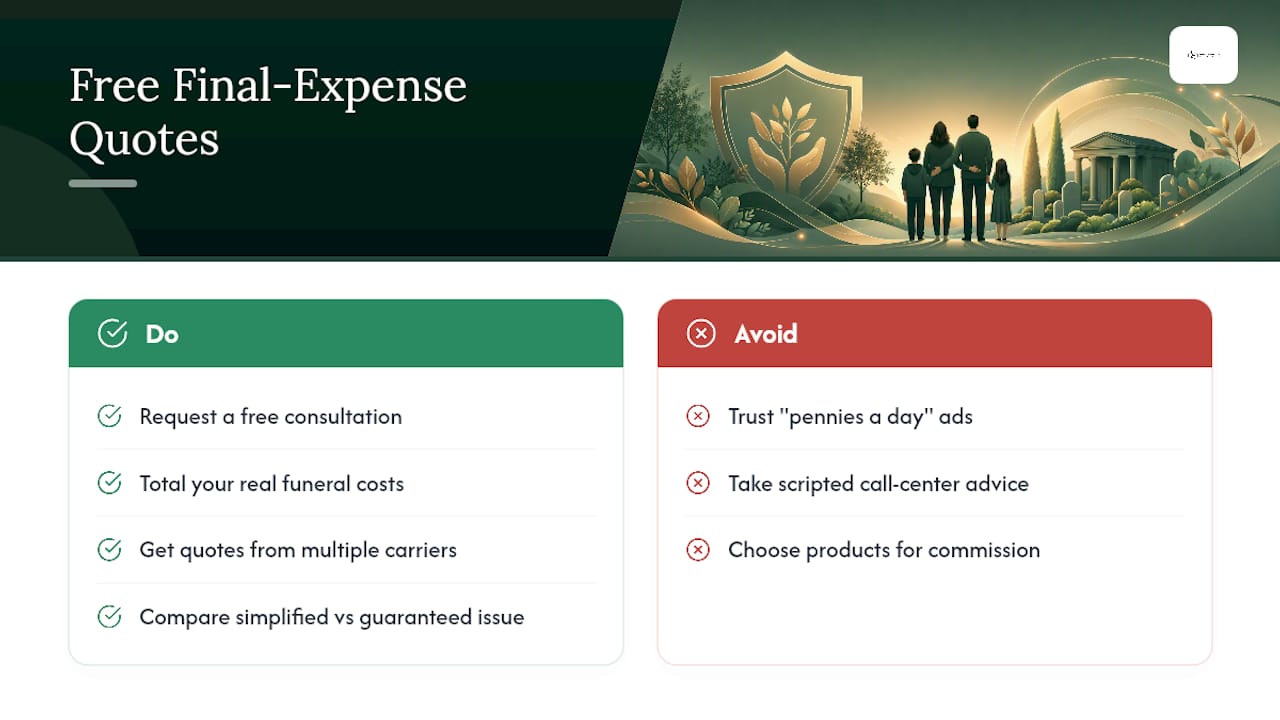
If you’re ready to see real numbers instead of ad copy, visit the life insurance page to schedule a consultation, or reach out through Mountaintop Insurance’s main site to get started.
Sources
- Final Expense Insurance Cost (2026 Rates) | MoneyGeek
- 2023 NFDA General Price List Study (PDF)
- How Much Does a Funeral Really Cost in 2026? | CNBC Select
This article is general information, not a substitute for advice from a qualified financial advisor. Consult a qualified financial professional about your own circumstances before acting on anything here.
FAQ
How much is a $10,000 burial policy?
For a healthy 50-year-old, a $10,000 policy typically runs $30 to $38 a month; the same coverage costs considerably more starting in your 70s and 80s.
Is it wise to get burial insurance?
It’s a reasonable choice for people without enough savings or existing life insurance to cover final expenses, since it guarantees a payout specifically earmarked for funeral costs without touching retirement accounts.
What does Dave Ramsey say about burial insurance?
Ramsey generally advises against standalone burial insurance for most people, arguing that a well-funded emergency savings account or existing term life coverage handles the same expense more cheaply; his advice assumes the buyer has both the time and financial discipline to build that savings cushion.
Is $10,000 enough for a funeral?
It’s often enough for a basic cremation, since the NFDA median cremation cost sits at $6,280, but it can fall short for a traditional burial once you add a cemetery plot, vault, and opening/closing fees on top of the $8,300 median burial cost.
Recommended
Disclaimer: This article is for general educational purposes only and does not constitute personalized advice. Medicare rules and plan details change frequently.
Discuss Your Situation With Us