Laddering Term Life Insurance: How to Build a Ladder

Laddering term life insurance means buying two or more term policies with different lengths, so your total coverage steps down as your debts shrink and your kids become independent. The idea is simple. Doing it well takes a clear count of what you owe, who depends on you and when each obligation ends. If you are close to Medicare age, those answers change quickly, and a local agent who sits down with you at no cost can help you size each rung. We offer free consultations in Bend and across Central Oregon, in person or remote, covering term, whole and final expense life insurance.
TL;DR
- A ladder is several term policies with staggered end dates, so coverage drops as your needs drop.
- In one published example, three $250,000 policies cost less per month than a single $750,000 30-year policy, mainly because the later rungs are cheap.
- Size each rung to a specific obligation: debts, income replacement, mortgage, education, final expenses.
- Near 65, the short rungs matter most, and a small permanent policy can cover the costs that never go away.
- Ask about conversion rights before you buy, so a rung can become permanent coverage later.
Table of Contents
- How a life insurance ladder works
- What a ladder can save
- Sizing each rung
- Laddering when you are close to Medicare age
- The permanent piece: what the ladder does not cover
- Details that decide whether the ladder works
- When a ladder makes sense, and when one policy does
- Build your ladder with us
- Perspective
- FAQ
- Sources
How a life insurance ladder works
Term life insurance pays a death benefit only if you die within a set number of years, commonly 10, 15, 20 or 30. A ladder uses several of these at once. Each policy covers a major financial obligation, and as the policies expire in different years, the total benefit steps down. According to Forbes Advisor’s guide to the ladder strategy, three $250,000 policies with 10-, 20- and 30-year terms give you $750,000 of coverage for the first 10 years, $500,000 for the next 10 and $250,000 for the last 10.
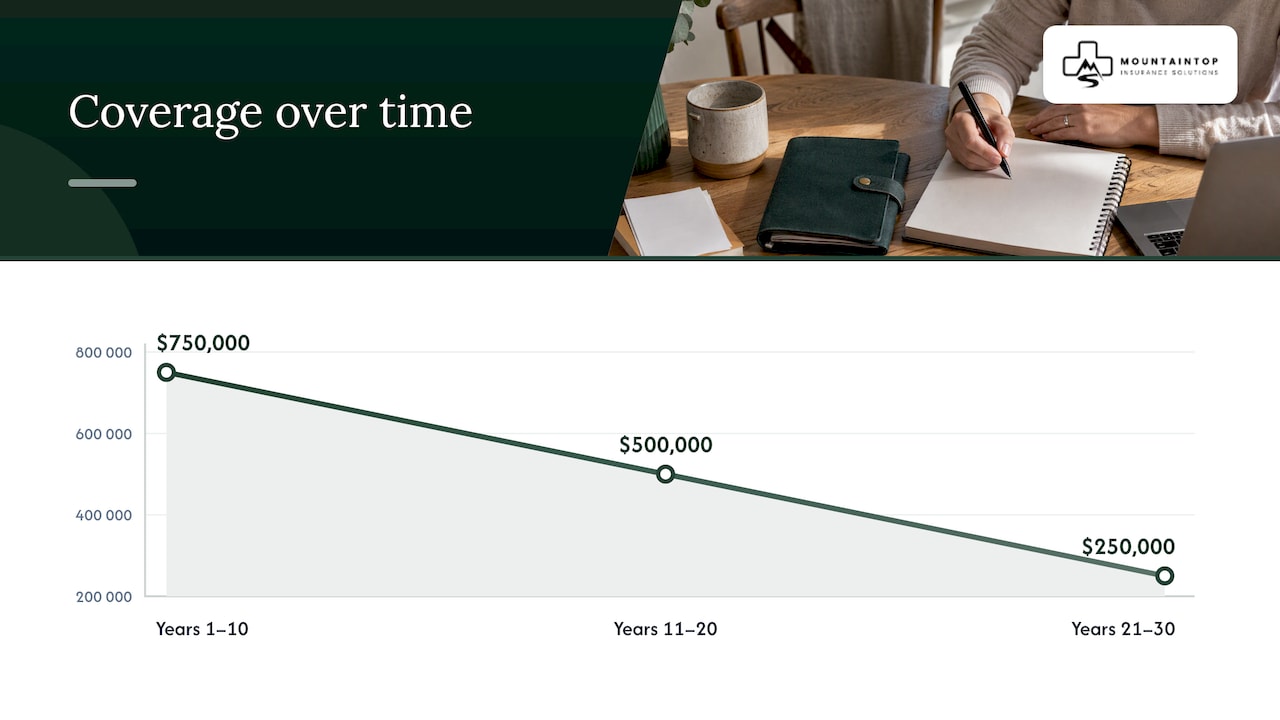
Compare that with one big policy. A single $750,000 30-year term keeps the full amount in force for 30 years, even though your mortgage balance is falling and your children will be on their own long before then. You are paying for coverage you will no longer need in year 25.
A picture of the steps
| Years | Rung 1 (10-year) | Rung 2 (20-year) | Rung 3 (30-year) | Total coverage |
|---|---|---|---|---|
| 1 to 10 | $250,000 | $250,000 | $250,000 | $750,000 |
| 11 to 20 | expired | $250,000 | $250,000 | $500,000 |
| 21 to 30 | expired | expired | $250,000 | $250,000 |
The amounts are the example from the source above. Your own rungs do not need to be equal. Many ladders have a large first rung and smaller later ones.
What a ladder can save

The same Forbes Advisor guide ran quotes for a 40-year-old nonsmoking man in average health in September 2023. Using the average of the five cheapest quotes, the ladder cost $63 a month for the first 10 years, $49 a month for the second 10 and $30 a month for the third 10. The single $750,000 30-year policy cost $69 a month.
Those are illustrative numbers for one profile, not a quote for you. What moves the price in your case:
- Age when you buy. Each year older raises the premium on every rung you add.
- Health and tobacco use. These set your rate class, which applies to the whole term.
- Term length. Longer terms cost more per $1,000 of coverage.
- Amount. A ladder lets you drop the amount on the long, expensive rungs.
The saving comes from paying for large coverage only while the need is large. It is also worth knowing that several policies means several premiums, and each one is locked at the age and health you had when you bought it.
Sizing each rung
A ladder is only as good as the sizing. Forbes Advisor describes the DIME rule, which adds up four items:
- Debt and final expenses, including funeral costs.
- Income, meaning your annual income multiplied by the number of years your family would need it, such as 10 or 20.
- Mortgage balance.
- Education costs for children.
The same guide notes that quick rules of thumb land between five and 15 times annual income, and that federal student loans need no coverage because they are discharged at death.
Matching each item to an end date
This is the step that turns a total into a ladder. For each obligation, ask when it ends:
- A mortgage with 18 years left suggests a rung of about 20 years.
- College costs for a child who is 8 suggest a rung of about 10 to 15 years.
- Income replacement for a spouse who will retire in 25 years suggests a longer rung, sized to the income gap.
- Funeral costs do not end on a schedule. They belong on the longest rung or in a permanent policy.
Write each as its own line, with an amount and an end year. The rungs fall out of the list.
Laddering when you are close to Medicare age
Most ladder articles are written for a 35-year-old with a toddler. If you are in your late 50s or early 60s, the picture looks different, and that changes how you should build the ladder.
Your obligations are shorter. Children are often grown, and the mortgage may be nearly paid. A 30-year rung rarely makes sense at 60, and one may not even be offered at your age. Your ladder is more likely to be a 10-year rung for the biggest remaining debts and a 15- or 20-year rung for a surviving spouse’s income gap.
Your income plan is changing. When you stop working, the paycheck your family counted on gets replaced by Social Security, a pension or savings. Life insurance for income replacement shrinks with it. What stays is the spouse who would lose part of a Social Security check when you die, and the costs of a final goodbye.
Health care costs enter the picture. Your first year on Medicare brings new premiums and out-of-pocket costs. Our 2027 Medicare budget worksheet helps you see what your household will spend, so you can size life insurance against a realistic retirement budget rather than your old salary.
Premiums are higher at every rung. Pricing rises with age, which is why the sizing step matters more now. Pay only for obligations that are real. If you are over 70, our guide to life insurance over 70 covers the options and costs.
The permanent piece: what the ladder does not cover
A ladder ends. Some costs do not. Funeral and burial bills arrive whenever you die, and a term policy that expired five years earlier pays nothing. That is why many people pair a short ladder with a small permanent policy.
Two types fit this job. Whole life insurance stays in force for life as long as premiums are paid. Final expense insurance is a smaller whole life policy designed for end-of-life costs. If you want to see what these bills look like in practice, our piece on burial insurance costs and real funeral bills walks through the range.
If your health has changed and underwriting is a concern, our article on guaranteed issue life insurance and its 2 to 3 year waiting period explains how that type works. For the exam itself, see what to expect at a life insurance medical exam.
Details that decide whether the ladder works
Conversion rights
Many term policies let you convert to permanent coverage without a new medical exam, but only within a window set by the policy. A ladder gives you several chances to use that right, and each rung has its own deadline. Check the conversion period for every policy before you buy, and put the dates on your calendar. Our guide to term life conversion steps shows how to set the reminder.
Riders
Riders are add-ons to a policy, such as one that waives premiums if you become disabled. Put them on the rung where they matter most rather than on all of them. Our overview of life insurance riders explains how to choose.
Return of premium
Some term policies refund your premiums if you outlive the term, at a higher price. That changes the math on a ladder, because each rung would carry the higher cost. See how return of premium term life works before you decide.
Staggered applications
You can apply for all rungs at once, which locks in today’s age and health on every one. Or you can add rungs over time as needs appear. Applying together is usually the simpler path. Applying later means a new health review each time.
When a ladder makes sense, and when one policy does
A ladder tends to fit when your obligations end at clearly different times: a mortgage that ends in 12 years, a child who finishes school in 8, a spouse who needs income support for 20. It also fits when you want lower premiums in later years without giving up high coverage now.
One policy tends to fit when you have a single obligation with a single end date, such as a 15-year mortgage and nothing else. It can also fit when you prefer one premium and one policy to track. The deciding factor is how many separate end dates your list of obligations has. If it has one, you need one policy. If it has three, you probably need three rungs.
Build your ladder with us
We help Central Oregon residents choose term, whole and final expense life insurance, and our consultations are free, in person or remote. Bring your list of debts, dependents and end dates, and we will turn it into rungs with you. If you are also approaching 65, we can look at your Medicare enrollment and life coverage in the same conversation. Start at Mountaintop Insurance, or see our Medicare eligibility page for how Parts A, B, C and D fit together.
Perspective
Most people who come to us at 60 or 63 are not asking how to buy more life insurance. They are asking how to stop overpaying for what they have, and how to line up life coverage with a new Medicare budget.
A ladder is a good way to think about that, even if you never buy a second policy. It forces you to write down what each dollar of coverage is for and when that job ends. Once it is on paper, the right amount often becomes obvious.
Our approach is education first. We would rather you leave a free consultation understanding your options and your deadlines than leave with a policy you do not fully understand. That applies to life insurance, and it applies to Medicare and Medigap, where timing rules like Oregon’s birthday rule can save you real money if you know about them.
Jesse Zimmerman
FAQ
What is the difference between laddering and buying one large policy?
A single policy keeps one amount in force for one term. A ladder stacks several policies with different end dates, so coverage steps down over time. The ladder is designed to match coverage to obligations that shrink.
Is life insurance laddering worth it at 60?
It can be, if you have separate obligations ending at different times, such as a mortgage and a spouse’s income gap. At this age, rungs are usually shorter, often 10 to 20 years. Add up each obligation and its end date first, and if there is only one, a single policy may be all you need.
Can I convert a rung to permanent coverage?
Many term policies include a conversion option, but the window and rules differ by policy. Ask about the conversion period for each rung before you buy. Our term life conversion guide explains the steps.
How much coverage should each rung have?
Start from the obligation it covers. The DIME rule adds debt and final expenses, income, mortgage and education, and rules of thumb range from five to 15 times annual income, per Forbes Advisor. Then give each amount its own end date.
Does the ladder cover funeral costs?
Only while a rung is in force. Because funeral costs arrive whenever you die, many people add a small permanent policy such as final expense insurance. We can show you how it fits with your ladder.
Sources
Recommended
Disclaimer: This article is for general educational purposes only and does not constitute personalized advice. Medicare rules and plan details change frequently.
Discuss Your Situation With Us