2–3 Year Waiting Period: Guaranteed Issue Life Insurance for Seniors

Guaranteed issue life insurance is a permanent policy that accepts almost anyone in a set age range with no medical exam and no health questions. The tradeoff: premiums run higher per dollar of coverage, face amounts stay modest, and most policies impose a graded waiting period lasting a few years that limits payouts if you die of natural causes early on. It fits seniors who’ve been turned down elsewhere or need coverage locked in fast, not healthy applicants who qualify for cheaper options.
TL;DR:
- Guaranteed issue policies offer small coverage amounts, typically up to $25,000, with premiums around $30 to $150 monthly for seniors.
- These policies include a graded death benefit period of two to three years that limits natural cause payouts, but accidental death pays full amount immediately.
- They are generally more expensive per dollar of coverage compared to simplified or fully underwritten policies, making them less suitable for healthy applicants.
- Guaranteed issue is mostly used for final expenses or for those who have been declined elsewhere, but healthy seniors should consider simplified-issue options first.
- Application approval is usually instant or very quick, with a straightforward process that involves no medical exam or questions, but the coverage size remains limited.
Table of Contents
- How Does Guaranteed Issue Life Insurance Work?
- What Is the Graded Death Benefit and How Long Does It Last?
- How Much Does Guaranteed Issue Life Insurance Cost?
- Simplified Issue vs. Guaranteed Issue: Which Should You Try First?
- What’s the Application and Claims Process Like?
- Is Guaranteed Issue Life Insurance Right for You? A Quick Checklist
- How Mountaintop Insurance Approaches Guaranteed Issue for Central Oregon Seniors
- Get a Side-by-Side Quote Before You Buy Guaranteed Issue
- Sources
- FAQ
How Does Guaranteed Issue Life Insurance Work?
Guaranteed issue policies are almost always whole life insurance, meaning permanent coverage with a fixed premium that never rises as you age. You pay the same amount every month for the rest of your life (or until the policy is paid up), and the death benefit stays flat too. There’s no renewal, no re-underwriting, and no risk of getting dropped because you developed a new health condition.
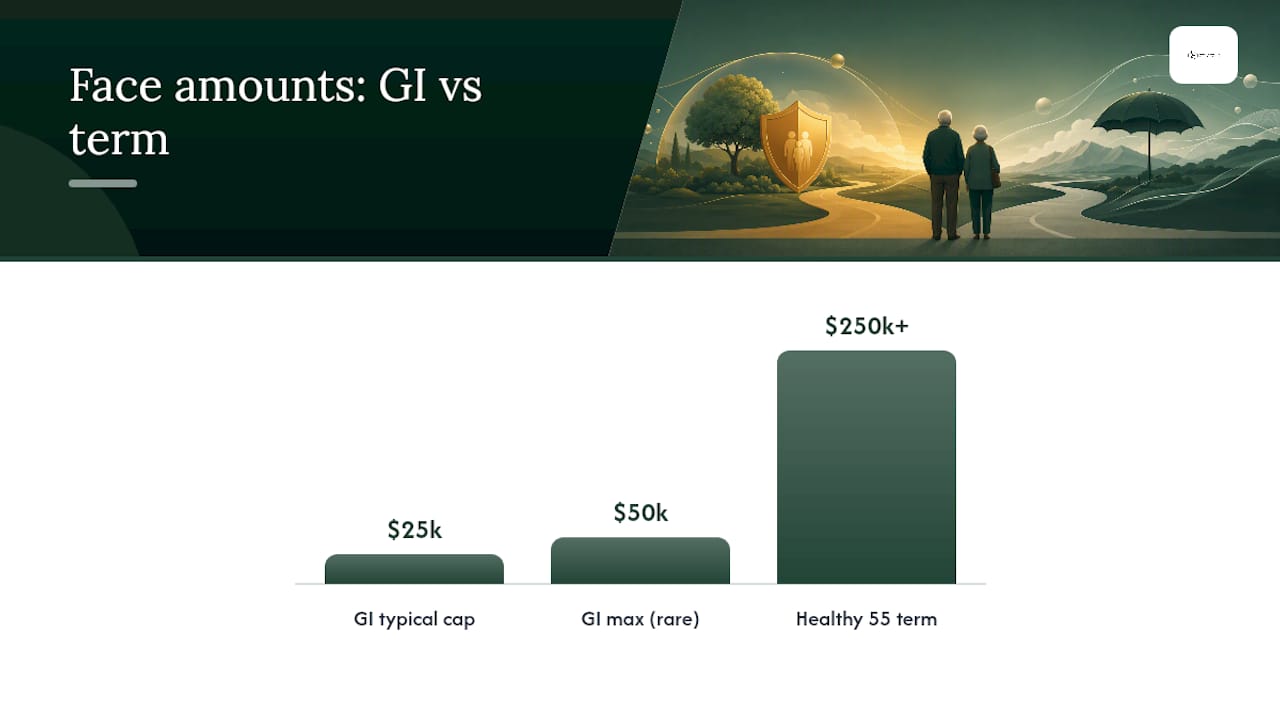
The catch is size. Because carriers accept every applicant in the eligible age band, they cap the face amount at levels commonly up to $25,000, with some limited products stretching toward $50,000. Compare that to a healthy 55 year old buying term coverage, who can often get $250,000 or more for a similar monthly premium. Guaranteed issue trades size for certainty.
Here’s what typically comes with the policy:
- Level premiums that never increase, billed monthly, quarterly, or annually
- A small cash value component that grows slowly and is not designed as a savings vehicle
- No expiration date, unlike term insurance, as long as premiums stay current
- No health questions or exam requirement at any point in the application
Cash value in these policies barely moves in the early years. Borrowing against it isn’t a realistic option until you’ve held the policy for several years, and even then the amount available is small. Treat any cash value here as a minor, long-term feature, not a source of near-term cash. If liquidity matters more to you than guaranteed acceptance, that’s a signal to look at alternatives before signing anything.
What Is the Graded Death Benefit and How Long Does It Last?
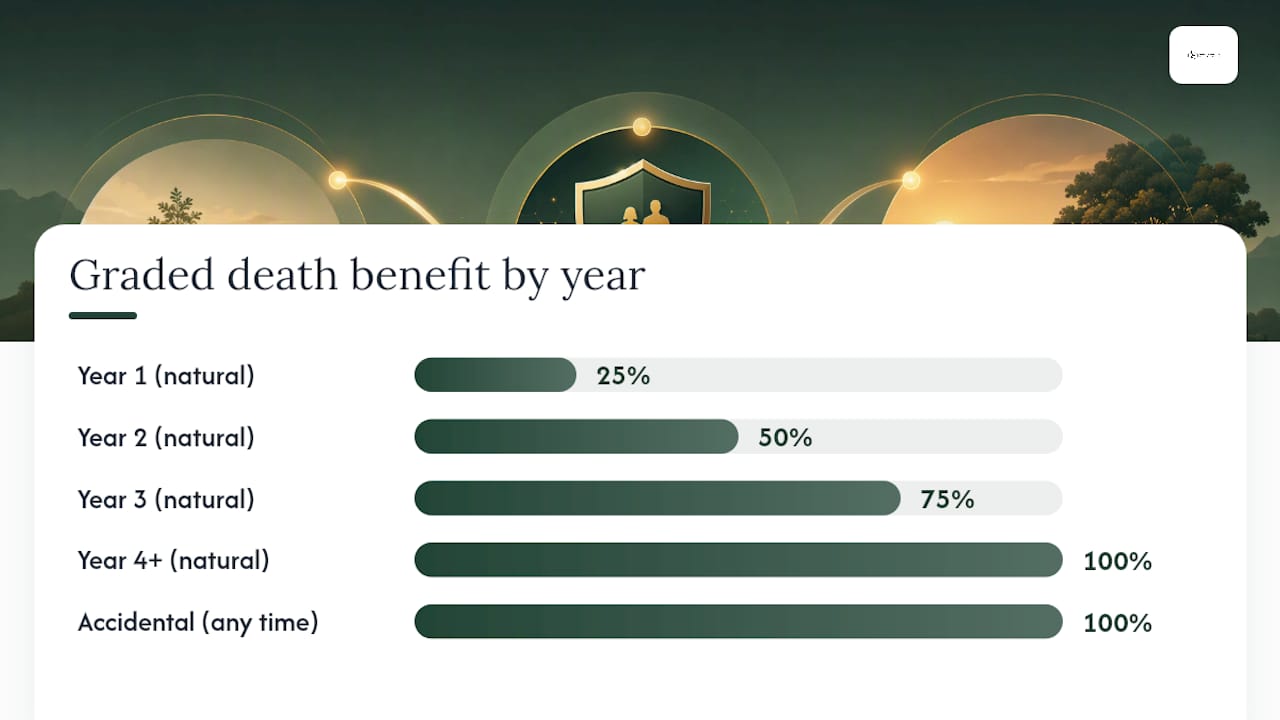
Carriers use the graded death benefit to protect themselves from adverse selection: without it, people in poor health would buy coverage right before dying, and insurers would lose money on every claim. The waiting period is usually two years, sometimes three, and it applies only to deaths from natural causes like illness.
Pro Tip: Ask for the exact Schedule of Benefits before you buy. It spells out the payout percentages year by year, and carriers are not required to make that math obvious in marketing materials.
Two payout structures dominate the market:
- Return of premiums plus interest. If you die of natural causes during the waiting period, your beneficiary gets back what you paid in, often with interest credited around 10%, or sometimes structured as 110% of total premiums paid.
- Tiered percentage staircase. A $25,000 policy might pay 25% of the face value ($6,250) in year one, 50% ($12,500) in year two, 75% ($18,750) in year three, and the full $25,000 from year four onward, though exact percentages vary by carrier.
Accidental death breaks this pattern entirely. If you die in an accident, most policies pay the full face amount from day one, no waiting period involved, because accidental death has nothing to do with a pre-existing health condition. The death certificate’s cause-of-death classification decides which payout rule applies, which is why beneficiaries should keep that document handy when filing a claim.
One more overlap to watch: the suicide exclusion often runs alongside the graded period and the contestability period. If a policyholder dies by suicide within that window, insurers can deny the death benefit and return premiums instead. None of this is hidden in fine print exactly, but it’s rarely explained clearly at the point of sale.
How Much Does Guaranteed Issue Life Insurance Cost?
Most carriers set eligibility between roughly ages 50 and 80, though some extend the window from 45 to 85. Availability and exact age bands vary by state and by carrier, so what your neighbor got approved for in Arizona might not match what’s offered in Oregon.
On cost, guaranteed issue is the most expensive coverage per dollar of death benefit in the senior insurance market. You’re paying a premium for the certainty of acceptance, not for a big payout. A simplified-issue or fully underwritten policy covering the same $10,000 or $15,000 will almost always cost less monthly for someone who can pass a short health screening.
Where guaranteed issue actually earns its place:
- Final expense coverage for funeral costs, which commonly run $30 to $150 a month depending on the policy size and provider
- Small debt payoffs so a spouse or adult child isn’t left covering a modest balance
- Applicants already declined by simplified-issue or fully underwritten carriers for health reasons
- People currently in active treatment for a serious condition who need something locked in now
If you’re generally healthy and simply dislike the idea of a medical exam, guaranteed issue is probably the wrong tool. You’d likely qualify for simplified-issue coverage at a lower rate with a higher face amount, and possibly no graded waiting period at all.
Simplified Issue vs. Guaranteed Issue: Which Should You Try First?
Try simplified issue first, in nearly every case. Simplified issue life insurance skips the medical exam but still asks a short list of health questions, usually 10 to 20 yes or no items covering major conditions like heart disease, cancer, and recent hospitalizations. Answer honestly and you can often qualify for higher coverage limits, lower premiums, and no graded waiting period at all.
The math favors simplified issue whenever your health allows it:
- Higher face amounts, frequently into the $50,000 to $100,000 range depending on age and carrier
- Lower cost per dollar of coverage than guaranteed issue
- Day-one full death benefit in many cases, since there’s no graded period to work around
- Faster underwriting decisions, often within days rather than weeks
Fully underwritten term or whole life policies go further still, requiring a medical exam and blood work, but rewarding healthy applicants with the best rates on the market. That route makes sense mainly for people under 70 in reasonably good health who want maximum coverage at minimum cost.
Pro Tip: Before signing anything, ask your agent to run side-by-side quotes: guaranteed issue against simplified issue, same face amount, same term. If the simplified-issue premium isn’t wildly different, there’s little reason to accept the graded waiting period.
What’s the Application and Claims Process Like?
Applying for guaranteed issue is designed to be fast. Many carriers approve coverage instantly online or over the phone, since there’s nothing to underwrite. Others require a mailed application and a signature, which can add a week or two before the policy takes effect.
- Submit the application with basic identifying information: name, date of birth, beneficiary designation, and payment method.
- Review your free-look period. States commonly require a minimum window, often 10 to 30 days, to cancel for a full refund. Use it to actually read the Schedule of Benefits.
- Keep premiums current. A grace period, typically 30 days, protects you if a payment is late, but a lapsed policy can mean losing coverage entirely and having to reapply.
- File a claim with a certified death certificate when the time comes. The cause-of-death classification on that document determines whether the graded rules or the full face amount apply.
The contestability period, usually two years, allows the insurer to investigate a claim for fraud or misstatement even after issuing the policy, though guaranteed issue has far fewer grounds for contest since there were no health questions to misstate in the first place.
Is Guaranteed Issue Life Insurance Right for You? A Quick Checklist
Pros: guaranteed acceptance in the eligible age range, no exam or health questions ever, permanent coverage with premiums that never rise, and a fixed death benefit once the graded period ends.
Cons: higher cost per dollar of coverage, low face amounts that rarely exceed $25,000, and a waiting period that limits payouts if you die of natural causes early.
Run through these questions before buying:
- Have you already been declined by a simplified-issue or fully underwritten carrier?
- Do you need coverage in place immediately, with no room for a health review?
- Could you honestly answer a short health questionnaire and qualify for simplified issue instead?
- Is the amount you need realistically under $25,000, matching what final-expense coverage typically provides?
Pro Tip: Walk away from any agent who won’t show you a simplified-issue quote alongside a guaranteed-issue one, or who glosses over exactly how the graded payout schedule works. That evasiveness is the biggest red flag in this corner of the market.
How Mountaintop Insurance Approaches Guaranteed Issue for Central Oregon Seniors
Mountaintop Insurance works with Central Oregon seniors every week who assume guaranteed issue is their only option, when it often isn’t. The first move in any consultation is checking whether a client can qualify for simplified issue instead, since that route usually delivers more coverage for less money. Guaranteed issue gets recommended only when the numbers genuinely support it, not by default.
That approach comes out of an education-first philosophy rather than a sales quota. Free consultations are offered, in person locally or remotely, so residents can compare options without pressure. For people navigating final-expense planning on a fixed income, having someone walk through the actual math, graded schedules included, tends to matter more than a fast signature.
— Jesse Zimmerman
Get a Side-by-Side Quote Before You Buy Guaranteed Issue
Guessing which policy fits your situation is exactly how people overpay for coverage they didn’t need to settle for. A free consultation gets you a clear eligibility check, a real comparison of simplified-issue versus guaranteed-issue quotes for your age and coverage target, and straight answers about what each option actually pays out and when.
Come prepared with your age, a rough list of any major medical conditions, and the name of your intended beneficiary. That’s enough for Mountaintop Insurance to pull relevant quotes and show you where the graded waiting period would apply and where it wouldn’t. Visit the whole life and final-expense insurance page to book a consultation and see what coverage actually looks like for your specific age and health situation before committing to anything.
This article is general information, not a substitute for advice from a qualified financial advisor. Consult a qualified financial professional about your own circumstances before acting on anything here.
Sources
- Graded death benefit: waiting periods in guaranteed issue life - LegalClarity
- Guaranteed issue life insurance - Forbes Advisor
- Guaranteed issue life insurance - NerdWallet
- Guaranteed Issue Life Insurance - Investopedia
FAQ
What Is the Best Guaranteed Issue Life Insurance?
There’s no single “best” policy across every carrier, since pricing and face amounts vary by state and age. The better question is whether guaranteed issue is even your best option. A consultation that compares simplified-issue and guaranteed-issue quotes side by side is more useful than chasing a single “top” product.
What Does a $9.95-a-Month Policy Typically Provide?
Ultra-low monthly premiums around that price point typically buy a small guaranteed-issue policy in the low thousands of dollars, not a large death benefit. These policies are usually marketed for basic final-expense help and often still carry a graded waiting period, so read the Schedule of Benefits before assuming full coverage applies immediately.
How Much Does a $1,000,000 Life Insurance Policy Cost Per Month?
A $1 million policy is not something guaranteed issue offers, since face amounts on those products typically cap around $25,000. A million-dollar death benefit requires a fully underwritten term or whole life policy, with monthly cost depending heavily on your age and health at the time of the medical exam.
How Much Does Guaranteed Issue Life Insurance Cost?
Cost depends on your age, the face amount you choose, and the carrier, but guaranteed issue runs more expensive per dollar of coverage than simplified-issue or fully underwritten policies. Final-expense policies in this category commonly land in the $30 to $150 monthly range for coverage in the low thousands to $25,000.
Is Guaranteed Issue the Same as Simplified Issue?
No. Guaranteed issue requires no health questions at all and accepts everyone in the eligible age range, while simplified issue asks a short health questionnaire and typically rewards honest, healthy answers with higher limits and lower premiums.
Recommended
Disclaimer: This article is for general educational purposes only and does not constitute personalized advice. Medicare rules and plan details change frequently.
Discuss Your Situation With Us