Medicare Vision Exams for Central Oregon Seniors, 20% Coinsurance

Original Medicare does not pay for routine eye exams, and it never covers eyeglasses or contact lenses bought for everyday vision correction. The exceptions matter: Medicare Part B does pay for diabetic eye exams, annual glaucoma screening if you’re high risk, and one pair of corrective lenses after cataract surgery. If you want routine eye care covered, a Medicare Advantage plan is usually where that benefit lives, and coverage varies widely by plan.
TL;DR:
- Medicare covers diabetic eye exams and glaucoma screenings for high-risk individuals once a year, but does not pay for routine eye exams or glasses outside of cataract surgery.
- Most routine eye care, including annual checkups and eyewear, requires a Medicare Advantage plan or standalone vision insurance, with coverage and allowances that vary significantly between plans.
- Out-of-pocket costs for covered services include the Part B deductible, 20% coinsurance, and ensuring eyewear suppliers are Medicare-enrolled to avoid unexpected bills.
- Confirming coverage details before appointments involves checking plan benefits, provider networks, and supplier Medicare status, especially to avoid billing surprises after cataract surgery.
- Local assistance improves plan comparisons by focusing on exam frequency, eyewear allowances, and network access, rather than relying solely on plan names or premiums.
Table of Contents
- What Does Original Medicare Cover for Vision?
- Which Eye Services Does Medicare Actually Pay For?
- Getting Routine Vision Coverage: Medicare Advantage and Other Options
- What Will You Actually Pay Out of Pocket?
- How to Confirm Your Vision Benefits Before Your Next Appointment
- How Do You Appeal a Denied Vision Claim?
- Does Medigap Help With Vision Costs?
- Why Beneficiaries Get Tripped Up on Vision Coverage
- Get Help Comparing Your Vision and Medicare Options
- Where to Verify These Rules Yourself
- Sources
- FAQ
What Does Original Medicare Cover for Vision?
Routine vision care sits outside what Original Medicare pays for. That includes the eye exam you’d get to update your glasses prescription, sometimes called an eye refraction, along with the glasses or contacts themselves. Medicare: you pay 100% of the cost for these routine services, whether that’s an annual checkup at your optometrist’s office or a new pair of frames.
What Original Medicare does cover is narrower and more specific. Part B pays for eye care that’s medically necessary, meaning a doctor determines the service is needed to diagnose or treat an illness, injury, or condition, not just to check whether your prescription changed. Medicare’s own language uses the phrase “reasonable and necessary” to describe this standard, and it’s the line that separates a covered diagnostic test from a non-covered vision checkup.
The Medicare & You handbook reinforces this same boundary every year: routine eye exams and corrective eyewear are out, medically necessary eye disease screening and treatment are in. Knowing which side of that line your appointment falls on determines whether Medicare pays a cent.
Which Eye Services Does Medicare Actually Pay For?
Four categories of eye care get Part B coverage, and each comes with its own eligibility rules.
Glaucoma screening is covered once a year, but only if you’re considered high risk: someone with diabetes, a family history of glaucoma, African American and age 50 or older, or Hispanic and age 65 or older. The screening itself includes a dilated eye exam and a measurement of intraocular pressure, billed under HCPCS codes G0117 or G0118 depending on whether an ophthalmologist or optometrist performs it.
Diabetic eye exams are covered once every 12 months for anyone with diabetes, since diabetic retinopathy can develop without symptoms. Medicare treats this as a preventive necessity, not a routine checkup, which is why it’s covered when a standard vision exam isn’t.
Cataract surgery is covered, and afterward Medicare pays for one pair of standard eyeglasses or one set of contact lenses, but only if you buy them from a supplier enrolled in Medicare.
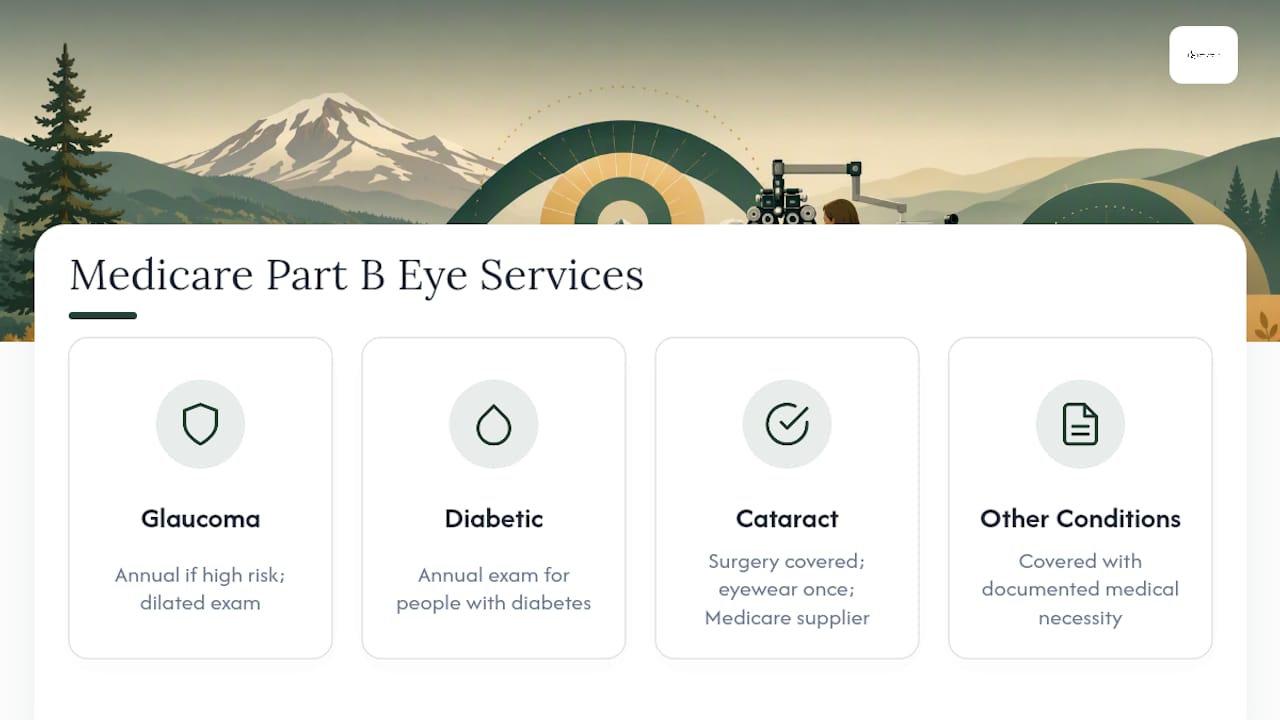
Other medical eye conditions, including wet macular degeneration treated with injections, are covered when a doctor documents medical necessity.
Getting Routine Vision Coverage: Medicare Advantage and Other Options
If you want your annual eye exam and a new pair of glasses covered, Original Medicare won’t get you there. This is where a Medicare Advantage plan usually comes in. Most Part C plans bundle in some level of routine vision benefit that Original Medicare simply doesn’t offer, but the scope of that benefit is entirely up to the individual plan. One plan might cover a comprehensive eye exam plus a $150 eyewear allowance every year; another might cap it at $100 every two years with a smaller provider network. There’s no standard baseline, so the plan name tells you almost nothing until you read the actual benefit summary.
A few things to check before you assume a Medicare Advantage plan solves your vision needs:
- Exam frequency: is it covered annually, or every 24 months?
- Eyewear allowance: what dollar amount applies to frames and lenses, and does it reset yearly?
- Provider network: is your current optometrist in-network, or will you pay more out of network?
- Upgrade costs: progressive lenses, anti-glare coating, and designer frames often cost extra even with an allowance.
Beyond Medicare Advantage, several other paths exist for routine vision care:
- Standalone vision insurance, bought separately from any Medicare plan, often at a modest monthly premium with set exam and eyewear allowances.
- Employer or retiree benefits, if you’re still covered under a former employer’s plan that includes vision.
- VA vision benefits, for eligible veterans, which can cover exams and eyewear outside the Medicare system entirely.
- Charitable and community programs, including local health department clinics and nonprofit vision assistance programs, for beneficiaries on a tight budget.
None of these routes are mutually exclusive. Plenty of Central Oregon retirees layer a Medicare Advantage plan’s vision benefit with an occasional charity clinic visit when they need something the plan doesn’t fully cover.
What Will You Actually Pay Out of Pocket?
For any Medicare-covered eye service, standard Part B cost sharing applies. You’ll owe the annual Part B deductible if you haven’t met it yet, then 20% coinsurance on the Medicare-approved amount for that service. For anything Medicare classifies as routine, non-covered vision care, you pay the full bill yourself with no Medicare contribution at all.
The supplier rule for post-cataract eyewear catches people off guard more than almost any other detail in this coverage: your eyeglasses or contacts have to come from a supplier enrolled in Medicare, or Medicare won’t pay its share, even though the surgery itself was fully covered.
Three steps protect you from a surprise bill:
- Ask your eye doctor’s office directly whether they bill Medicare for the service you’re scheduled for.
- Confirm the eyewear supplier’s Medicare enrollment status before you order post-cataract glasses or contacts.
- Get a written cost estimate for anything beyond the basic covered service, including lens upgrades.
Pro Tip: Call the supplier and ask them to say, in plain words, “Yes, we are enrolled in Medicare and will bill Medicare for this order.” A vague “we accept Medicare patients” answer isn’t the same thing and won’t guarantee payment.
How to Confirm Your Vision Benefits Before Your Next Appointment
Start by figuring out which type of Medicare you actually have. If you’re on Original Medicare, your vision coverage is limited to the medically necessary services already covered above. If you’re on a Medicare Advantage plan, pull out your Summary of Benefits and look specifically for the vision section.
From there, a short phone call saves you from a surprise invoice later:
- Use your plan’s provider directory to confirm your eye doctor is in-network before booking.
- Call and ask: “Is this specific exam or service covered under my plan?”
- Ask: “Will you bill Medicare or my Medicare Advantage plan directly, or do I pay upfront?”
- Ask: “What will I owe out of pocket after coverage, including any frame upgrade?”
If you need vision care right now and don’t have routine coverage in place, you still have options. Retail optical chains often run flat-fee exam specials, community health centers sometimes offer sliding-scale eye care, and basic frames can run under $50 at discount opticals when you’re paying cash. None of these replace a real benefit, but they keep you from delaying care while you sort out your plan.
How Do You Appeal a Denied Vision Claim?
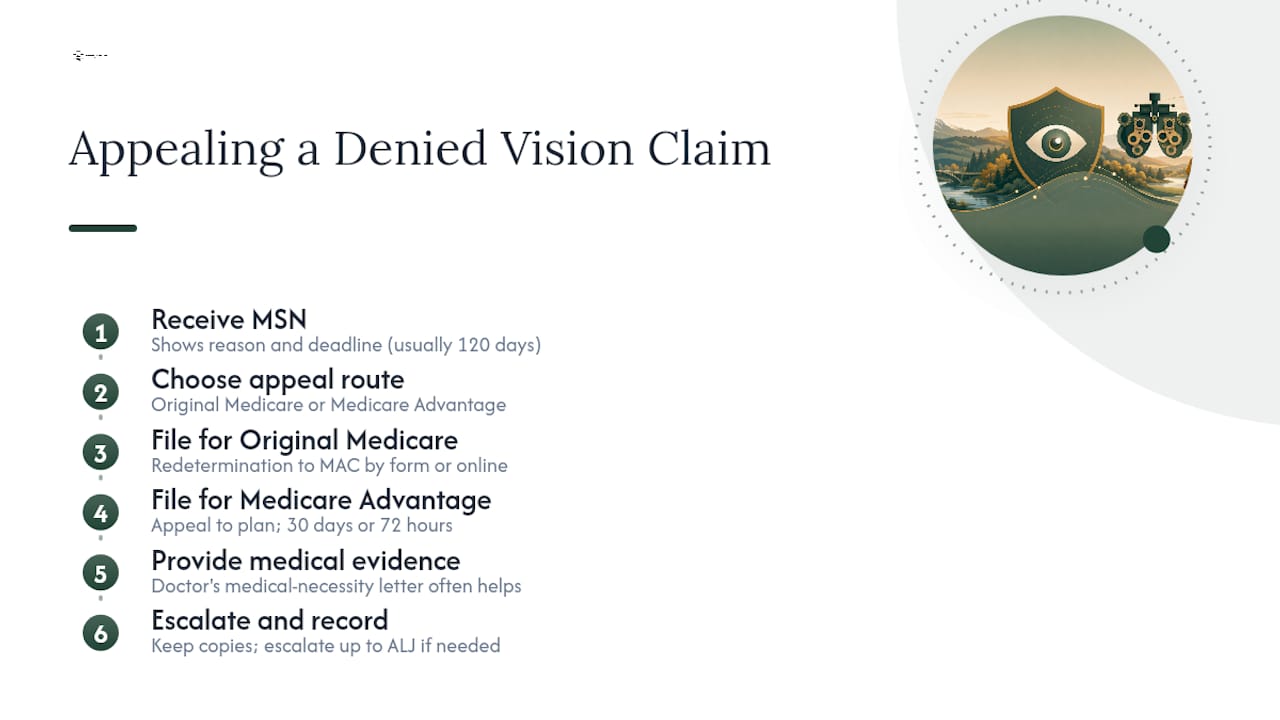
Start with the Medicare Summary Notice (MSN) you receive after a claim is processed. It lists the reason for denial and the deadline to appeal, usually 120 days from the date on the notice. If you’re on Original Medicare, you file what’s called a redetermination request directly with the Medicare Administrative Contractor listed on the MSN, either by mail using the form on the back of the notice or online.
If you’re enrolled in a Medicare Advantage plan, the appeal goes to the plan itself, not to Medicare directly, and the plan is required to respond within a set timeframe, typically 30 days for a standard request or 72 hours if you mark it urgent. Ask your plan for its specific appeals form and address when you call to dispute the denial.
Before filing, get your eye doctor’s office involved. A short letter of medical necessity from the provider, explaining why the service met Medicare’s coverage criteria, often resolves a denial faster than the formal appeal process alone. This is especially common with glaucoma screening denials, where the paperwork sometimes fails to document the high-risk qualifying factor clearly enough the first time around.
If the first appeal is denied, you have the right to escalate through additional levels of review, up to and including a hearing before an administrative law judge for larger disputed amounts. Most vision-related denials resolve at the first or second level once the medical necessity documentation is corrected, so don’t assume a denial is final. Keep copies of every notice, letter, and phone call date in case you need to reference the timeline later.
Does Medigap Help With Vision Costs?
Medigap plans don’t add new vision benefits, but they change what you pay for the vision services Original Medicare already covers.
That distinction trips people up constantly. Medigap doesn’t pay for routine eye exams or eyeglasses, because Medicare itself doesn’t cover those services in the first place. There’s nothing for Medigap to supplement.
If routine vision coverage is your priority, Medigap isn’t the tool for that job. That’s a Medicare Advantage plan’s job, or a standalone vision policy. But if you’re already dealing with a diabetic eye condition or recovering from cataract surgery and want to minimize your out-of-pocket exposure on the covered portions of that care, a Medigap policy paired with Original Medicare can make a real difference in your annual costs. It’s worth reviewing during any Medicare plan comparison, particularly if you switch plans during Oregon’s birthday rule window.
Why Beneficiaries Get Tripped Up on Vision Coverage
The confusion around Medicare and vision care almost never comes from a lack of information. It comes from too much information delivered without context. Beneficiaries read that Medicare covers “eye exams” somewhere online, assume that means the annual checkup at their optometrist, and get blindsided at checkout when it’s a diabetic screening or glaucoma test that qualified, not the vision refraction they actually came in for.
The NCOA has flagged this exact misconception as one of the more persistent ones among older adults navigating Medicare, and I think it’s worth saying plainly: the gap between “Medicare covers eye care” and “Medicare covers this specific eye care” is where most surprise bills originate. It’s not that the rules are secret. It’s that nobody explains them in the order that actually matters to a person sitting in an exam chair.
What frustrates me most about how this topic gets covered elsewhere is the assumption that once someone picks a Medicare Advantage plan with a vision benefit, the job is done. It isn’t. Those benefits reset, change from year to year, and vary enormously between plans that look nearly identical on a brochure. A plan that covered a full frame allowance last year might trim that benefit at renewal, and most people don’t find out until they’re standing at the counter with a pair of glasses they didn’t budget for.
This is exactly the kind of detail that gets lost when people compare plans purely on premium. If routine vision coverage matters to you, ask about it by name, every single year, not just when you first enroll.
— Jesse Zimmerman
Get Help Comparing Your Vision and Medicare Options
There are local alternatives to guessing your way through a plan brochure. Unlike national call centers, these services provide personal consultations to Central Oregon residents, in person or remotely, to explain exactly what Medicare Advantage plan vision benefits cover before enrollment, not after.
Our Medicare Enrollment Assistance service helps you compare plans side by side on the details that actually matter: exam frequency, eyewear allowance, and network access. If you’re already enrolled, an Annual Medicare Plan Review checks whether your current plan’s vision benefit still fits your needs or quietly changed at renewal. We also help clients sort through dental and vision coverage options alongside their Medicare choices, since the two often get bundled together in ways that are easy to misread.
Consultations are free, and there’s no pressure to enroll through us. Visit Mountaintop Insurance to schedule a conversation and get clear answers on what your plan actually covers.
Where to Verify These Rules Yourself
For the official word on what’s covered, Medicare.gov’s eye exam page and the CMS Medicare Learning Network vision services fact sheet lay out coverage rules and billing codes directly from the source. The NCOA’s guide to Medicare and vision coverage breaks down common misconceptions in plainer language, and the annual Medicare & You handbook confirms the same rules in the booklet mailed to every beneficiary each fall.
This article is general information, not a substitute for advice from a qualified financial advisor. Consult a qualified financial professional about your own circumstances before acting on anything here.
Sources
FAQ
Does Medicare Still Pay for Eye Exams?
Medicare pays for eye exams only when they’re medically necessary, such as diabetic eye exams or glaucoma screening for high-risk beneficiaries. It does not pay for routine eye exams done simply to update your glasses or contacts prescription.
How Often Will Medicare Pay for an Eye Test?
Medicare covers a diabetic eye exam once every 12 months for people with diabetes, and a glaucoma screening once a year for those meeting high-risk criteria. Routine eye exams have no coverage frequency because Original Medicare doesn’t cover them at all.
What Are the Vision Coverage Options for Medicare in 2026?
Original Medicare still excludes routine vision care, so most beneficiaries who want eye exams and eyewear covered turn to a Medicare Advantage plan, a standalone vision policy, or employer retiree benefits. Medicare Advantage vision benefits vary by plan, so comparing exam frequency and eyewear allowance across plans matters more than the plan’s name or premium.
How Many Eye Exams Will Medicare Cover in a Year?
Original Medicare covers one diabetic eye exam and one glaucoma screening per year if you qualify for each, but zero routine vision exams. A Medicare Advantage plan with a vision benefit may cover one comprehensive routine exam annually, though the exact frequency depends on the specific plan you’re enrolled in.
Can a local insurance agency help me find a plan with vision coverage?
Yes. Many local agencies offer free consultations to compare Medicare Advantage plans with vision benefits against Original Medicare paired with standalone vision coverage, based on your specific eye care needs and budget.
Recommended
Disclaimer: This article is for general educational purposes only and does not constitute personalized advice. Medicare rules and plan details change frequently.
Discuss Your Situation With Us