$2,100 Part D Cap: Medicare Open Enrollment 2026 for Central Oregon

Medicare Open Enrollment 2026 runs from October 15 through December 7, giving every Medicare enrollee a window to join, switch, or drop a Medicare Advantage or Part D plan, or move between Original Medicare and Medicare Advantage. Make the switch by December 7, and your new coverage starts January 1, 2027. Miss it, and your options narrow fast.
TL;DR:
- Most plan changes must be submitted by December 7 to take effect on January 1, 2027, with early submission recommended to avoid errors.
- Switching from Medicare Advantage to Original Medicare may require applying for Medigap, but out-of-state insurers can underwrite unless protected by specific state rules.
- The 2026 Part D out-of-pocket spending cap is approximately $2,100, making it essential to compare total drug costs and formulary changes rather than premiums alone.
- Checking your current plan’s benefit and drug formulary details in ANOC and EOC letters helps avoid costly surprises from formulary shifts or network restrictions.
- Those who miss the deadline can still use the Medicare Advantage Open Enrollment or qualifying Special Enrollment Periods, but late enrollment can lead to penalties.
Table of Contents
- What Actions Can You Take During Medicare Open Enrollment?
- When Do Medicare Plan Changes Take Effect in 2026?
- What’s New for Medicare Part D and Advantage in 2026?
- How Do You Compare and Enroll in a 2026 Medicare Plan?
- What If You Miss the Medicare Enrollment Deadline?
- Can You Still Change Plans If You Get Extra Help?
- What Should You Know If You’re Newly Eligible for Medicare?
- A Local Agent’s View on Getting Open Enrollment Right
- Book a Free Medicare Enrollment Consultation With Mountaintop Insurance
- Sources
- FAQ
What Actions Can You Take During Medicare Open Enrollment?
What you can actually do during Open Enrollment depends on where you’re starting from. Medicare does not hand every enrollee the same menu of choices, so it helps to know your own starting point before you start comparing plans.
- If you have Original Medicare: You can add a standalone Part D drug plan, or leave Original Medicare altogether and enroll in a Medicare Advantage plan that includes drug coverage.
- If you have Medicare Advantage: You can switch to a different MA plan, or drop MA and return to Original Medicare (picking up a Part D plan if you want drug coverage).
- If you’re moving from MA back to Original Medicare: You may want to apply for a Medigap policy, but insurers outside your state’s guaranteed-issue window can medically underwrite you. Oregon residents get extra protection here through the state’s Medigap Birthday Rule, which allows an annual switch window without medical underwriting.
- Service-area limits apply: Not every plan is sold in every county, so a plan that looks perfect on paper may not actually be available where you live.
None of these moves happen automatically. Each one requires you to actually submit a request, whether online, by phone, or through an agent.
When Do Medicare Plan Changes Take Effect in 2026?
The mechanics are simple, but the timing trips up a lot of people every single year. Open Enrollment runs October 15 through December 7, and any enrollment request a plan receives by that closing date takes effect January 1, 2027.
Here’s the sequence that matters:
- October 15: Open Enrollment begins. Plan details for the coming year are typically published by CMS and insurers starting in October, so you can start comparing before the window even opens.
- Early to mid November: The ideal submission window. Submitting now, rather than waiting until the last few days, gives you time to catch and fix errors, like a missing signature or a mismatched Medicare number, before the deadline closes.
- December 7: The hard cutoff. Your enrollment request must be received by the plan by this date, not just postmarked or started.
- January 1, 2027: New coverage begins for everyone who enrolled on time.
If you’re already in a Medicare Advantage plan, you get a second bite at the apple: the Medicare Advantage Open Enrollment Period runs January 1 through March 31. During that window you can switch to a different MA plan or drop MA for Original Medicare, but you cannot use it to join Part D from Original Medicare or hop between standalone drug plans. It’s a narrower tool, not a second AEP.
Pro Tip: Save your confirmation number and the date you submitted every enrollment request. If a plan later claims it never received your change, that record is often the only thing standing between you and a coverage gap.
What’s New for Medicare Part D and Advantage in 2026?
The biggest shift for 2026 isn’t a new plan option. It’s a restructured Part D benefit that changes how much you’ll actually pay out of pocket over the course of the year.
Under the Inflation Reduction Act changes finalized by CMS, the Part D out-of-pocket spending cap lands at roughly $2,100 for 2026. Once you hit that threshold, you owe nothing more for covered drugs the rest of the year.
That single number reshapes how you should shop:
- The deductible and initial coverage phase both shifted under the redesign, changing how quickly you move toward that cap depending on which drugs you take.
- Insulin products carry a separate cost-sharing cap, so check that figure specifically if insulin is part of your regimen.
- CMS’s rate announcement also updates negotiated prices on select high-cost drugs, which can shift a plan’s formulary tier and your copay for that drug specifically.
- Prior authorization rules and formulary tiers vary by plan and can change year to year, even for a drug you’ve taken for a decade.
Policy analysts covering the 2026 contract-year changes note that these formulary and cost-sharing shifts make projected annual drug spending a more useful comparison point than the sticker price of the monthly premium. A plan with a $10 lower premium can easily cost you hundreds more over a year if your specific prescriptions sit on a higher tier. Read our breakdown of the Part D deductible for 2026 for the deductible-side detail, and check CMS’s own fact sheets before assuming last year’s plan still fits.
How Do You Compare and Enroll in a 2026 Medicare Plan?
Comparing plans well takes about 30 minutes if you gather the right documents first. Skipping that step is how people end up re-enrolling in the same plan out of habit, even when a better fit exists.
Start with paperwork:
- Pull your current plan’s Annual Notice of Change (ANOC) and Evidence of Coverage (EOC). Medicare’s own guidance is blunt about this: benefits, costs, and provider networks can all change year to year, even if you never touch a thing.
- List every prescription you currently take, including dosage and frequency.
- Write down the names of your doctors, specialists, and preferred pharmacy.
From there, move to Medicare.gov’s Plan Finder tool and run the comparison:
- Compare monthly premiums against estimated yearly drug costs, not just the premium alone.
- Check whether your specific medications appear on each plan’s formulary, and at what tier.
- Confirm your doctors and pharmacy are in-network, since a lower premium plan with an out-of-network specialist can cost far more overall. If network fit is a top concern, it helps to understand how HMO and PPO structures differ before you commit.
- Note any prior authorization or step-therapy requirements attached to your medications.
You can submit the actual enrollment online through Medicare.gov, by calling 1-800-MEDICARE, by mail, or through a licensed agent. Whichever channel you use, save the confirmation number or a copy of the completed form. That’s your proof if anything gets lost in processing.
What If You Miss the Medicare Enrollment Deadline?
Missing December 7 doesn’t lock you out for the whole year, but it does shrink your options considerably.
- If you’re already in Medicare Advantage, the MA Open Enrollment Period (January 1 to March 31) lets you switch MA plans or return to Original Medicare, but it won’t let you add a standalone Part D plan from scratch.
- Special Enrollment Periods open up for specific life events: moving out of your plan’s service area, losing employer coverage, qualifying for Extra Help, or a handful of other triggers. Our guide to Medicare Special Enrollment walks through which events qualify.
- Going without Part D or creditable drug coverage for 63 days or more can trigger a late-enrollment penalty that gets added to your premium for as long as you have Part D, so this isn’t a risk-free wait-and-see situation.
- If you think you tried to enroll on time and something went wrong, document everything and call 1-800-MEDICARE, or bring the paperwork to a local agent who can help sort out what happened.
Can You Still Change Plans If You Get Extra Help?
Yes, and the rules actually work in your favor if you receive Extra Help (the Low-Income Subsidy). Beneficiaries with Extra Help get a Special Enrollment Period that runs once per calendar quarter for the first three quarters of the year, letting you switch Part D plans outside the standard Open Enrollment window without waiting for AEP. That flexibility disappears in the fourth quarter, when Extra Help recipients fall back into the same October 15 to December 7 window everyone else uses.
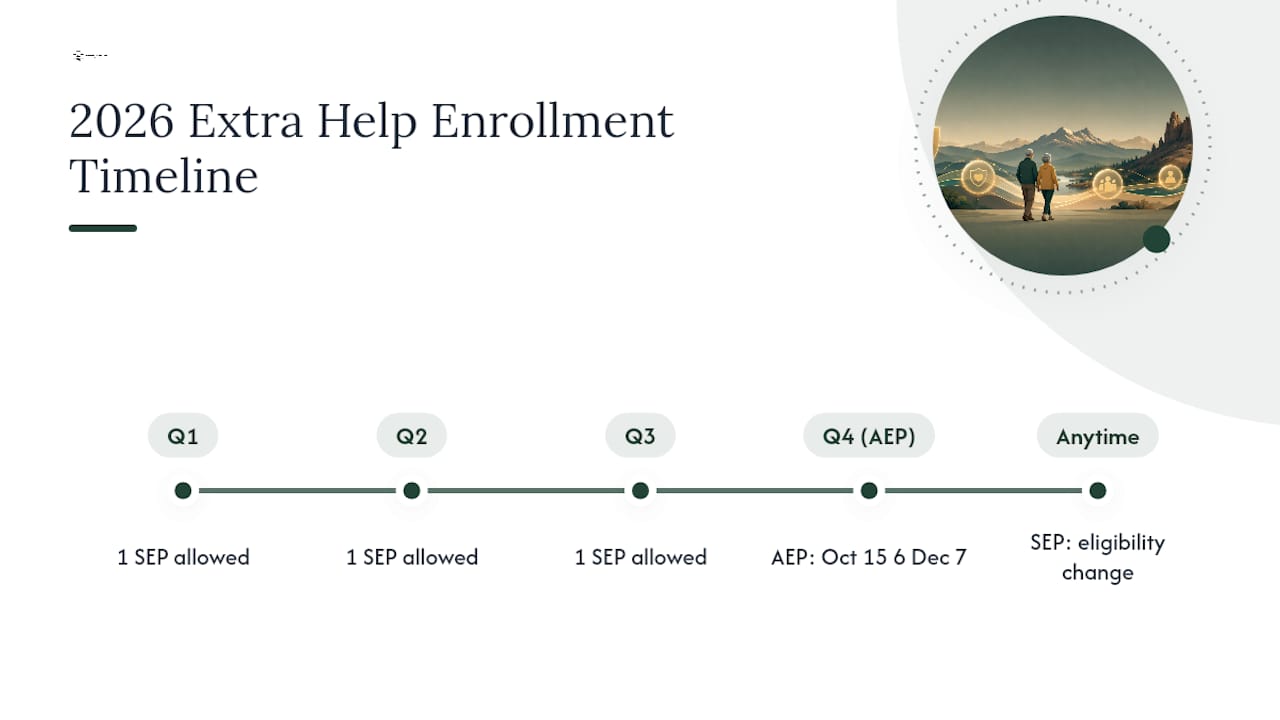
Losing or gaining Extra Help eligibility itself can also trigger a Special Enrollment Period, so a change in your subsidy status is worth checking against your current plan even outside AEP.
One detail catches people off guard: your Extra Help subsidy doesn’t automatically follow you to a new plan’s specific costs. Copay amounts for covered drugs can vary slightly between plans even for subsidy recipients, so it’s still worth checking your prescription list against a new plan’s formulary rather than assuming the subsidy makes every plan identical. If you’re reassigned to a new benchmark plan because your current one changed its premium, Medicare will typically notify you by mail. Read that notice carefully. It often arrives close to the same time as your ANOC, and the two documents cover different things.
What Should You Know If You’re Newly Eligible for Medicare?
Turning 65 or becoming Medicare-eligible right around Open Enrollment puts you in a slightly different situation than someone who’s had coverage for years.
Your Initial Enrollment Period is seven months long: it starts three months before the month you turn 65, includes your birthday month, and runs three months after. If your IEP overlaps with the October 15 to December 7 Open Enrollment window, you generally follow whichever period’s rules apply to the specific action you’re taking; a licensed agent or 1-800-MEDICARE can confirm which timeline governs your exact case.
A few things worth checking before you enroll for the first time:
- Confirm whether you’re still covered by an employer plan, since that can change whether you need to enroll in Part B right away or can delay it without penalty.
- If you’re choosing between Original Medicare and Medicare Advantage for the first time, that first decision is worth more research time than most people give it, since switching later isn’t always as simple as switching back.
- Enrolling in Part B late without creditable coverage can trigger a permanent premium penalty, so don’t assume you can wait indefinitely.
Our overview of Medicare enrollment periods for 2026 breaks down how IEP, AEP, and SEP windows interact for anyone approaching eligibility for the first time.
A Local Agent’s View on Getting Open Enrollment Right
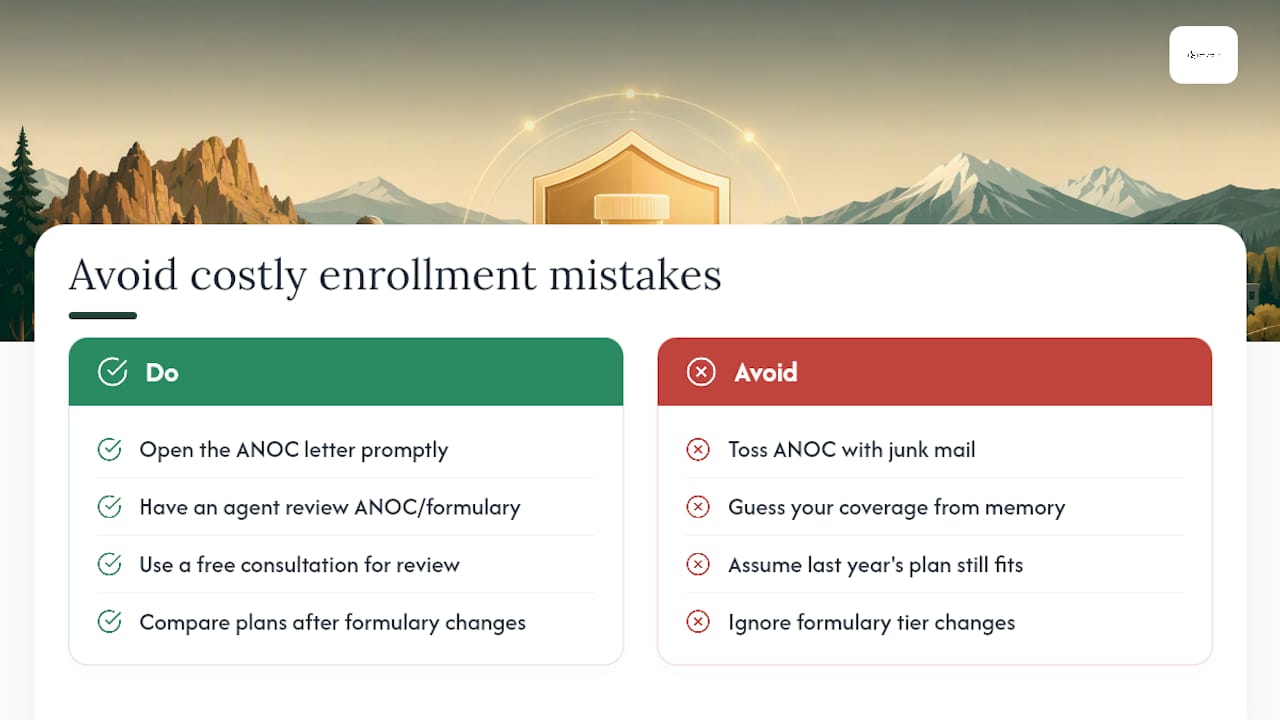
Most of the confusion during Open Enrollment isn’t about the dates. It’s about the paperwork nobody reads: the ANOC letter that arrives in a plain envelope in September and gets tossed with the junk mail. That letter is where your plan quietly tells you it’s moving a drug to a higher tier or dropping a doctor from network, and most people never open it.
The Part D redesign for 2026 makes that habit more expensive than usual. When formularies shift and out-of-pocket caps change, the plan that made sense last year might not be the best value this year, even if nothing about your health changed. Working through that comparison with someone who reviews these documents for a living, rather than guessing from memory, tends to catch the changes that actually affect your wallet. Free consultations are offered that include ANOC and formulary review to help clients understand their current coverage before considering changes.
— Jesse Zimmerman
Book a Free Medicare Enrollment Consultation With Mountaintop Insurance
A local agency provides an alternative to call center approaches for Medicare Open Enrollment 2026 in Central Oregon, offering free consultations—both in person and remotely—to help residents compare plans, check formulary and network fit against the 2026 Part D changes, and assist with accurate enrollment submission.
Before your consultation, gather your ANOC letter, your full medication list with dosages, and the names of your doctors and pharmacy. That’s it. From there, options are reviewed side by side, with assistance provided to help file for the plan that fits health needs and budget.
Schedule your free Medicare consultation with Mountaintop Insurance before the December 7 deadline closes.
This article is general information, not a substitute for advice from a qualified financial advisor. Consult a qualified financial professional about your own circumstances before acting on anything here.
Sources
FAQ
Is It Too Late to Switch Medicare Plans for 2026?
Not yet. Open Enrollment runs through December 7, and any switch a plan receives by that date takes effect January 1, 2027. After December 7, your options shrink to Special Enrollment Periods or the narrower Medicare Advantage Open Enrollment Period from January through March.
Is Medicare Free at Age 65 for Seniors?
Part A is usually premium-free if you or a spouse paid Medicare taxes for at least 10 years, but Part B carries a monthly premium, and most people also pay something for Part D drug coverage or a Medicare Advantage plan.
What Will the Medicare Premium Be for 2026?
Part B premiums for 2026 are set annually by CMS and vary by income bracket, so check the current figure directly through Medicare.gov or your Medicare & You handbook rather than relying on last year’s amount; our Part B premium guide covers what factors into that number.
Can I Drop My Medicare Advantage Plan and Go Back to Original Medicare?
Yes. You can drop Medicare Advantage and return to Original Medicare during Open Enrollment (October 15 to December 7) or during the Medicare Advantage Open Enrollment Period (January 1 to March 31), and you can add a Part D plan at the same time if you want drug coverage.
Recommended
Disclaimer: This article is for general educational purposes only and does not constitute personalized advice. Medicare rules and plan details change frequently.
Discuss Your Situation With Us