Stand-Alone Dental Plans for Medicare-Age Adults in Oregon

A stand-alone dental plan is a dental policy you buy by itself, not as part of a medical plan. For most people on Medicare, it is one of two realistic ways to pay for cleanings, fillings, crowns and dentures. The other is a Medicare Advantage plan that includes dental benefits. At Mountain Top Insurance in Bend, we help Central Oregon residents compare both, at no cost, so you pick the one that fits your teeth and your budget before you enroll.
TL;DR
- Original Medicare doesn’t cover most dental care, including routine cleanings, fillings, extractions, dentures and implants.
- Retirees can buy a stand-alone dental plan directly from an insurance company, and an agent can compare several for you. Medigap plans mostly don’t include dental.
- The details that decide whether a plan is worth it are the waiting period, the annual maximum, the deductible and whether your dentist is in the network.
- If you pay too much for Medigap, Oregon’s birthday rule lets you change Medigap plans without health questions, which can free up money for dental.
Table of Contents
- What Medicare leaves out, and why it matters
- What a stand-alone dental plan is
- The five things that decide whether a plan is worth it
- A quick example of how the math works
- Stand-alone plan or Medicare Advantage with dental?
- If you pay too much for Medigap: the Oregon birthday rule
- What about other ways to pay for dental care?
- How to choose, step by step
- How we help with dental coverage
- Our perspective
- FAQ
- Sources
What Medicare leaves out, and why it matters
Medicare.gov says Original Medicare covers no routine dental care in most cases: no cleanings, fillings, tooth extractions, dentures or implants. It can pay for certain dental services tied closely to a covered medical treatment, such as a heart valve replacement, an organ transplant, cancer treatment or kidney dialysis. When Part B does pay, you owe 20% of the Medicare-approved amount after the Part B deductible.
The law behind this is old. KFF explains that Medicare is prohibited by statute from paying for the care, filling, removal or replacement of teeth. Recent payment rules have widened the exceptions slightly, for exams before organ transplants and heart valve procedures, around head and neck cancer treatment, and around dialysis. KFF notes that these changes help a small number of people, and that routine preventive care, root canals and dentures remain generally uncovered.
The Oregon Department of Human Services’ 2026 Medicare guide (the SHIBA guide) says the same about Parts A, B and D. It lists three ways to get dental insurance: buy a dental plan directly from an insurance company, work with a licensed agent to compare stand-alone plans, or join a Medicare Advantage plan that includes dental.
If you want the wider picture of what Original Medicare skips, our guide to Medicare coverage gaps walks through it. For a dental-specific version, see dental coverage with Medicare.
What a stand-alone dental plan is
HealthCare.gov defines a stand-alone dental plan as a dental plan that isn’t part of a health plan. People choose one when their medical coverage has no dental benefit, or when they want different dental coverage.
The word “stand-alone” is used in two settings, and the difference matters for you.
On the federal Marketplace (HealthCare.gov). You can’t buy a Marketplace dental plan unless you are buying a health plan at the same time. Marketplace dental plans carry their own premium, and adult services can come with waiting periods. Once you have Medicare, you generally aren’t shopping for a Marketplace medical plan, so this route is not the one retirees use. If you are moving from Marketplace coverage to Medicare, our Marketplace-to-Medicare guide covers the steps and the penalties to avoid.
Directly from an insurance company. The Washington State Insurance Commissioner’s office notes that people on Medicare can buy a dental plan directly from an insurer. FAIR Health, a nonprofit that publishes consumer guides, adds that individual dental plans are sold directly by insurers, through brokers and agents, or through associations such as AARP. This is the route that works for retirees in Oregon.
One more fact worth knowing: FAIR Health reports that there are no subsidies for stand-alone dental plans on federal or state exchanges. You pay the full premium yourself, which is why comparing plans carefully pays off.
The five things that decide whether a plan is worth it
Two plans with similar monthly premiums can pay out very differently. Read these five items on any plan before you enroll.
1. The waiting period
Many dental plans pay for cleanings and exams right away but make you wait before they cover crowns, root canals, bridges or dentures. HealthCare.gov warns that waiting periods can apply to adult services and that you must keep paying premiums while you wait.
This is the detail most likely to disappoint someone who signs up in November planning a crown in January. If you already know you need major work, ask the plan how its waiting period works and whether prior dental coverage shortens it. We explain the common patterns in how to avoid a 12-month dental waiting period.
2. The annual maximum
Most dental plans cap what they pay in a year. KFF’s analysis of 2021 stand-alone plans found typical annual limits of $1,000 to $2,000. That figure is from 2021, so use it only as a sense of scale and read the current limit in each plan’s own documents. A single implant, with its crown and any bone graft, can use up a cap quickly.
The same KFF analysis found that 78% of Medicare Advantage enrollees with extensive dental benefits were in plans with an annual dollar cap, so the cap question applies to both kinds of coverage. Our post on Medicare Advantage dental caps in Central Oregon looks at what that means locally.
3. Coverage tiers and coinsurance
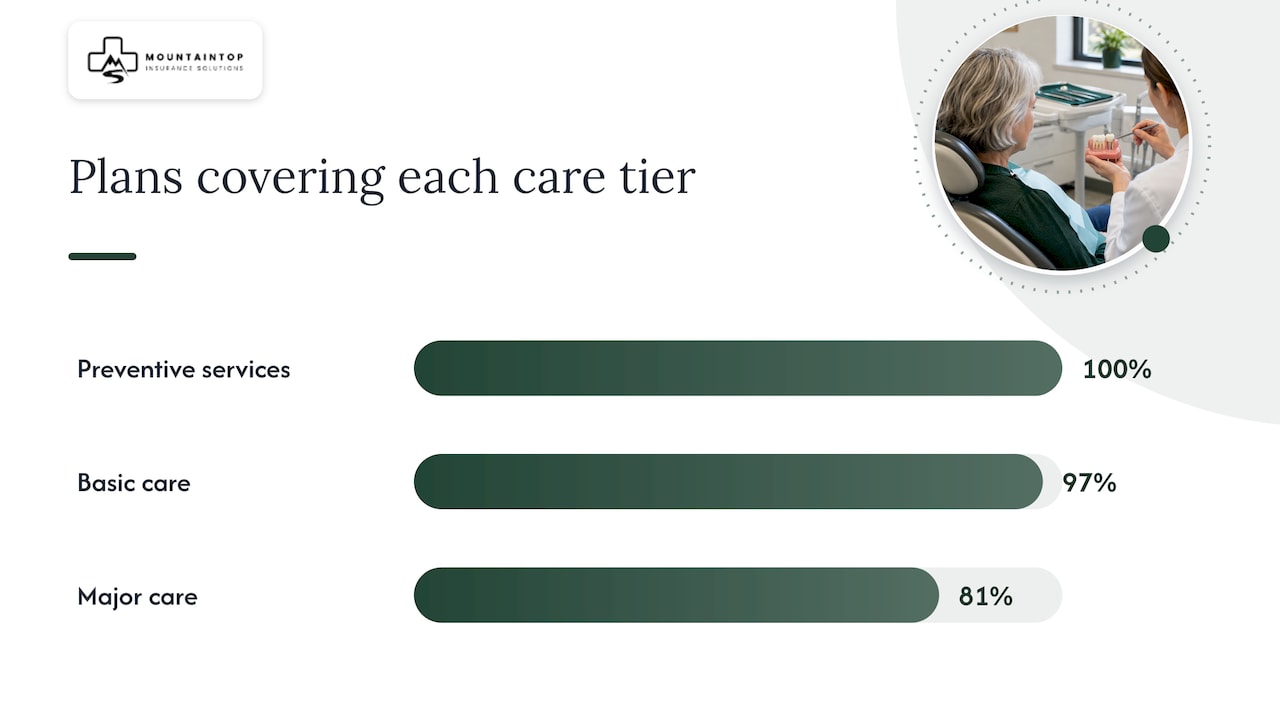
Dental plans sort services into preventive, basic and major, and pay a different share of each. KFF found that among 2021 stand-alone plans on HealthCare.gov, all covered routine preventive services, 97% covered basic care and 81% covered major care. So “dental plan” doesn’t automatically mean “covers dentures.” Check that the services you expect to need sit in a tier the plan actually covers, and note what percentage you pay.
4. The deductible
KFF reported a median individual dental deductible of $50 in 2021. Preventive care is often exempt from the deductible, while basic and major work is not. A small deductible is easy to overlook, but it applies before the plan starts paying on a filling or crown.
5. The network
Most plans pay best when you see a dentist in their network. Before enrolling, confirm your current dentist participates in the specific plan you’re considering, not just with the insurer in general. A plan that looks cheap loses its value if you have to change dentists or pay out-of-network rates.
A quick example of how the math works
Suppose a plan costs $40 a month, or $480 a year. It pays 100% of two cleanings and exams, which would cost you, say, $300 to $400 out of pocket. After that, the question is whether the plan will help with the larger bills. If you need a crown and the plan has a waiting period for major services, you could pay premiums for a year before it contributes. If the plan pays 50% of major work up to a $1,500 annual maximum, the benefit for a single large procedure is capped well short of the bill.
These figures are illustrative, not a quote. The point is the method: add up the year’s premiums, add your deductible and coinsurance, then compare the total to what you would pay for the care you expect to need. A plan that covers your known needs after a short wait is worth far more than the cheapest premium.
Stand-alone plan or Medicare Advantage with dental?
The Medicare & You 2027 handbook says most Medicare Advantage plans offer extra benefits that Original Medicare doesn’t, including vision, hearing and dental. The Washington Insurance Commissioner’s office describes the dental benefit in some Advantage plans as basic care such as cleanings and screenings.
Here is how we frame the choice for people in Central Oregon:
| Question | Stand-alone dental plan | Medicare Advantage plan with dental |
|---|---|---|
| What it is | A separate dental policy with its own premium | A Medicare plan that bundles medical coverage with extra benefits |
| Works with Original Medicare and Medigap | Yes | No, Advantage replaces Original Medicare |
| Choice of dentist | Set by the dental plan’s network | Set by the Advantage plan’s network |
| What to check | Waiting period, annual maximum, deductible | Dental cap, plus doctors, hospitals and drug coverage |
| Best when | You want to keep Original Medicare and Medigap and add dental | You want one plan covering medical and dental |
The decision usually turns on the whole of your coverage, not dental alone. If you keep Original Medicare with a Medigap plan, a stand-alone dental plan is how you add dental. The SHIBA guide notes that most Medigap plans don’t include dental, vision or hearing. If you choose an Advantage plan, you take its dental benefit as part of the package. Our explainer on how Medicare Part C works and our page on Medicare Advantage plans in Bend cover that side in detail.
If you pay too much for Medigap: the Oregon birthday rule
Many readers come to dental coverage because they want to free up money. Medigap is often the place to look first.
The SHIBA guide explains Oregon’s Medigap birthday rule. Each year, if you already have a Medigap policy, you get a 60-day window starting 30 days before your birthday to switch to a plan with the same or lesser benefits, with the same or a different company, without answering health questions. This is separate from the federal six-month Medigap open enrollment period that starts the day Part B begins.
In practice, a Medigap policyholder whose premium has crept up can use the window to move to a comparable plan at a lower rate, then put some of the savings toward a stand-alone dental plan. The Medigap switch and the dental purchase are separate decisions, but they are easiest to weigh side by side. Our Medigap plans page explains the plan types, and the birthday window is something we can review with you before your next birthday.
What about other ways to pay for dental care?
FAIR Health’s retiree guide lists a few other routes, and which applies depends on your situation:
- Retiree group plans. Check any plan from a former employer or union first.
- TRICARE Retiree Dental Program. For retired service members, it offers free exams and cleanings and 100% accident coverage, with annual deductibles and maximums on other services.
- Medicaid. State programs don’t have to offer dental benefits, though many do, which may matter for low-income retirees.
- Dental discount plans. These are not insurance. They give discounted rates for a yearly fee.
If you want a plan that pays you a set amount per procedure rather than working through a network, read our guide to dental indemnity plans. If implants are what you are planning for, see whether Medicare covers dental implants.
How to choose, step by step
- List the care you expect. Cleanings only, or crowns, a bridge, dentures or implants? Ask your dentist for a treatment plan if you have one.
- Settle your Medicare path. Original Medicare with Medigap, or Advantage. This decides whether a stand-alone plan is the right fit.
- Gather plans that work with your dentist. Check network participation for each one.
- Compare on the five points: waiting period, annual maximum, tier coverage, deductible and network.
- Run the yearly math. Premiums plus out-of-pocket costs against the care you expect.
- Time your start. If you need major work soon, find out how a prior-coverage credit affects the waiting period before you switch.
A licensed agent can do steps 3 and 4 with you, which is the SHIBA guide’s second suggested route. With us, that conversation is a free consultation, in person in Central Oregon or remote.
How we help with dental coverage
Mountain Top Insurance is a local agency in Bend that helps Central Oregon residents age 65 and over with Medicare, Medigap, and supplemental dental and vision plans. Our consultations are free and educational: we explain your options and deadlines, and you decide. Read more on our dental and vision coverage page or our dental insurance coverage page for Bend, then book a consultation when you are ready to compare plans against your own dentist and your own Medicare coverage.
Our perspective
Dental coverage is where Medicare surprises people most. Someone turns 65, signs up for Parts A and B, maybe adds a Medigap plan, and assumes the basics are handled. Then the first crown bill arrives.
We think the right answer starts with your mouth and your Medicare plan together, not with a premium. Which Medicare path you are on decides whether a stand-alone plan or an Advantage plan with dental makes sense. Then the waiting period, the annual maximum and your dentist’s network decide which specific plan.
That is why we teach before we sell. Our approach is education first and pressure never, and we are a local agency, so you can sit down with someone in Bend who knows the Central Oregon market. If you are overpaying for Medigap, we can also look at the Oregon birthday rule with you, because the savings may be what makes good dental coverage affordable.
Jesse Zimmerman
FAQ
Can I buy a stand-alone dental plan if I’m on Medicare?
Yes. People on Medicare can buy a dental plan directly from an insurance company, or through an agent who compares several. The federal Marketplace route is different: it requires buying a health plan at the same time, which doesn’t fit most Medicare enrollees.
Does Medicare ever pay for dental work?
Only in limited cases. Medicare.gov says Original Medicare may cover dental services directly linked to a covered treatment, such as a heart valve replacement, a transplant, cancer treatment or dialysis. Routine cleanings, fillings, extractions, dentures and implants are generally not covered.
Why do some dental plans make me wait before covering a crown or dentures?
Waiting periods are common for major services, and you keep paying premiums while you wait, according to HealthCare.gov. Ask each plan how long its waiting period lasts and whether prior dental coverage shortens it, so you can time your enrollment around the care you need.
Is there a dental plan with no annual maximum?
Most individual plans set an annual limit on what they pay, and KFF found typical limits of $1,000 to $2,000 in 2021 stand-alone plans. Because limits vary by plan, the useful step is to read the current maximum in each plan’s documents and match it to the work you expect. We can go through that comparison with you.
Can I use the Oregon birthday rule to change my dental plan?
No. The birthday rule applies to Medigap, not dental. It gives current Medigap holders a 60-day window each year to switch to a plan with the same or lesser benefits without health questions. Savings from a lower Medigap premium can then help pay for a separate dental plan.
Sources
- Stand-alone dental plan, HealthCare.gov glossary
- Dental Coverage in the Health Insurance Marketplace, HealthCare.gov
- Dental service coverage, Medicare.gov
- Medicare & You 2027, Medicare.gov
- 2026 Oregon Guide to Medicare Insurance Plans (SHIBA)
- 2026 Oregon SHIBA guide, Medigap birthday rule
- Dental insurance, Washington Office of the Insurance Commissioner
- Dental Coverage for Retirees, FAIR Health
- Medicare and Dental Coverage: A Closer Look, KFF
- Coverage of Dental Services in Traditional Medicare, KFF
Recommended
Disclaimer: This article is for general educational purposes only and does not constitute personalized advice. Medicare rules and plan details change frequently.
Discuss Your Situation With Us