U.S. Medicare: Ambulance Rides Cost 20% After Part B Deductible

Medicare Part B pays for ambulance transportation only when it’s medically necessary and you’re taken to the nearest appropriate facility. If your trip qualifies, Medicare generally covers a large portion of the Medicare-approved amount after you’ve met your Part B deductible, leaving you responsible for a coinsurance share. Claims get denied most often for three reasons: thin documentation of medical necessity, transport to a facility that wasn’t the closest appropriate option, or missing prior authorization for repeated non-emergency trips.
TL;DR:
- Medicare covers ambulance services only when the transport is medically necessary and there are strict criteria for bed confinement, walking inability, and sitting in a chair.
- Claims are frequently denied due to incomplete documentation, transport to non-closest facilities, or lack of prior authorization for repetitive non-emergency trips, especially for dialysis.
- Air ambulance is only covered in genuine emergencies when ground transport cannot ensure safe or timely care, with Medicare paying only the nearest appropriate facility.
- Patients are responsible for 20% of the Medicare-approved bill once the deductible is met, and full coverage depends on accepted assignment and supplemental policies like Medigap.
- Early preparation, including physician certification and proper documentation, helps prevent surprise bills and increases chances of claim approval.
Table of Contents
- How Does Medicare Cover Ambulance Services?
- What Counts as “Medically Necessary” for an Ambulance?
- When Does Medicare Pay for Air Ambulance Transport?
- How Much Will You Pay for an Ambulance Under Medicare?
- Do You Need Prior Authorization for Repeated Ambulance Trips?
- What Should You Do If Medicare Denies an Ambulance Claim?
- Why Ambulance Denials Catch So Many Beneficiaries Off Guard
- Get Help Making Sense of Your Medicare Coverage
- Where to Verify Medicare’s Ambulance Rules Yourself
- Sources
- FAQ
How Does Medicare Cover Ambulance Services?
Medicare ambulance coverage splits into two very different categories, and the difference determines whether you’re covered at all.
Emergency coverage applies when your health is in serious danger and any other form of transport, driving yourself, a family member’s car, a taxi, would put you at risk. A suspected heart attack, stroke symptoms, or severe trauma all clear this bar easily.
Non-emergency coverage is narrower. Medicare will pay only when you’re bed-confined or need medical monitoring during the ride itself, and scheduled or repetitive trips (think regular dialysis runs) require a physician certification statement confirming the need.
Medicare recognizes a specific list of covered destinations:
- Hospitals and critical access hospitals (CAHs)
- Rural emergency hospitals
- Skilled nursing facilities (SNFs)
- Return trips home in certain qualifying situations
What Medicare won’t touch: wheelchair van or ambulette services, transport chosen purely for convenience, and trips justified only because no one else was available to drive you. That last point trips up a lot of families who assume “we had no other way to get there” counts as medical necessity. It doesn’t.
What Counts as “Medically Necessary” for an Ambulance?
Medicare’s standard is narrower than most people expect. The transport has to be necessary because your condition would be endangered by any other method, not because an ambulance was simply more convenient or faster.
CMS applies a specific bed-confined test with three parts. A patient qualifies as bed-confined only if all three apply:
- Unable to get up from bed without assistance
- Unable to walk
- Unable to sit in a chair or wheelchair
Meeting even two of the three isn’t enough. A patient who can be wheeled to a car, even slowly and with help, generally doesn’t meet the standard, according to CMS guidance on ambulance services. Availability of a family member’s car, or the lack of one, has no bearing on medical necessity either way.
For scheduled repetitive non-emergency trips, such as three-times-a-week dialysis transport, Medicare requires a physician certification statement dated within 60 days before the service begins.
Pro Tip: A signed doctor’s order is not automatically proof of necessity. Medicare contractors compare the clinical facts against the Benefit Policy Manual standard, so ask your doctor’s office to include specific notes explaining why other transportation was unsafe, not just that an ambulance was ordered.
When Does Medicare Pay for Air Ambulance Transport?
Air ambulance, whether a helicopter or fixed-wing plane, is covered only in genuine emergencies where ground transport can’t get you to appropriate care safely or quickly enough. CMS requires documentation justifying why flying was necessary instead of driving.
A few rules matter here more than people realize:
- Medicare pays only to the nearest appropriate facility capable of treating your specific condition, not your preferred hospital or the one your specialist works out of.
- Choosing a farther hospital, even for good reasons like continuity of care, can leave you owing the difference between what Medicare pays toward the nearer facility and the actual bill.
- Combined transports, ground ambulance to a landing zone, then air to the hospital, get evaluated as a single trip for payment purposes, with mileage and necessity assessed at each leg.
Because Medicare determines its payment based on the nearer facility regardless of where you actually went, that gap can run into thousands of dollars unless the provider waives it or you never signed an Advance Beneficiary Notice agreeing to pay it.
How Much Will You Pay for an Ambulance Under Medicare?
If Medicare covers your trip, you’re on the hook for 20% of the Medicare-approved amount after your yearly Part B deductible. Check Medicare.gov’s current cost guide for the exact deductible amount for the year, since it’s adjusted annually.

One number worth remembering: ambulance companies that accept Medicare assignment are barred from billing you more than the Medicare-approved amount, full stop.
A few pieces of paperwork worth knowing:
- Medicare Summary Notice (MSN): Arrives quarterly and lists denial reason codes when a claim doesn’t pay. Those codes, published by CMS, spell out exactly why a claim was rejected, whether it’s insufficient documentation or a non-nearest-facility issue.
- Advance Beneficiary Notice (ABN): A form the ambulance provider should give you when they suspect Medicare won’t pay, letting you decide in advance whether to accept financial responsibility.
- Assignment: Accepting assignment protects you from balance billing beyond your 20% share; a provider that doesn’t accept assignment can charge more.
A Medigap policy can cover that 20% coinsurance entirely, which is worth discussing during an annual plan review if ambulance transport is a recurring part of your care.
Do You Need Prior Authorization for Repeated Ambulance Trips?
Medicare’s prior authorization program kicks in for scheduled, repetitive non-emergency ambulance transport, generally three or more round trips in 10 days, or at least once a week for three or more weeks. Dialysis patients hit this threshold constantly.
Either you or your ambulance supplier can request authorization, but skipping it is risky: claims can be denied outright, and the ambulance company may bill you directly for trips it can’t collect from Medicare.
- Get a physician certification statement documenting why ambulance transport, not another method, is medically required.
- Gather supporting clinical records that back up the certification.
- Have your ambulance supplier submit the prior authorization request before the pattern of trips begins, not after.
Coordinating this early, rather than after a denial shows up, is what actually prevents the surprise bills.
What Should You Do If Medicare Denies an Ambulance Claim?
Start with your MSN. It lists the specific denial reason code and the deadline for filing an appeal, which is typically 120 days from the date on the notice.
- Ask the ambulance company to refile. Many denials stem from missing or incomplete paperwork on the provider’s end, not an actual coverage problem.
- Collect clinical records. Contemporaneous doctor’s notes explaining why other transportation was contraindicated are the strongest evidence you can gather for an appeal.
- File your appeal. Submit your signed MSN along with supporting documents to your Medicare contractor, or file CMS Form 20027, within the deadline listed on the notice.
Pro Tip: If the paperwork feels like a maze, contact your State Health Insurance Assistance Program (SHIP) for free help. Bring your MSN, any physician notes, and dates of service. Having those three things ready before the call cuts the process down significantly.
Why Ambulance Denials Catch So Many Beneficiaries Off Guard
Most people assume that if a paramedic decided to transport them, Medicare will pay. That assumption is wrong often enough to matter, and it’s rarely explained clearly at the moment it counts, in the back of a moving ambulance.
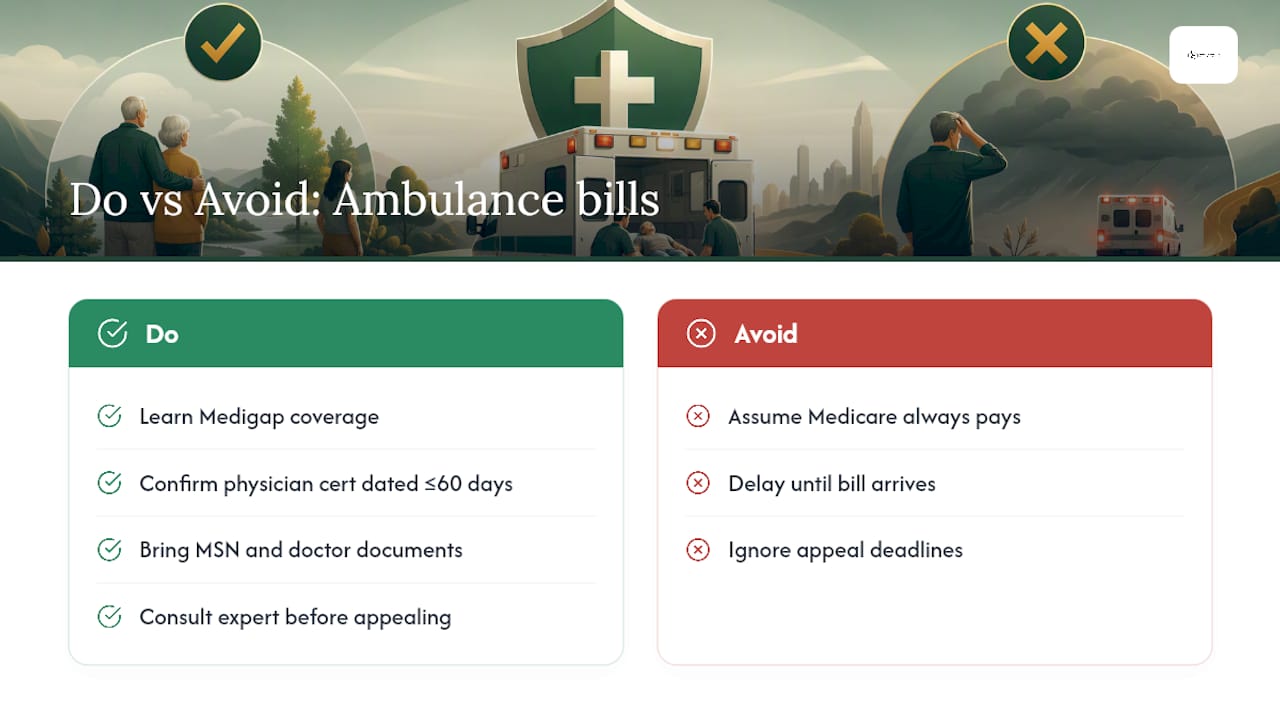
The real gap isn’t in the rules themselves. Medicare’s medical necessity standard, the bed-confined test, the nearest-appropriate-facility rule, is publicly documented and fairly consistent. The gap is in awareness. Beneficiaries don’t know these standards exist until a bill shows up citing a denial code they’ve never seen before. By then, the appeal clock is already running.
What is often seen most often isn’t outright coverage confusion. It’s beneficiaries who didn’t realize a Medigap policy could have wiped out that 20% coinsurance entirely, or who didn’t know a physician certification needed to be dated within 60 days. Education before the ambulance ride matters more than any appeal filed after it. Bring your Medicare Summary Notice and any physician documentation to a consultation, and the conversation moves faster because there’s something concrete to work from.
— Jesse Zimmerman
Get Help Making Sense of Your Medicare Coverage
Mountaintop Insurance is the alternative to a national call center for Medicare questions in Central Oregon: a local, no-pressure consultation instead of a scripted sales call, focused on making sure you actually understand your coverage before a bill catches you off guard. If ambulance coinsurance, Medigap options, or a confusing denial letter has you wondering what your plan actually covers, Medicare Guidance walks through your specific situation at no cost. The team also handles Medicare Enrollment Assistance for anyone approaching eligibility and Annual Medicare Plan Reviews to catch gaps, like unprotected coinsurance costs, before they become a bill in your mailbox. Consultations are educational first: no pressure to enroll, just a clear explanation of your options. Reach out to schedule a free review of your current coverage.
Where to Verify Medicare’s Ambulance Rules Yourself
For the source documents behind everything above: the Medicare.gov ambulance coverage page covers the basics and links to appeals guidance. The Medicare Benefit Policy Manual, Chapter 10 has the full regulatory detail on necessity and payment. For fee-schedule or local payment questions, contact your regional Medicare Administrative Contractor (MAC) directly.
This article is general information, not a substitute for advice from a qualified doctor. Consult a qualified healthcare professional about your own circumstances before acting on anything here.
FAQ
Do People on Medicare Have to Pay for an Ambulance?
Yes. Even when Medicare covers the trip, you typically owe 20% of the Medicare-approved amount after meeting your Part B deductible, unless a Medigap policy covers that coinsurance.
Why Would Medicare Deny an Ambulance Claim?
The most common reasons are insufficient documentation of medical necessity, transport to a facility that wasn’t the nearest appropriate option, or missing prior authorization for a repetitive non-emergency trip pattern.
What Are the Medicare Ambulance Billing Guidelines?
Ambulance suppliers that accept Medicare assignment must accept the Medicare-approved amount as full payment and cannot bill you beyond your standard coinsurance share, protecting you from surprise balance bills.
What Doesn’t Medicare Cover for Ambulance Transport?
Medicare won’t pay for wheelchair van or ambulette services, transport chosen for convenience rather than medical need, or trips where the only justification was a lack of another driver available.
Can Mountaintop Insurance Help With an Ambulance Claim Denial?
Mountaintop Insurance offers free educational consultations to help Central Oregon beneficiaries interpret a Medicare Summary Notice, understand a denial, and review whether supplemental coverage could prevent future surprise bills.
Recommended
Disclaimer: This article is for general educational purposes only and does not constitute personalized advice. Medicare rules and plan details change frequently.
Discuss Your Situation With Us