20 Minute Medicare ANOC Checklist for U.S. Beneficiaries

Your Annual Notice of Change is your Medicare plan’s formal warning that next year won’t look like this year: premiums, deductibles, drug coverage, or your doctor network may all shift starting January 1. It must reach you by September 30, and if you do nothing during the Annual Enrollment Period, you’re automatically kept on the new terms. Verify anything confusing at Medicare or 1-800-MEDICARE, or get local help from a local insurance agent.
TL;DR:
- Most changes in premiums, deductibles, drug tiers, and provider networks will be outlined in the ANOC, which you should review carefully during September.
- If your medications or providers are dropping from the network or moving to higher tiers, your plan is required to offer a transition fill of at least one month for affected drugs.
- The cost and network adjustments detailed in the ANOC can significantly impact total yearly expenses, especially if your out-of-pocket maximum or drug formulary changes.
- Use Medicare Plan Finder starting October 1 to compare cost estimates and plan features based on your actual medications and providers before deciding to stay or switch.
- Local insurance agents offer free, personalized help reviewing the ANOC to identify hidden or unexpected changes that could affect your coverage and costs.
Table of Contents
- What Is ANOC Medicare Coverage and Who Gets One
- When Should You Receive Your ANOC Letter
- Who Sends the ANOC and How It Might Reach You
- What Changes Show Up in the ANOC: Costs, Networks, and Drug Coverage
- How to Read Your ANOC: A Fast Comparison Checklist
- What to Do After Reading Your ANOC
- ANOC vs. Evidence of Coverage: What’s the Difference
- How Mountaintop Insurance Helps You Make Sense of Your ANOC
- Why Most People Get ANOC Season Wrong
- Get Local Help Reviewing Your ANOC
- Where to Verify ANOC Details and Deadlines
- Sources
- FAQ
What Is ANOC Medicare Coverage and Who Gets One
ANOC stands for Annual Notice of Change, and it’s the letter your Medicare Advantage or Part D plan sends every fall to spell out what’s different about your coverage next year. Original Medicare enrollees and most Medigap policyholders don’t get one, because those plans don’t change their benefit structure the way private Medicare plans do.
Federal rules require every Medicare Advantage and Part D carrier to send this notice, and the Medicare Annual Notice of Change details what to check each year: premium shifts, network changes, and drug list revisions. Think of it as a legally required heads-up, not a courtesy.
A few things worth knowing before the letter shows up:
- The ANOC only covers changes. It won’t explain your entire plan from scratch.
- The full rulebook lives in a separate document called the Evidence of Coverage (EOC), which we’ll cover further down.
- If you’re in a Medicare Advantage plan with Part D built in (an MA-PD plan), one ANOC covers both your medical and drug changes.
When Should You Receive Your ANOC Letter
Mark your calendar for late September. Here’s the sequence that matters:
- By September 30: Your plan must deliver the ANOC, either by mail or electronically if you’ve opted into digital communications.
- October 1: The Medicare.gov Plan Compare tool refreshes with next year’s plan data, so you can actually shop.
- October 15 through December 7: This is the Annual Enrollment Period (AEP), your main window to switch plans.
- January 1: Whatever you chose, or didn’t choose, takes effect.
- January 1 through March 31: A second chance, the Medicare Advantage Open Enrollment Period, lets MA enrollees make one additional switch.
If September 30 comes and goes with no letter in your mailbox, don’t assume nothing changed. Call your plan directly or dial 1-800-MEDICARE to request a copy.
Who Sends the ANOC and How It Might Reach You
Your specific plan, not Medicare itself, sends the ANOC. That distinction trips people up constantly, since the letter often looks like it’s coming from a government agency.
- Delivery follows whatever contact preference you’ve set with your plan: paper mail or a digital notification if you opted in.
- Most carriers also post a copy directly on their member portal, which is worth bookmarking.
- If your address changed and you never updated it, that’s the most common reason people miss it entirely.
- Still nothing by early October? Call the plan’s Member Services line or 1-800-MEDICARE and ask them to mail or email a replacement copy immediately.
What Changes Show Up in the ANOC: Costs, Networks, and Drug Coverage
This is the section that actually determines whether next year gets more expensive. The ANOC gives you a side-by-side comparison of your current and upcoming benefits, and four categories deserve real attention.
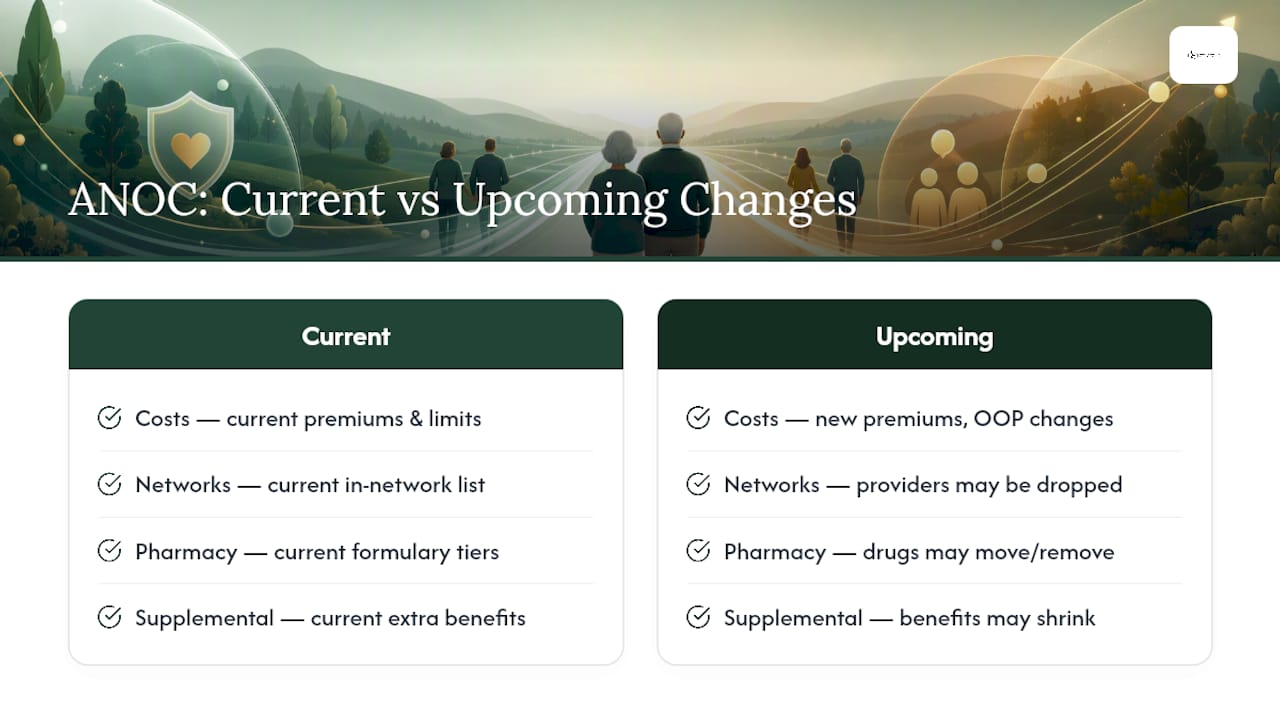
Cost changes include your monthly premium, your medical deductible, your Part D deductible (see how it’s shifting in Medicare Part D deductible changes for 2026), your copays and coinsurance for doctor visits and hospital stays, and your maximum out-of-pocket limit. That last figure caps your total risk for the year, and even a small increase changes your worst-case scenario.
Provider network changes matter just as much as cost. If a hospital system or specialist you see gets dropped from the network, your ANOC should flag it, though not always in plain language. A dropped provider means you’d pay out-of-network rates or lose access entirely, depending on your plan type.
Pharmacy and formulary changes are where people get blindsided. Drugs can move to a higher cost tier, get removed from the formulary altogether, or suddenly require prior authorization or step therapy before the plan will cover them.
If a drug you rely on gets pulled mid year, Part D plans are required to provide a temporary transition fill of at least a month so you and your doctor have time to sort out alternatives.
Supplemental benefits round out the list: dental allowances, vision coverage, over-the-counter benefit cards, and fitness perks. These often shrink or get restructured year to year, and they’re easy to overlook next to the bigger cost numbers.
How to Read Your ANOC: A Fast Comparison Checklist
You don’t need an hour to get through this. Work down this list in order:
- Pull up your medication list and run it through Medicare Plan Finder to see if anything changed tiers or requires new authorization.
- Confirm your doctors and pharmacies are still in-network for next year, not just this year’s directory.
- Compare your premium against your maximum out-of-pocket. A lower premium with a much higher MOOP can cost you more if you have a bad health year.
- Note any new prior authorization or step therapy rules attached to drugs or procedures you use regularly.
- Check supplemental benefits like dental and vision allowances for reductions.
Bring three things to this review: your current medication list with dosages, a recent pharmacy receipt showing what you actually paid, and the names of every provider you see regularly.
Pro Tip: If a plan’s online directory says your doctor is in-network but you’re not sure, call the provider’s billing office directly and ask if they’re contracted with that specific plan for next year. Directories lag behind actual contract status more often than people expect.
What to Do After Reading Your ANOC
Once you’ve spotted the changes, the next move depends on what you found. Nothing alarming, and you can probably stay put. Something concerning, and you’ve got until December 7 to act.
- Starting October 1, use Medicare.gov Plan Compare to enter your exact medications, dosages, and preferred pharmacy. The tool ranks plans by your realistic total annual cost, not just the advertised premium.
- If you want to switch, do it during the Annual Enrollment Period, October 15 through December 7, for coverage that starts January 1.
- Missed that window but you’re in Medicare Advantage? The Medicare Advantage Open Enrollment Period from January 1 through March 31 gives you one more shot to switch plans.
- Need help sorting through it? Call your plan’s Member Services number, dial 1-800-MEDICARE, or schedule a free consultation with a local insurance agent for one-on-one guidance.
ANOC vs. Evidence of Coverage: What’s the Difference
The ANOC is the highlight reel. The Evidence of Coverage (EOC) is the full script. Where the ANOC summarizes what’s changing, the EOC spells out every rule, limit, and procedure governing your plan for the entire year.
- Plans typically post the EOC on their website by October 15, a couple weeks after the ANOC deadline.
- For authoritative details on either document, Medicare.gov and the Centers for Medicare & Medicaid Services (CMS) are your official references.
- Pull up the EOC specifically when you need to decode prior authorization procedures, appeals rights, or the exact dollar limits on a specific benefit the ANOC only mentioned in passing.
How Mountaintop Insurance Helps You Make Sense of Your ANOC
Local insurance agents review ANOC letters with clients every fall, working line by line through cost changes and running comparisons in Plan Finder together. The most common surprises: a specialist quietly dropped from network, a maintenance drug suddenly needing prior authorization, or a formulary tier jump nobody noticed. An agent can spot these fast and walk through what a switch would actually cost. Free consultations are available for anyone who wants a second set of eyes before AEP closes.
Why Most People Get ANOC Season Wrong
The standard advice, “read your mail in the fall,” undersells how much this one letter can cost you if you skim it. The real failure point isn’t ignoring the ANOC entirely. It’s reading the premium line, seeing it stayed flat or dropped a few dollars, and stopping there. That’s backwards. Premium is often the least predictive number in the whole document.
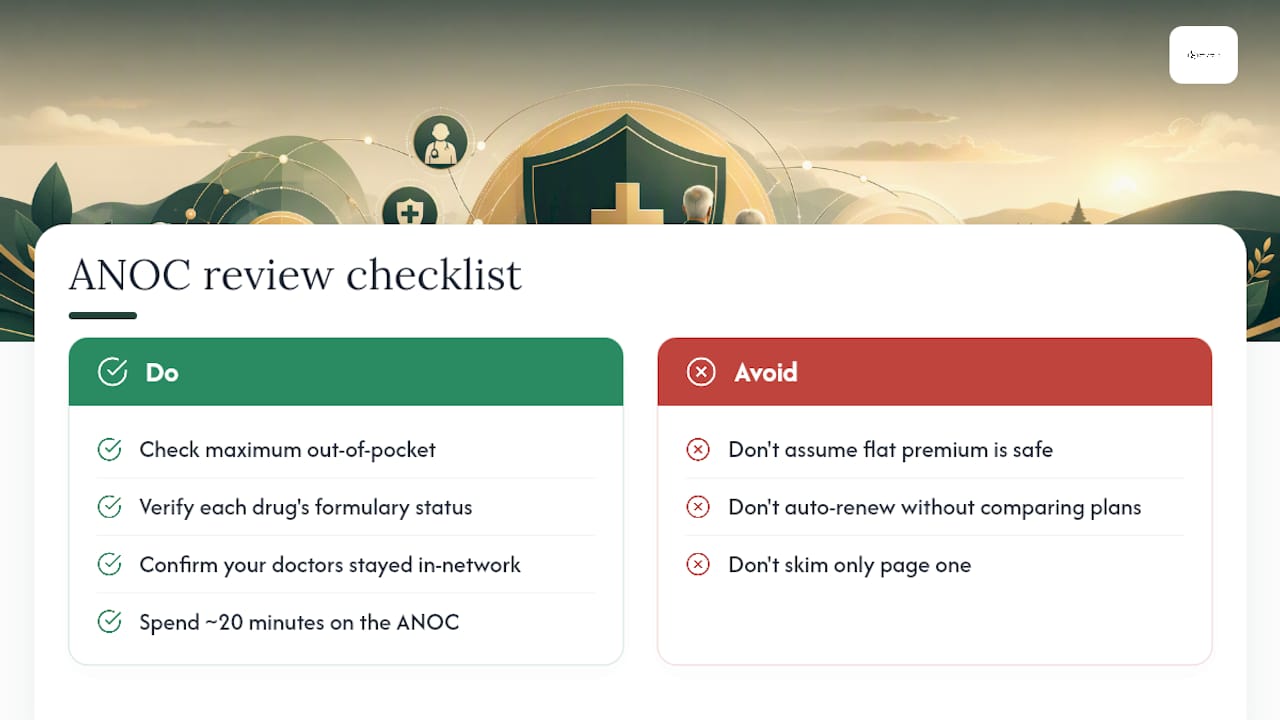
What actually determines your financial exposure next year is the combination of your maximum out-of-pocket, your specific drugs’ formulary status, and whether your regular doctors stayed in network. None of those show up in a quick glance at page one. They take the 20 minutes the checklist above is built around, and most retirees never spend those 20 minutes.
I’d also push back on treating “staying put” as the safe default. Auto-renewal feels passive and low-risk, but it’s a decision with real consequences if your plan quietly added a step therapy requirement on your blood pressure medication. Inertia isn’t neutral here. If your ANOC shows any change touching your medications, your specialists, or your out-of-pocket cap, that’s your signal to actually compare, not just glance and file it away.
— Jesse Zimmerman
Get Local Help Reviewing Your ANOC
Reading an ANOC alone means guessing whether a formulary change or dropped provider actually matters for your situation. Mountaintop Insurance gives Central Oregon Medicare beneficiaries a free, no-pressure consultation to walk through the letter together, compare what changed against your actual medications and doctors, and figure out whether staying put or switching makes financial sense for you specifically. There’s no sales script here, just a local agent explaining your options in plain language before your December 7 deadline.
If you’d rather talk through your specific plan changes with someone in Bend, schedule a free Medicare consultation with Mountaintop Insurance, or explore how a licensed local agent supports your coverage decisions year-round, not just during enrollment season.
Where to Verify ANOC Details and Deadlines
Confirm anything in this article directly: Medicare.gov Plan Compare for cost estimates, Your Yearly Medicare Review for CMS guidance, or 1-800-MEDICARE for phone support. Save or print both your ANOC and EOC for reference.
This article is general information, not a substitute for advice from a qualified financial advisor. Consult a qualified financial professional about your own circumstances before acting on anything here.
Sources
FAQ
When Should I Receive My ANOC?
Your Medicare Advantage or Part D plan must deliver the ANOC by September 30, ahead of the Annual Enrollment Period that starts October 15.
What Happens if a Drug Moves to a Higher Tier or Gets Removed?
If your medication changes formulary tier or gets dropped mid-year, Part D plans must provide a temporary transition fill of at least a month while you and your prescriber sort out alternatives or file an exception.
When Can I Switch Plans After Reading My ANOC?
You can switch during the Annual Enrollment Period, October 15 through December 7, for coverage starting January 1, or during the Medicare Advantage Open Enrollment Period, January 1 through March 31, if you’re already in an MA plan.
What Is the Downside of Medicare Part C?
Medicare Advantage (Part C) plans often use provider networks and require prior authorization for certain services, meaning your specialists or treatments from last year may not be covered the same way next year. Reviewing your ANOC closely each fall is how you catch these shifts before they cost you.
Is the ANOC the Same as My Plan’s Full Contract?
No. The ANOC only summarizes changes; the Evidence of Coverage (EOC), typically posted by October 15, contains the complete rules, limits, and procedures governing your plan for the year.
Recommended
Disclaimer: This article is for general educational purposes only and does not constitute personalized advice. Medicare rules and plan details change frequently.
Discuss Your Situation With Us