2026 Medicare Mental Health Costs: $283 Deductible, Avoid Fees

Yes, Medicare covers mental health care. Part A pays for inpatient psychiatric stays, Part B covers outpatient therapy, psychiatric evaluations, and programs like partial hospitalization, and Part D covers most psychiatric medications. In 2026, the Part B deductible is $283 with 20% coinsurance after that, while Part A carries a $1,736 deductible per benefit period. For specifics on your plan, call 1-800-MEDICARE or check Medicare for enrolled providers near you.
TL;DR:
- Most outpatient therapy and medication management services are covered under Part B, with a $283 annual deductible and 20% coinsurance in 2026.
- Inpatient psychiatric stays are limited to 190 lifetime days in freestanding psychiatric hospitals and are only covered if medically necessary in a hospital setting.
- Medicare Advantage plans may offer additional mental health benefits, but coverage varies significantly between plans and requires careful review of the Evidence of Coverage.
- The 2026 cost for inpatient care starts with a $1,736 deductible per benefit period, with coinsurance costs increasing after day 60.
- Dual-eligible beneficiaries often pay little to nothing for mental health services, thanks to Medicaid coverage of cost-sharing and additional programs.
Table of Contents
- Medicare Mental Health Coverage: How Parts A, B, and D Divide the Work
- What Outpatient Therapy and Programs Medicare Actually Pays For
- Inpatient Psychiatric Care: Coverage Rules and the 190-Day Limit
- Medicare Mental Health Coverage Costs in 2026: Deductibles and Coinsurance
- Finding Medicare-Enrolled Mental Health Providers and Using Telehealth
- Medicare Advantage and Part D: How Plan Choice Changes Mental Health Access
- What Medicare Doesn’t Cover and Where to Turn Instead
- Who Qualifies for Medicare Mental Health Coverage
- Filing Claims and Appeals for Denied Mental Health Services
- Coordination With Medicaid and Other Insurance for Dual Eligibles
- Preventive Mental Health Screenings Covered at No Cost
- How a Mental Health Diagnosis Affects Your Broader Medicare Usage
- How Mountaintop Insurance Helps You Navigate This
- Get Personalized Medicare Help in Central Oregon
- Sources
- FAQ
Medicare Mental Health Coverage: How Parts A, B, and D Divide the Work
Medicare splits mental health coverage across three parts, and knowing which one applies to your situation saves you from calling the wrong number or reading the wrong benefits booklet. Part A handles the hospital side. Part B handles almost everything else, including therapy, evaluations, and same-day outpatient programs. Part D handles the prescriptions that often go alongside talk therapy.
Part A (hospital insurance) pays for inpatient psychiatric care, whether you’re admitted to a general hospital’s psychiatric unit or a freestanding psychiatric hospital. This is for acute situations requiring round-the-clock monitoring, not routine counseling.
Part B (medical insurance) is the workhorse for most beneficiaries. It covers outpatient visits with psychiatrists, psychologists, and clinical social workers, plus preventive screenings, partial hospitalization, and intensive outpatient programs. Most people managing depression, anxiety, or a substance use disorder from home will interact with Medicare mostly through Part B.
Part D (prescription drug coverage) covers most antidepressants, mood stabilizers, and antipsychotic medications, though specific drugs and tiers vary by plan.
Medicare Advantage (Part C) plans must cover everything Original Medicare covers, but many go further. Some add expanded telehealth mental health visits, lower copays for therapy, or care coordination programs not found in Original Medicare. The catch: benefits vary enormously plan to plan, so you have to check the Evidence of Coverage document rather than assume.
A few services have setting rules worth knowing upfront:
- Annual depression screenings must happen in a primary care setting capable of follow-up treatment.
- Partial hospitalization requires a hospital outpatient department or community mental health center, not a private office.
- Telehealth mental health visits generally require an in-person visit within six months prior, with some exceptions for behavioral health.
What Outpatient Therapy and Programs Medicare Actually Pays For
Part B’s outpatient mental health benefit is broader than most people expect. It covers individual and group psychotherapy, psychiatric diagnostic evaluations, and medication management visits, along with several services that often get overlooked.
- Individual and group psychotherapy sessions with a Medicare-enrolled provider
- Psychiatric diagnostic evaluations, including intake assessments
- Medication management visits with a psychiatrist or psychiatric nurse practitioner
- Family counseling, when the primary purpose is helping with your treatment
- Annual depression screening at no cost when done in a primary care setting
- Brief alcohol misuse screening and counseling, typically four sessions per year
- Partial hospitalization program (PHP) services, structured day treatment that’s more intensive than a weekly therapy visit but doesn’t require overnight admission
- Intensive outpatient program (IOP) services, a newer Medicare benefit for people who need more than routine therapy but less than PHP
- Opioid treatment program services, including medication-assisted treatment through Medicare-enrolled opioid treatment programs
PHP and IOP billing gets confusing because these programs run through hospital outpatient departments or community mental health centers, and Medicare pays through a specific billing structure tied to the facility, not just the individual provider seeing you. Ask the program directly how many days per week they bill and whether you’ll see separate charges for the facility and the clinician.
Digital mental health treatment devices, FDA-authorized software-based tools for conditions like insomnia or substance use disorder, are a newer coverage category. Medicare requires these to be ordered by your treating provider as part of a broader treatment plan rather than used as a standalone product, per CMS guidance on covered behavioral health services.
Inpatient Psychiatric Care: Coverage Rules and the 190-Day Limit
Inpatient psychiatric admission under Part A isn’t automatic just because you’re struggling. It requires a physician to certify that you need active treatment in a hospital setting, meaning outpatient care wouldn’t be sufficient to keep you safe or stabilize your condition. Once admitted, Medicare evaluates medical necessity throughout your stay, and hospitals are required to review whether continued inpatient care is still warranted.
The rule that catches people off guard is the 190-day lifetime limit on inpatient care in a freestanding psychiatric hospital. Once you’ve used those 190 days across your lifetime, Medicare won’t pay for another stay in that type of facility, ever. This limit does not apply if you’re treated in a distinct-part psychiatric unit inside a general acute care hospital. That’s a meaningful distinction if you anticipate needing inpatient psychiatric care more than once.
Benefit periods also matter for cost. A benefit period starts the day you’re admitted and ends once you’ve been out of inpatient care for 60 consecutive days. If you’re readmitted within that 60-day window, you’re still in the same benefit period and won’t pay a second deductible. Get readmitted after 61 days, though, and a new benefit period, with a new deductible, begins. Timing your discharge and any follow-up admission can genuinely affect what you owe.
Medicare Mental Health Coverage Costs in 2026: Deductibles and Coinsurance
The dollar figures for 2026 are worth memorizing if you’re managing an ongoing mental health condition, because they determine your out-of-pocket exposure for the rest of the year.
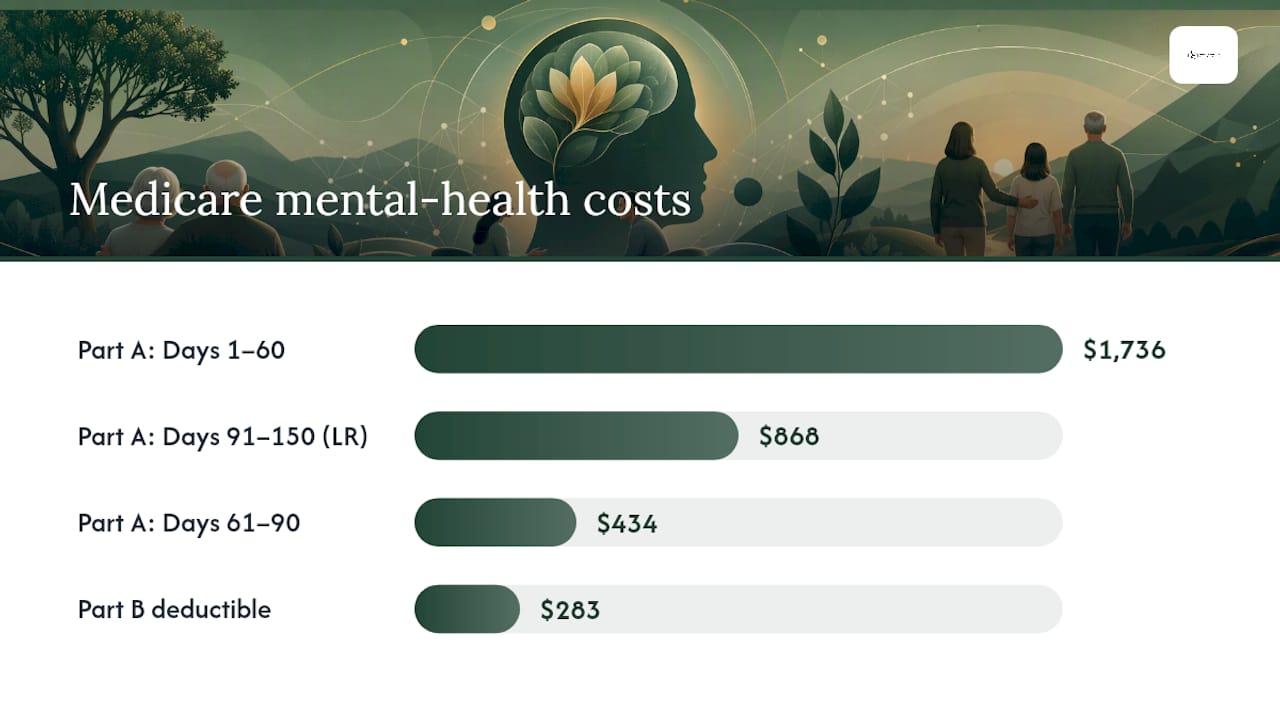
For outpatient care under Part B, you’ll pay a $283 annual deductible before Medicare starts sharing costs. After that, you’re responsible for 20% coinsurance on each visit, whether it’s a therapy session, a psychiatric evaluation, or a medication management appointment.
For inpatient care under Part A, the numbers scale with how long you stay:
- Days 1–60: $1,736 deductible per benefit period, no daily coinsurance
- Days 61–90: $434 per day coinsurance
- Lifetime reserve days 91–150: $868 per day coinsurance
One thing that surprises a lot of beneficiaries: mental health therapy coinsurance is the same 20% you’d pay for a standard physician visit. Older assumptions that therapy carries higher cost-sharing are largely outdated thanks to mental health parity rules that brought behavioral health cost-sharing in line with physical health.
The bigger risk to your wallet is usually facility fees and excess charges, not the coinsurance itself. If a provider “accepts assignment,” they’ve agreed to the Medicare-approved amount as full payment and can’t bill you extra. If they don’t, they can charge up to 15% above the Medicare-approved rate. Separately, if you’re treated in a hospital outpatient department rather than a private practice, you may see a facility fee tacked on top of the clinician’s charge. Ask both questions before your first appointment: “Do you accept assignment?” and “Will I be billed a separate facility fee?”
Pro Tip: If your income is limited, ask about the Extra Help program for Part D drug costs and check with your state Medicaid office. Many dual-eligible beneficiaries pay little to nothing for both therapy visits and psychiatric medications once these programs are layered on top of Medicare.
For a deeper look at how the annual deductible interacts with your monthly premium, see our breakdown of the 2026 Part B premium changes.
Finding Medicare-Enrolled Mental Health Providers and Using Telehealth
Not every therapist or psychiatrist accepts Medicare, and provider shortages in behavioral health make this a real hurdle in many areas. Here’s how to work through it:
- Start at Medicare.gov’s Care Compare tool and search by specialty and ZIP code to pull up Medicare-enrolled providers near you.
- Call the office directly and confirm they’re currently accepting new Medicare patients, since directories can lag behind real-world availability.
- Ask if they accept assignment, whether they’re affiliated with a hospital (which can trigger facility fees), and whether they offer telehealth visits.
- If Care Compare comes up empty, ask your primary care provider for a referral. Primary care offices often know which local behavioral health clinicians actually take Medicare, even when the online directory is outdated.
Telehealth has become a much bigger part of mental health access. As of 2026, updated supervision definitions and payment rules allow rural health clinics and federally qualified health centers to bill for telehealth mental health visits more flexibly than before, per CMS’s mental health coverage guidance. That’s meaningful if you live somewhere with few local psychiatrists.
Pro Tip: Save time by calling your top three provider choices in one sitting and asking the exact same four questions at each. You’ll spot the differences in billing practices in about fifteen minutes. For more on avoiding surprise bills through referrals, see Medicare referrals and free local help for seniors.
Medicare Advantage and Part D: How Plan Choice Changes Mental Health Access
Original Medicare sets the floor, not the ceiling. Medicare Advantage plans have to cover at least what Part A and Part B cover, but plenty go beyond that with added mental health perks.
- Some Medicare Advantage plans include expanded telehealth psychiatry visits with lower or no copays.
- Some offer care coordination or case management for members managing chronic mental health conditions.
- None of this is guaranteed. It varies plan by plan, and the only reliable way to know is reading the plan’s Evidence of Coverage document before you enroll or during your annual enrollment window.
Part D adds another layer. Plans are required to cover most drugs in six protected classes, including antidepressants, anticonvulsants, and antipsychotics, but the specific brand, generic, or dosage on your prescription might still require prior authorization or step therapy before the plan pays. If your psychiatrist wants to switch your medication, ask upfront whether the new drug needs prior approval, because that process can take days you may not have if you’re stabilizing on a new regimen.
If you’re weighing Original Medicare against a Medicare Advantage plan for mental health needs specifically, our guide to how Advantage plans really work walks through the tradeoffs in more depth.
What Medicare Doesn’t Cover and Where to Turn Instead
Medicare draws firm lines around a few categories of care. Long-term custodial care, room-and-board style residential treatment programs, and many alternative or holistic therapies (think acupuncture for anxiety or non-FDA-authorized wellness apps) generally fall outside coverage. Some inpatient substance use residential programs are only partially covered, and the rules depend heavily on the specific service billed.
Before assuming something isn’t covered, verify it directly through Care Compare or by calling the provider, since coverage categories shift year to year.
If a service genuinely isn’t covered, or a provider won’t take Medicare at all, you still have options:
- Community mental health centers often use sliding-scale fees based on income.
- The SAMHSA National Helpline and treatment locator connect you with low-cost or free local resources.
- Crisis lines, including 988, are free regardless of insurance status.
- Ask your primary care provider about integrated behavioral health programs, where a counselor works directly within the primary care practice.
Who Qualifies for Medicare Mental Health Coverage
Mental health benefits under Medicare follow the same eligibility rules as the rest of Medicare. You qualify once you turn 65 and enroll in Part A and/or Part B, or earlier if you’ve received Social Security Disability Insurance for 24 months, or immediately if you have End-Stage Renal Disease or ALS.
There’s no separate application for mental health coverage and no diagnosis requirement to unlock the benefit. Once you’re enrolled in Part B, outpatient mental health services are available to you the same way a visit to your primary care doctor would be. Part A mental health coverage kicks in automatically alongside your hospital coverage.
The one eligibility wrinkle worth knowing: if you enroll in a Medicare Advantage plan instead of staying on Original Medicare, your mental health benefits are administered through that plan’s network rules rather than Original Medicare’s open provider access. That means a psychiatrist who accepts Original Medicare might be out of network for your specific Advantage plan. Checking network status before you need care, not after, avoids a scramble during a mental health crisis.
If you’re near 65 and trying to decide between Original Medicare with a supplement or a Medicare Advantage plan, mental health access is a real factor to weigh, not an afterthought. Rural residents especially should confirm which specialists are actually in-network before locking in a plan choice for the year.
Filing Claims and Appeals for Denied Mental Health Services
Most of the time, your provider files the claim directly with Medicare, and you never touch the paperwork. Denials still happen, often because a service needed prior authorization it didn’t get, documentation was incomplete, or the billed service fell outside what Medicare considers medically necessary for your situation.
If you get a Medicare Summary Notice showing a denial, you have 120 days from the date on that notice to file an appeal. The process runs in stages:
- Redetermination: File a written request with the company that processes Medicare claims in your state. This is the first and fastest level of appeal.
- Reconsideration: If denied again, an independent contractor reviews the case fresh.
- Administrative Law Judge hearing: Available if the disputed amount meets a minimum threshold, this involves a formal hearing.
- Further appeals to the Medicare Appeals Council and federal district court exist but are rarely needed for routine mental health claims.
Your provider’s office can often help draft the appeal letter, since they know the specific billing codes and medical necessity language that triggered the denial. Keep copies of every notice and any letter your psychiatrist or therapist writes supporting continued treatment. That documentation matters at every stage of the appeal.
Coordination With Medicaid and Other Insurance for Dual Eligibles
If you qualify for both Medicare and Medicaid, known as being dual-eligible, your mental health coverage gets noticeably stronger. Medicaid typically picks up the Part B coinsurance and deductible that Medicare leaves you owing, which means many dual-eligible beneficiaries pay little to nothing out of pocket for therapy visits, psychiatric evaluations, or medication management.
Medicare pays first as the primary insurer for covered services. Medicaid then covers the remaining cost-sharing, and in many states, Medicaid also covers services Medicare doesn’t, like certain case management programs or extended behavioral health support. If you carry a separate Medigap policy instead of Medicaid, that policy typically covers the coinsurance in a similar way, though the exact benefit depends on which Medigap plan letter you hold.
The coordination isn’t always seamless. Providers need to bill both Medicare and Medicaid correctly, in the right order, and some mental health clinicians choose not to take Medicaid patients even if they accept Medicare, which narrows your provider options further. If you’re dual-eligible and having trouble finding a provider who takes both, your state Medicaid office or a local Medicare counseling program can usually point you toward clinics set up specifically to handle dual-eligible billing.
Preventive Mental Health Screenings Covered at No Cost
Medicare covers an annual depression screening at no cost to you, with no deductible or coinsurance, as long as it’s done in a primary care setting equipped to provide follow-up treatment or referral. This screening is also built into your Medicare Annual Wellness Visit, so many beneficiaries get it automatically without realizing it’s a distinct covered benefit.
Beyond depression screening, Medicare covers brief counseling for alcohol misuse, typically up to four sessions per year, delivered by a qualified primary care provider. This is a preventive service, meaning it’s meant to catch a problem early rather than treat an established diagnosis, and it carries no cost-sharing when billed correctly as a preventive visit.
These screenings matter more than they sound. Depression and alcohol misuse often go undiagnosed in older adults because symptoms get attributed to aging, medication side effects, or grief. A five-minute screening during an annual visit catches conditions that might otherwise go unaddressed for years. If your primary care provider hasn’t mentioned this screening at your last wellness visit, ask directly. It’s covered, it’s quick, and it’s designed to open the door to treatment before a condition escalates into something requiring inpatient care.
How a Mental Health Diagnosis Affects Your Broader Medicare Usage
A mental health diagnosis rarely stays isolated from the rest of your Medicare usage. Beneficiaries managing depression, anxiety, or a substance use disorder tend to use more of their overall Medicare benefit, not just the behavioral health slice of it, because mental health conditions frequently travel alongside chronic physical conditions like diabetes, heart disease, and chronic pain.
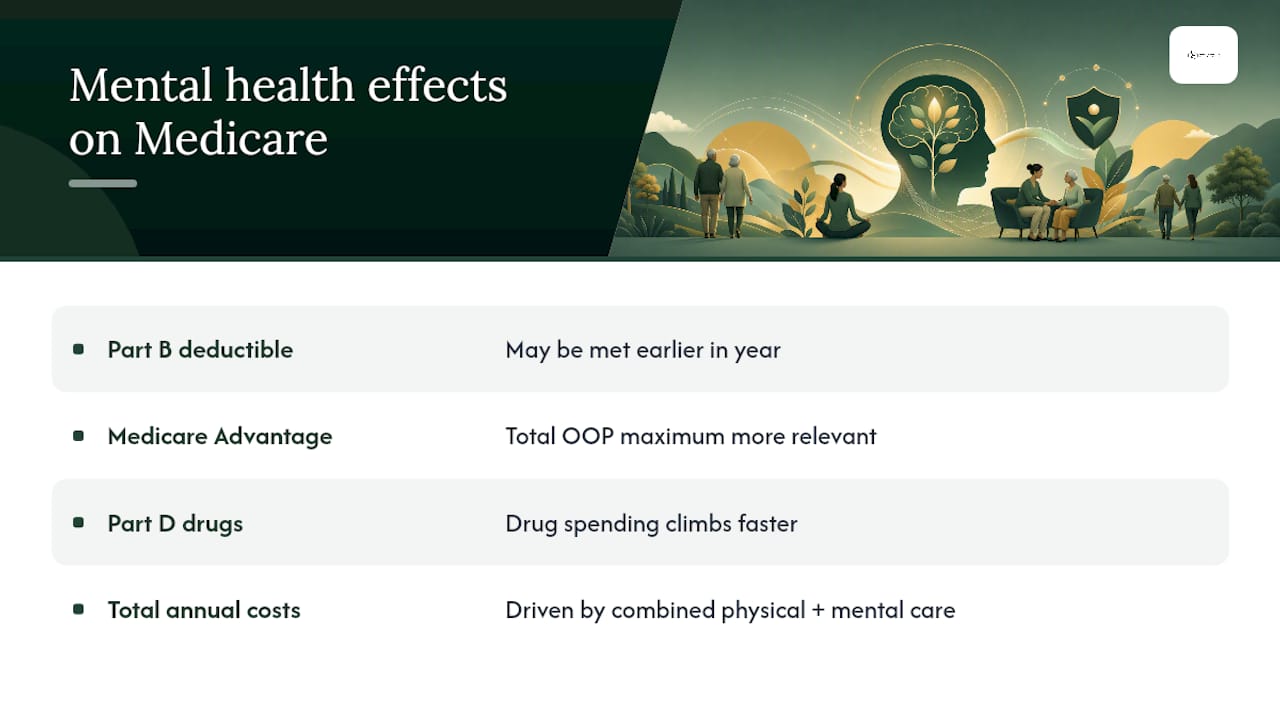
This shows up practically in a few ways. You may hit your Part B deductible earlier in the year if you’re seeing a therapist regularly alongside your primary care provider. If you’re on Medicare Advantage, heavier utilization across both mental and physical health services makes the plan’s total out-of-pocket maximum more relevant to you than it would be for a healthier enrollee. And your Part D drug spending can climb faster if you’re managing psychiatric medications on top of medications for other chronic conditions, since each additional prescription counts toward the coverage gap thresholds within your specific plan’s formulary.
None of this means a mental health diagnosis makes Medicare more expensive in some punitive sense. Coverage and cost-sharing rules are the same whether your therapy is for grief, anxiety, or trauma. It just means your total annual Medicare costs are more likely to be driven by the interaction between mental and physical health care than by either one alone, which is exactly why comparing plans based on your full health picture, not just one diagnosis, tends to serve people better over time.
How Mountaintop Insurance Helps You Navigate This
Most of the confusion in Medicare mental health coverage doesn’t come from what’s covered. It comes from what’s assumed. People assume their Medicare Advantage plan works like Original Medicare until a claim gets denied. They assume a hospital-affiliated psychiatrist bills the same as a private practice one until a facility fee shows up. They assume their antidepressant is covered until a pharmacist says it needs prior authorization.
A local Medicare agent’s job is catching those assumptions before they become bills. Mountaintop Insurance, based in Bend, Oregon, spends its consultations doing exactly that: reading Evidence of Coverage documents line by line, comparing supplemental mental health benefits across Medicare Advantage plans, and flagging where a client’s preferred psychiatrist might trigger a facility fee they didn’t expect. This is education-first work, not a sales pitch dressed up as advice.
If you’re in Central Oregon and want someone to walk through your specific situation, Mountaintop Insurance’s free Medicare consultation is a real place to start.
— Jesse Zimmerman
Get Personalized Medicare Help in Central Oregon
Reading about deductibles and coinsurance only gets you so far when you’re trying to figure out what your specific plan actually covers this year. Mountaintop Insurance is the local alternative to a call center script: a Bend, Oregon agency that sits down with you, pulls up your plan’s Evidence of Coverage, and tells you plainly whether your therapist’s facility charges a fee or whether your antidepressant needs prior authorization, before you find out the hard way.
There’s no cost to sit down and ask questions, and no pressure to enroll through the agency if you decide not to. If you’re comparing Medicare Advantage plans for their mental health benefits, weighing a Medigap policy, or just trying to understand what your Part D plan actually covers, schedule a free Medicare consultation with Mountaintop Insurance and get a straight answer specific to your coverage, not a generic script.
This article is general information, not a substitute for advice from a qualified doctor. Consult a qualified healthcare professional about your own circumstances before acting on anything here.
FAQ
Does the US have free mental health care through Medicare?
Medicare isn’t free, but preventive services like the annual depression screening carry no cost, and dual-eligible beneficiaries with Medicaid often pay little to nothing for ongoing therapy.
What should I do if I can’t afford therapy on Medicare?
Ask about Extra Help for medication costs, check with your state Medicaid office if you have limited income, and look into sliding-scale community mental health centers or the SAMHSA treatment locator for low-cost options.
What mental health services does Medicare not cover?
Medicare generally doesn’t cover long-term custodial care, most residential room-and-board treatment programs, or many alternative and holistic therapies; always verify specific services through Care Compare before assuming coverage.
Why do some therapists not accept Medicare?
Medicare’s reimbursement rates run lower than many private insurance plans pay, which leads some independent therapists to opt out of the program entirely rather than accept assignment.
Does Medicare cover marriage or family counseling?
Medicare covers family counseling only when its primary purpose is helping with your own mental health treatment, not general relationship counseling unrelated to a diagnosed condition.
How much does therapy cost with Medicare in 2026?
After meeting the $283 Part B deductible, you pay 20% coinsurance per session, the same coinsurance rate as a standard physician office visit.
Recommended
Disclaimer: This article is for general educational purposes only and does not constitute personalized advice. Medicare rules and plan details change frequently.
Discuss Your Situation With Us