2026–2027 Medicare Star Ratings: What U.S. Beneficiaries Must Know

Medicare star ratings are CMS’s official 1 to 5 scale grading how well Medicare Advantage and Part D plans perform on quality, service, and member experience. A higher rating signals stronger performance on the specific measures CMS tracks, but it’s a starting point, not a verdict on whether a plan fits your life. Your next move: enter your ZIP code at Medicare Plan Finder and check every candidate plan against your actual prescriptions and preferred pharmacy before you rely on the stars alone.
TL;DR:
- Star ratings are calculated at the contract level, meaning plans with different benefits, networks, and formularies can share the same score.
- For accurate comparison, review detailed scores for Part C and Part D separately, as overall ratings can mask differences in drug coverage or network quality.
- A plan rated 4 stars or higher typically benefits from increased federal rebates, often translating into better benefits or lower costs for members.
- Changes in ratings from year to year may reflect updated measure sets or reweighted domains, not necessarily improvements or declines in actual care quality.
- Use Medicare Plan Finder to verify formulary coverage, provider networks, and estimate total costs, rather than relying solely on star ratings.
Table of Contents
- How Are Medicare Star Ratings Calculated?
- Where Can I Find Official Medicare Star Ratings?
- What Do the Star Ratings Actually Mean?
- How Do Star Ratings Affect Your Coverage and Costs?
- What’s Changing With Star Ratings in 2026 and 2027?
- How Should You Use Star Ratings to Choose a Plan?
- Mountaintop Insurance’s Take on Star Ratings in Real Enrollment Decisions
- Sources
- FAQ
How Are Medicare Star Ratings Calculated?
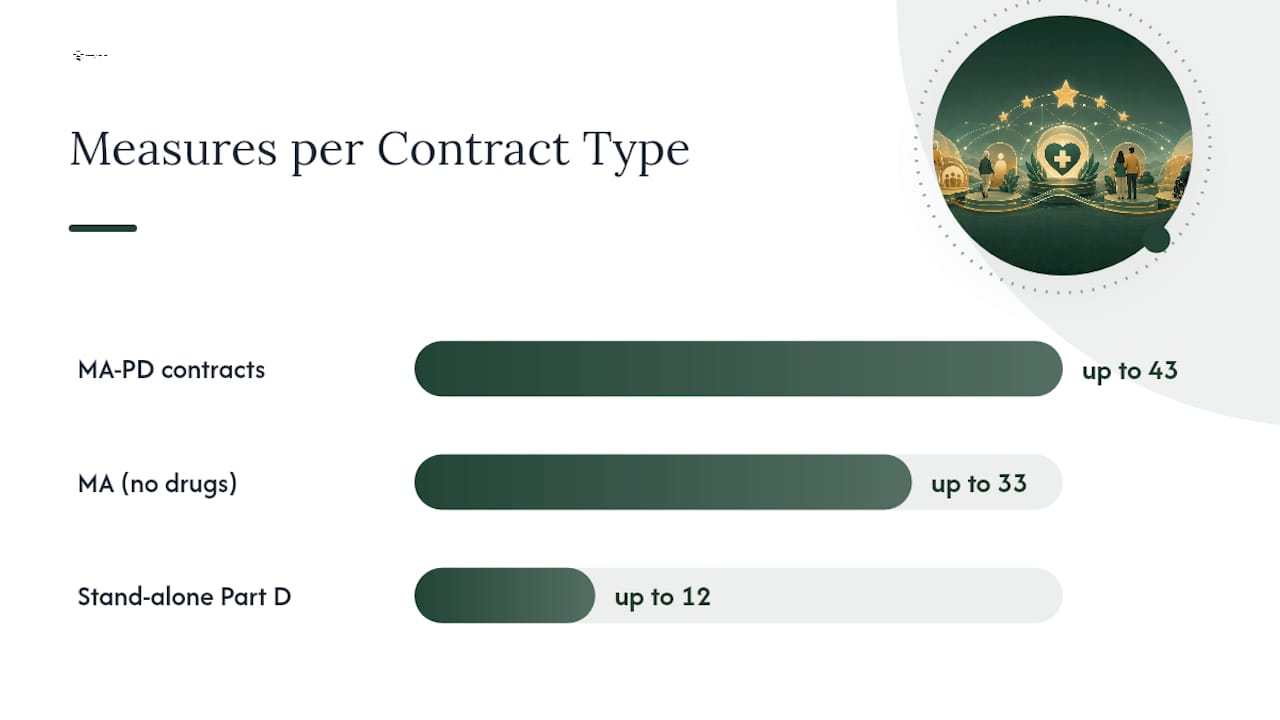
CMS doesn’t hand out stars based on gut feeling. Every rating comes from a defined set of measures that vary by contract type. A Medicare Advantage plan that also covers prescription drugs, known as an MA-PD contract, can be scored on up to 43 separate measures. A Medicare Advantage plan without drug coverage tops out at 33. A standalone Part D prescription drug plan is scored on a much shorter list, up to 12 measures.
Those measures aren’t graded in isolation. CMS sorts them into five categories, and understanding these categories tells you what the stars are actually rewarding:
- Outcomes — real health results, like whether blood sugar or blood pressure stayed controlled
- Intermediate outcomes — steps along the way to a health outcome, such as medication adherence
- Process — whether the plan delivered recommended care, like screenings or vaccinations
- Patient experience — member-reported satisfaction with the plan and its providers
- Access — how easily members could get the care and services they needed
Outcome and intermediate outcome measures typically carry more weight in the final calculation than process measures, which pushes plans to focus on results rather than just paperwork compliance. CMS also applies an improvement measure that rewards contracts for getting better year over year, even if their raw scores aren’t the highest in the pool.
Here’s where it gets technical, and where a lot of confusion starts. Each individual measure gets converted into a 1 to 5 star score using statistical cut points. Those measure-level stars then get grouped into domain ratings, and domains roll up into a summary rating for Part C, a summary rating for Part D, and finally one overall rating for MA-PD contracts. Half stars are allowed at every level above the individual measure, which is why you’ll see a plan rated 4.5 stars instead of a flat 4 or 5. CMS also requires a contract to report a minimum number of rated measures before it will publish a rating at all; contracts that are too new or too small to have enough data often show up as “not enough data” rather than a numeric score.
One detail trips up a lot of people: ratings are calculated at the contract level, not the plan level. A single insurance company can bundle several different plans, each with its own premium, network, and benefit design, under one contract number. That means two plans sitting side by side on Medicare Plan Finder with different costs and different doctor networks might carry the identical star rating, because they’re technically the same contract for CMS’s purposes. The rating tells you about the parent contract’s performance. It does not guarantee your specific doctor is in network or that your specific drug is on the formulary.
Where Can I Find Official Medicare Star Ratings?
The single best source is Medicare Plan Finder, where you enter your ZIP code and get a side-by-side view of every plan available in your area, complete with quality scores, estimated costs, and covered benefits. It pulls directly from CMS data, so you’re not relying on a marketing brochure or a call center script.
If you want the underlying methodology instead of just the final scores, three CMS documents matter:
- CMS fact sheets summarize contract distributions, measure counts, and what changed since the prior year. The 2026 Star Ratings fact sheet is the current example.
- Technical notes walk through the actual math: how measures get grouped into domains, how weights are applied, and where the cut points fall. The 2026 technical notes are the document to download if you want the full calculation logic.
- Downloadable data tables, usually distributed as ZIP files on CMS.gov, contain the raw contract-by-contract scores for readers or researchers who want to build their own comparisons rather than browsing plan by plan.
CMS typically releases the new Star Ratings in the fall, ahead of the Medicare Open Enrollment period that runs October 15 through December 7. That timing isn’t an accident. The ratings published each October reflect a prior measurement year’s performance and set the stage for the plan year that follows. Before you compare ratings across two years, confirm which measurement year each rating actually covers. Comparing a 2026 rating to a 2024 rating without checking the technical notes for methodology changes in between can lead you to the wrong conclusion about whether a plan actually got better or worse.
What Do the Star Ratings Actually Mean?
A 5-star rating means a contract hit the top statistical tier on the measures CMS tracks that year. A 1-star rating means it landed in the bottom tier. Everything in between, including those half-star scores like 3.5 or 4.5, reflects where the contract’s blended measure performance fell relative to other contracts nationally that same year.
Here’s what the stars don’t tell you, and this is the part beneficiaries get wrong most often:
- They’re calculated at the contract level, so plans under the same contract number can differ in benefits, provider networks, and drug coverage despite sharing one rating.
- Cut points shift from year to year, so a rating change doesn’t always mean quality changed. It can mean CMS raised the bar.
- Stars don’t capture whether your specific specialist is in network or whether your specific medication requires a prior authorization.
- Areas like customer service hold-times or network adequacy in your particular ZIP code aren’t broken out separately in the summary number.
A half-star gap between two plans in your area might not matter much if both cover your drugs and your doctors. A full star gap, especially when one plan sits below 3 stars, is worth taking seriously, since CMS treats consistently low-performing contracts differently for enrollment purposes. The practical rule is simple: use the star rating to narrow your list, then verify formulary coverage, pharmacy network, and total estimated out-of-pocket cost before you commit to anything.
Pro Tip: Don’t stop at the overall rating. Click into the separate Part C and Part D summary scores on Medicare Plan Finder. A plan can carry a strong overall number while its drug coverage piece lags behind, which matters a lot if you take several maintenance medications.
How Do Star Ratings Affect Your Coverage and Costs?
This is where star ratings stop being an abstract quality score and start affecting your wallet. CMS runs a quality bonus payment program that rewards higher-performing Medicare Advantage contracts with more federal money, and that money often flows back to you as richer benefits or lower cost-sharing.
Contracts rated 4 stars or higher qualify for a benchmark increase, typically 5 percentage points, with some designated “double bonus” counties pushing that increase to 10%. Those benchmark dollars translate into rebates the plan can spend on your behalf.
- Higher-rated contracts generally receive larger rebate percentages, which fund extra benefits like dental, vision, or reduced premiums.
- Lower-rated contracts, especially those below 4 stars, work with a smaller rebate pool and often pass that constraint on through higher cost-sharing or thinner supplemental benefits.
- A contract with consistently low star ratings can face additional CMS scrutiny and consumer warnings on Plan Finder.
The federal government is projected to spend more than $13 billion on Medicare Advantage quality bonus payments in 2026 alone. That figure is a useful reminder that star ratings aren’t just a consumer report card. They’re wired directly into how much money insurers receive to run these plans, which is exactly why a higher-rated plan often, though not always, comes with better-funded extras.
Star ratings also carry an enrollment consequence most people never hear about until they need it. A contract that achieves a full 5-star overall rating creates a Special Enrollment Period that lets you switch into that plan once during the year, outside the usual Open Enrollment window. It’s a narrow tool, but it exists specifically because CMS wants beneficiaries able to move toward the highest-performing option without waiting for fall. Legal challenges to ratings calculations have also led CMS to recalculate scores after the fact in past years, which occasionally opens retroactive enrollment windows tied to the correction.
What’s Changing With Star Ratings in 2026 and 2027?
CMS doesn’t freeze the measure set in place. The agency regularly adds, removes, and reweights measures, and the changes finalized for the 2027 rating year are significant enough that they’ll shift how plans compare, not just what they score.
- CMS is removing certain administrative measures that tracked paperwork and process compliance rather than direct clinical results.
- New clinical measures, including kidney health indicators, are being phased in to sharpen the focus on outcomes that matter to member health.
- Domain weights are being adjusted so outcome-based performance counts for more of the final score relative to process measures.
The practical effect: a contract that scored well historically on administrative measures might see its rating dip in 2027, not because care quality declined, but because the yardstick moved. This is exactly the scenario the KFF analysis on Medicare Advantage payment policy warns about: cut points and measure sets shift often enough that a year-to-year rating change can reflect tougher grading rather than a real swing in performance.
Timing matters here too. Measures finalized for the 2026 rating year and those phasing in for 2027 won’t hit published ratings and payment calculations on the same calendar. If you’re tracking a plan’s trend across two or three years, pull the technical notes for each specific year before you draw conclusions. A drop from 4.5 to 4 stars might mean a real service issue, or it might just mean CMS reweighted the domains that year. The only way to tell the difference is to check what actually changed in the current technical notes rather than assuming the number alone tells the whole story.
How Should You Use Star Ratings to Choose a Plan?
Treat the star rating as your first filter, not your final answer. Here’s a sequence that actually works when you sit down to compare plans:
- Enter your ZIP code on Medicare Plan Finder and pull the full list of plans available in your county, including Medicare Advantage and standalone Part D options.
- Compare the overall rating alongside the separate Part C and Part D summary scores, since a plan can be strong on one side and weak on the other.
- Check the formulary for every prescription you currently take, not just the common ones. A plan can carry 5 stars overall and still put your specific medication in an expensive tier or require prior authorization.
- Verify the pharmacy network and confirm your preferred pharmacy offers preferred cost-sharing, not just in-network status, since the difference in copay can be substantial.
- Run the total out-of-pocket estimate Medicare Plan Finder generates, which combines premium, deductible, and expected drug costs into one number you can actually compare across plans.
- Confirm your doctors and specialists are in network, especially if you’re considering a Medicare Advantage HMO with a narrower panel than you’re used to.
If you’re working with a State Health Insurance Assistance Program (SHIP) counselor or a local agent, come prepared with specific questions: Does this plan’s formulary cover my exact medications at an affordable tier? Is my primary care doctor and my specialist in network? What’s the estimated total annual cost, not just the premium?
There’s a real judgment call buried in this process. A 5-star plan that doesn’t cover your blood pressure medication well, or that drops your longtime cardiologist from network, is not the better choice for you personally, even though it’s the better performer on paper. A solid 3.5 star or 4 star plan that nails your specific formulary and network needs will usually serve you better than chasing the top rating alone.
Pro Tip: Screenshot or print your Plan Finder comparison before you call an agent or carrier. Star ratings and plan details get updated periodically, and having your original comparison in hand makes it much easier to spot if something changed between your research and your enrollment call.
For readers weighing Medicare Advantage against a Medigap and Part D combination instead, it helps to understand how Medicare Advantage plans are structured before assuming star ratings apply the same way across both paths. They don’t; star ratings are a Medicare Advantage and Part D concept, not a Medigap one.
Mountaintop Insurance’s Take on Star Ratings in Real Enrollment Decisions
Star ratings are one input among several we weigh with clients, never the deciding factor on their own. A 4.5 star plan that doesn’t cover a client’s insulin or drops their longtime primary care doctor isn’t the right recommendation, no matter how the summary number looks on Medicare Plan Finder. We’ve found the rating is most useful as a filter to narrow a crowded field of options down to a handful of worth a closer look.
Mountaintop Insurance offers free Medicare guidance to Central Oregon residents navigating exactly this kind of comparison, along with annual plan reviews so your coverage gets checked against your current prescriptions and providers every year, not just once at initial enrollment. If star ratings, formularies, or network details feel like more than you want to untangle alone, enrollment assistance from a local agent costs you nothing and skips the high-pressure call center approach entirely.
This article is general information, not a substitute for advice from a qualified doctor. Consult a qualified healthcare professional about your own circumstances before acting on anything here.
Sources
- Contract Year 2027 Medicare Advantage and Part D final rule (CMS)
- 2026 Star Ratings fact sheet (CMS)
- 2026 Part C & D Star Ratings technical notes (CMS)
- How Medicare pays Medicare Advantage plans: issues and policy options (KFF)
FAQ
What Is the Highest Rated Medicare Company?
There’s no single “highest rated” Medicare company, because CMS rates individual contracts, not entire insurance carriers. A carrier can operate several contracts nationwide, some earning 5 stars and others earning 3.5, so the only reliable way to check is looking up the specific contract for the specific plan you’re considering on Medicare Plan Finder.
Where Can I Find Star Ratings for Medicare Plans?
The official source is Medicare Plan Finder, where entering your ZIP code shows every available plan with its current star rating, estimated costs, and covered benefits. CMS also publishes downloadable fact sheets and technical notes each fall for readers who want the underlying methodology.
Where Can I Download the CMS Star Ratings Data as a PDF?
CMS posts the annual fact sheet and technical notes as downloadable PDFs directly on CMS.gov, alongside ZIP files containing the full contract-level data tables. The 2026 Star Ratings fact sheet and its companion technical notes are the two documents to search for by name.
What States Have 5-Star Medicare Advantage Plans?
Five-star contracts appear in various states and counties each year, and the list changes annually as CMS recalculates ratings using updated measures and cut points. Rather than relying on a fixed list, check Medicare Plan Finder with your own ZIP code, since availability depends entirely on which contracts operate in your specific county that plan year.
— Jesse Zimmerman
Recommended
Disclaimer: This article is for general educational purposes only and does not constitute personalized advice. Medicare rules and plan details change frequently.
Discuss Your Situation With Us