Documents Needed for Medicare: Your Enrollment Checklist

Most people enrolling in Medicare need less paper than they fear: your Social Security number, proof of where and when you were born, and details about any job-based health coverage. Which of those Social Security asks you to prove depends on your situation, and that is where people lose weeks. Below is the full list, sorted by situation, with the mistakes that slow an application down. If you live in Bend or anywhere in Central Oregon, we at Mountain Top Insurance walk people through this in free consultations, so you arrive at Social Security with the right pile the first time.
TL;DR
- Everyone should have their Social Security number, birth details (city, state, country) and dates of any current or recent group health coverage ready. Social Security lists these as the core information for signing up.
- If you already collect Social Security benefits at least 4 months before turning 65, Medicare enrolls you in Parts A and B automatically and mails your card.
- Still working at 65 or just retired? Part B needs proof of employer coverage on form CMS-L564, signed by your employer, filed with form CMS-40B.
- Missing a document is not a reason to wait. Submit what you have and send the rest later.
- Since July 4, 2025, Medicare eligibility is limited to citizens, nationals and certain lawful residents, so status documents matter more than they used to.
Table of Contents
- Start with the situation, not the paperwork
- The information everyone needs
- Proof of birth and identity
- Work, spouse and money details for the application
- Working past 65 or leaving a job: the employer form
- If you are not on Social Security: form CMS-4040
- Citizenship and residency: what changed in 2025
- What if you do not have a document?
- Where to send it and when coverage starts
- A simple pre-enrollment checklist
- Where Mountain Top Insurance fits
- Our perspective
- FAQ
- Sources
Start with the situation, not the paperwork
There is no single Medicare document list, because Medicare is enrolled through several routes. Work out which one is yours first.
| Your situation | What you do | Main form |
|---|---|---|
| Already receiving Social Security 4+ months before 65 | Nothing; you are enrolled in Parts A and B automatically | None |
| Turning 65, not yet receiving Social Security | Apply for Part A, and Part B if you want it | Online application, or CMS-18-F-5 for Part A |
| Have Part A, adding Part B | Request Part B | CMS-40B |
| Not entitled to Social Security or Railroad Retirement benefits | Request Part B | CMS-4040 |
| Still covered by an employer plan, or lost it within 8 months | Part B through a Special Enrollment Period | CMS-40B plus CMS-L564 |
| End-stage renal disease | Apply for Parts A and B | CMS-43 |
The form numbers come from the CMS Original Medicare enrollment page, which lists each form and who uses it. Most people turning 65 in Central Oregon fall into the second or fifth row.
The information everyone needs
Whether you apply online, by phone at 1-800-772-1213, or at a Social Security office, Social Security says to have these on hand:
- Your Social Security number
- Where you were born: city, state and country
- The start and end dates of any group health plan you have now, and any you had after turning 65
If you are signing up for Part B only, you also need a valid email address and your existing Medicare number.
None of this requires a trip to a filing cabinet, but the group health plan dates trip people up. Pull up your HR portal or an old benefits letter before you apply. The dates decide whether you pay a late-enrollment penalty or qualify for a Special Enrollment Period, and they are the thing Social Security cannot guess for you.
Proof of birth and identity
Social Security’s application guidance says you may be asked for:
- Your original birth certificate or other proof of birth. A copy certified by the issuing agency is acceptable.
- Proof of U.S. citizenship or lawful alien status, if you were not born in the United States.
- A copy of your U.S. military service papers (such as a DD-214) if you served before 1968.
- Your W-2 forms and/or self-employment tax return for last year.
Photocopies are fine for W-2s, tax returns and medical documents. For most other papers, Social Security must see the original, and it returns them to you. That means a plain photocopy of a birth certificate usually will not do. If you were born in Oregon, you can order a certified copy from the state’s vital records office well before you apply, and it is worth doing months ahead rather than the week you turn 65.
There is no separate “Medicare ID” you need to produce. Your photo ID is useful at a Social Security office, but the identity trail runs through your Social Security number and birth record. Your Medicare card, with its own Medicare number, arrives after you are enrolled.
Work, spouse and money details for the application
The full Social Security application asks for more than the Medicare shortcut. Based on the same guidance, gather:
- Family: the name, Social Security number and date of birth of your current spouse and any former spouses, with marriage and divorce dates, and the names of any qualifying unmarried children.
- Work: employer names and addresses for this year and last year, your earnings for last year and this year, and a Social Security Statement or earnings record if you have one. If you file between September and December, expect to estimate next year’s earnings.
- Other history: whether you or your spouse ever worked for the railroad, whether anyone has ever filed for benefits on your behalf, and whether you have ever used another Social Security number.
- Banking: your bank’s routing number and your account number, if you are applying for retirement benefits at the same time and want direct deposit.
If you are not applying for retirement benefits, much of this will not come up. Still, a married person who wants a smooth application is better off having a spouse’s details written down than guessing at a dialogue box.
Working past 65 or leaving a job: the employer form
This is the case with the most paperwork and the most expensive mistakes. If you or your spouse are covered by a group health plan through current employment, you can usually wait on Part B without penalty. When that coverage ends, you need to prove it.
The proof is form CMS-L564, the Medicare Request for Employment Information. You fill out Section A, your employer fills out Section B, and you send it with the Part B application, form CMS-40B, to your local Social Security office. Medicare.gov explains that this applies if you are still working, retired within the last 8 months, or lost job-based coverage within the last 8 months.
The timing rule, per CMS: you can enroll any time while you are covered through current employment, or during the 8 months that begin the month the employment or coverage ends, whichever comes first. Coverage starts the month after you enroll during that window.
Two details are worth knowing:
- COBRA and retiree coverage do not count as current employer coverage for this purpose, according to Social Security’s Medicare publication. The 8-month clock keeps running while you are on COBRA. We explain the trap in Medicare and COBRA.
- If your employer cannot sign Section B, the same publication says you complete it as best you can and attach secondary evidence: tax returns showing premiums paid, W-2s with pre-tax medical contributions, pay stubs with premium deductions, an insurance card showing the policy effective date, explanations of benefits, or premium payment receipts.
For the rules on when a small employer’s plan is or is not primary, see our guide to the 20-employee rule at 65. Married couples where one spouse is still working should read how to avoid spouse Medicare gaps in Oregon.
If you are not on Social Security: form CMS-4040
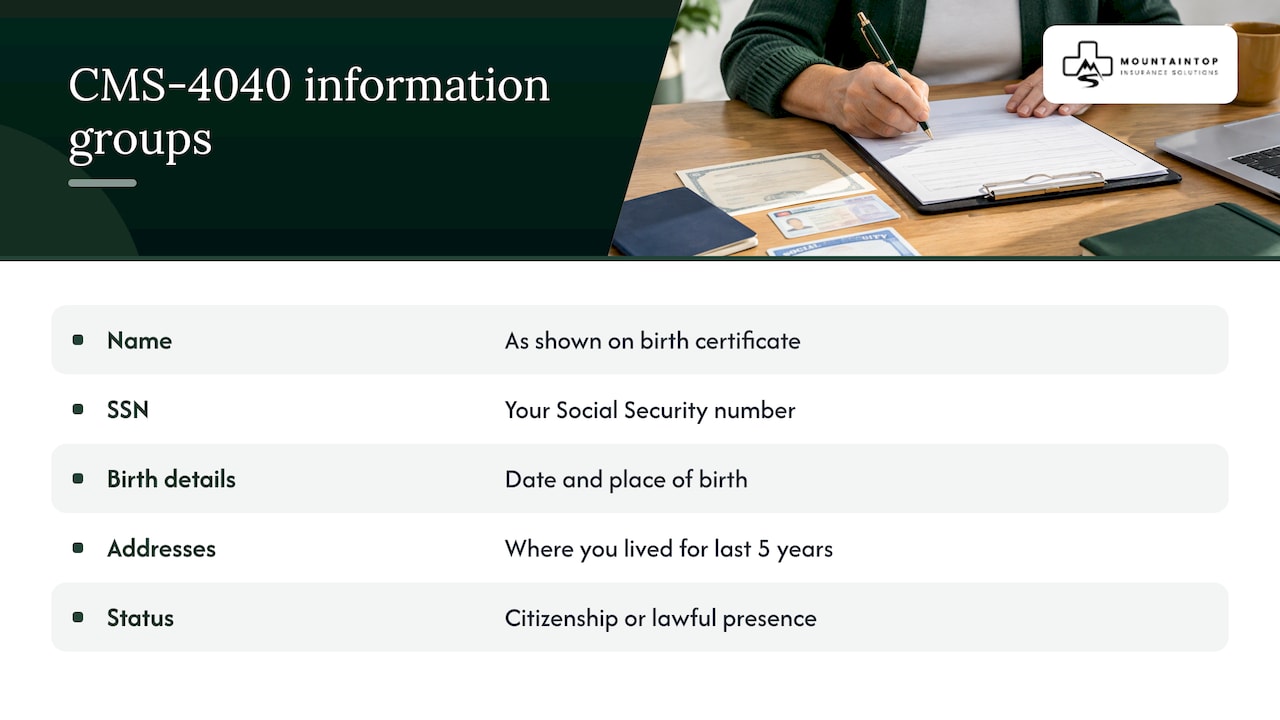
If you are not entitled to Social Security or Railroad Retirement Board benefits, you use form CMS-4040 to enroll in Part B. According to the form itself, it requires an original birth certificate or a religious record of birth made before age 5. Social Security must see the original or a copy certified by the issuing agency, and returns everything you submit.
The form also asks for your name as it appears on the birth certificate, your Social Security number, your date and place of birth, the addresses where you have lived for the last 5 years, and your citizenship or lawful presence status. Make the five-year address list before you start. It is the part people most often have to stop and reconstruct.
Citizenship and residency: what changed in 2025
CMS’s Medicare Overview Job Aid says that beginning July 4, 2025, eligibility to enroll in Medicare is limited to U.S. citizens, U.S. nationals, lawful permanent residents, Cuban-Haitian entrants and COFA migrants. This applies to Parts A, B, C and D. The same job aid notes that to buy premium Part A you must live in the U.S. and be a citizen or lawful permanent resident for at least five consecutive years, and that Part B requires five years of continuous U.S. residence before the month you apply.
In practice, if you were not born in the U.S., bring the document that proves your status, such as a passport, naturalization certificate or permanent resident card, along with your birth record. If you are a naturalized citizen or a long-time resident, having it in your hand avoids a second trip.
What if you do not have a document?
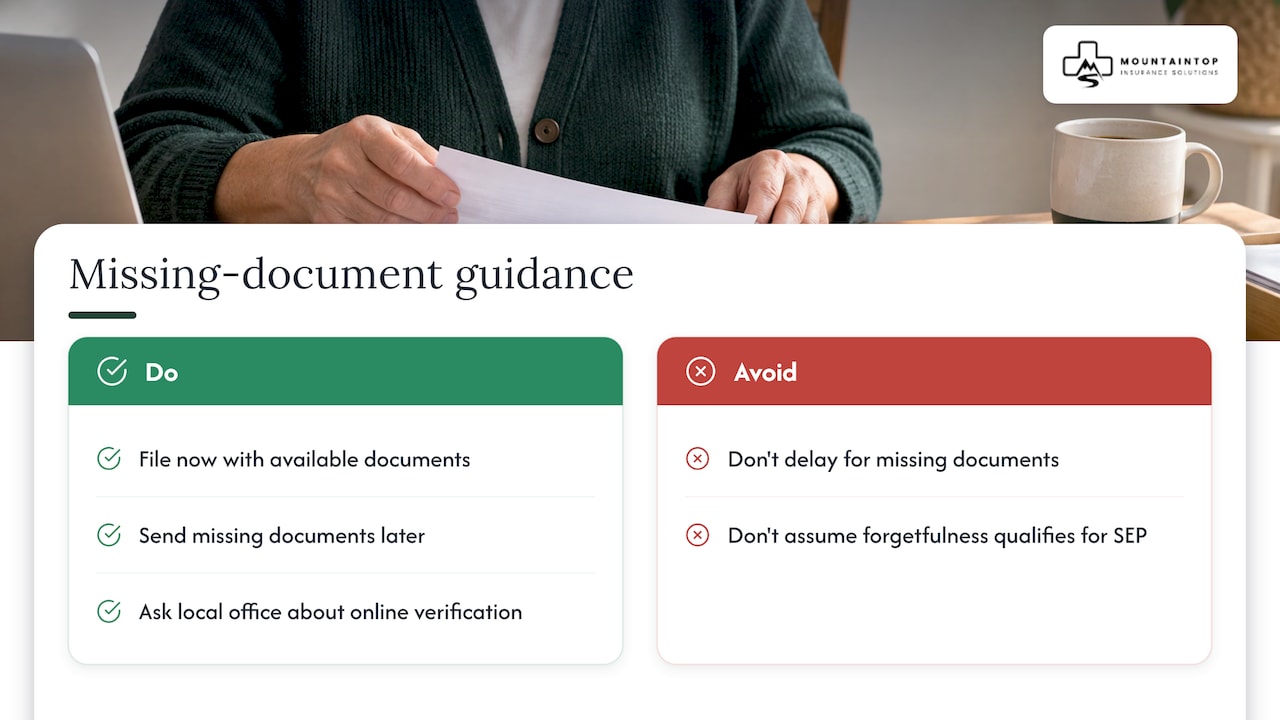
Do not hold the application back. Social Security’s guidance tells applicants to submit the application and whatever documents they have, then provide the rest later. It adds that in many cases the local office can verify your information online with your state’s vital statistics bureau at no cost, and that delaying could cost you benefits you are due.
That matters for Medicare because your Initial Enrollment Period is finite. It is a seven-month window around your 65th birthday, and each month you wait can shift when coverage starts or whether a penalty applies. For a closer look at the windows, see our guide to Medicare enrollment periods. Gathering evidence you do not have yet is a common task in any Social Security matter, from retirement to disability, and documents that prove a disability claim follow the same principle of filing what you have and building the file.
If you missed a window because of something outside your control, there is a route. Since January 1, 2023, CMS describes exceptional-conditions Special Enrollment Periods for premium Part A and Part B. These cover people affected by a declared emergency or disaster, and people who missed enrollment because an employer, plan, agent or broker materially misrepresented information. You show this with documentation or a written attestation. A separate “other exceptional conditions” SEP exists for conditions outside your control, but Social Security grants it only for truly exceptional circumstances, not for forgetfulness or lack of knowledge. These cases use form CMS-10797. Our overview of Medicare special enrollment covers who qualifies.
Where to send it and when coverage starts
You have three routes: apply online, call Social Security at 1-800-772-1213 (TTY 1-800-325-0778), or send forms to your local Social Security office. The Part A application asks for your Social Security number, date of birth, current address and phone number, work history, and a CMS-L564 completed by your employer if you are signing up for premium Part A or Part B during a Special Enrollment Period. Our walkthrough of enrolling in Medicare online shows the screens one by one.
Coverage dates depend on when you sign up. Per CMS’s job aid:
- If you sign up for premium-free Part A or Part B during the first three months of your Initial Enrollment Period, coverage starts the first day of the month you turn 65. If your birthday is on the first of the month, it starts the month before.
- For premium Part A and Part B, signing up before the month you turn 65 starts coverage that month. Signing up the month you turn 65 or in the three months after starts coverage the next month.
If you take Social Security early enough, Medicare mails a welcome package with your card about 3 months before coverage starts. Keep that card safe and carry it, because you will need the Medicare number for every later step, including choosing a Medigap or Medicare Advantage plan.
A simple pre-enrollment checklist
A week before you apply, put this in a folder:
- Social Security number (card or a record of the number)
- Original or certified birth certificate
- Proof of citizenship or lawful status if you were not born in the U.S.
- Employer coverage start and end dates, and CMS-L564 if you are working or recently left a job
- Last year’s W-2 or self-employment tax return
- Spouse’s details, if you are married or were previously married
- Military discharge papers if you served before 1968
- Bank routing and account numbers, if you are also filing for retirement benefits
Where Mountain Top Insurance fits
Enrolling is one half of the job. The other half is picking what sits on top of Original Medicare, and that is where the documents you assembled keep paying off. Our Medicare Enrollment Assistance is built for people in Bend and Central Oregon who want to know what to bring, which deadline applies to them, and what happens after the card arrives. Consultations are free, in person or remote, and our approach is education first.
If you already have a Medigap policy and think you are paying too much, ask us about Oregon’s birthday rule during your consultation. It is one reason to review your coverage every year, and our Annual Medicare Plan Reviews and Medigap plan guide are where to start.
Our perspective
Paperwork is rarely what trips people up at 65. Dates are. A birth certificate can be ordered in a week; a missed Part B window cannot be undone.
When we sit down with someone in Bend, we ask three things before anything else: are you still working, is your spouse, and when does that coverage end? Those answers decide which form you need and which deadline applies. The documents follow from them.
We are a local agency, not a call center, and we believe a clear explanation beats a quick sale. Our consultations are free because we want you to understand Parts A, B, C and D before you choose. You leave with a short list of what to gather and when to file, whether you enroll through us or not.
Then, once you are enrolled, we help you keep the coverage right. Medigap premiums and plan options change, and an annual review, including Oregon’s birthday rule, is how people stop overpaying.
Jesse Zimmerman
FAQ
What documents do I need to sign up for Medicare at 65?
You need your Social Security number, your birth details, and the dates of any group health coverage. Social Security may also ask for an original or certified birth certificate, proof of citizenship or lawful status if you were born abroad, and last year’s W-2 or tax return. Employer coverage requires form CMS-L564 if you are adding Part B.
Do I need a photo ID or a Medicare ID to apply?
The application runs on your Social Security number and birth record rather than a separate Medicare ID. Your Medicare card, with your own Medicare number, comes after you are enrolled. Bringing a photo ID to a Social Security office is sensible, but proof of birth and status are the documents the agency specifically lists.
Do I need a birth certificate if I am already on Social Security?
Probably not. If you receive Social Security benefits at least 4 months before turning 65, Medicare enrolls you in Parts A and B automatically and mails your card. Your birth record is already on file.
What if my employer will not sign the CMS-L564?
Complete your section as best you can and submit secondary evidence of your coverage, such as pay stubs showing premium deductions, W-2s with pre-tax medical contributions, or an insurance card with the policy effective date. Send it with the CMS-40B to your local Social Security office.
How long does it take to get Part A after applying?
That depends on your enrollment month, not on a fixed processing time. If you sign up in the first three months of your Initial Enrollment Period, premium-free coverage starts the first day of the month you turn 65.
Sources
- Sign up for Medicare, Social Security Administration
- Information You Need To Apply, Form SSA-1
- Original Medicare (Part A and B) Eligibility and Enrollment, CMS
- How do I sign up for Medicare?, Medicare.gov
- Medicare Request for Employment Information, CMS-L564
- Enrollment Forms, Medicare.gov
- Medicare publication, Social Security Administration (2022)
- Request for Enrollment in Medicare Part B, CMS-4040
- Application for Part A, CMS-18-F-5
- Medicare Overview Job Aid, CMS (2026)
Recommended
Disclaimer: This article is for general educational purposes only and does not constitute personalized advice. Medicare rules and plan details change frequently.
Discuss Your Situation With Us