Central Oregon: Switch Medigap Plans During the 60 Day Birthday Window

You cannot switch Medigap plans whenever you feel like it. Federal law only guarantees the right to change during two windows: your six-month Medigap Open Enrollment Period and any guaranteed-issue event, which usually gives you 63 days to act. Oregon is a notable exception, since its Birthday Rule opens a switching window every single year. Whatever window applies, keep your old policy active until the new one is confirmed, use your 30-day free look before deciding, and check Medicare or call your State Health Insurance Assistance Program before you sign anything.
TL;DR:
- The six-month Medigap Open Enrollment Period and certain guaranteed-issue events are the only times insurers must sell you a plan without medical underwriting or denial based on health.
- Oregon’s Birthday Rule provides a unique annual 60-day window before and after your birthday to switch plans without answering health questions, but only to plans with the same or fewer benefits.
- Switching plans requires confirming eligibility, gathering proof, applying during the correct window, and only cancel your old policy after the new one is active and verified.
- Moving out of a Medigap plan’s service area generally qualifies as a guaranteed-issue event, giving you a 63-day window to switch without health questions.
- Avoid switching from legacy policies or high-rated plans unless the new policy offers genuine benefit improvements or lower costs after comprehensive comparison.
Table of Contents
- Federal Rules for Switching Medigap Plans
- Does Your State Give You Extra Switching Rights?
- How to Switch Medigap Plans Step by Step
- What Happens After You Switch Medigap Plans
- When Switching Medigap Plans Isn’t Worth It
- How a Local Agent Approaches a Switching Case
- Get Help Switching Medigap Plans in Central Oregon
- Sources
- FAQ
Federal Rules for Switching Medigap Plans
Outside of two specific circumstances, insurers can put you through medical underwriting before approving a new Medigap policy, and they can deny you outright based on your health history. The two protected paths are worth knowing cold.
Your Medigap Open Enrollment Period runs six months, starting the day your Medicare Part B coverage begins. During that window, insurers in most states have to sell you any Medigap policy they offer, at their best available rate, regardless of your health. Miss it, and you’re relying on guaranteed-issue rights or state-specific protections for the rest of your Medigap life.
Guaranteed-issue (GI) rights kick in during specific triggering events, and Medicare.gov lists the most common ones:
- Your employer group coverage or COBRA plan is ending
- Your Medigap insurer goes bankrupt or you lose coverage through no fault of your own
- You joined a Medicare Advantage plan and want to switch back within your trial right window
- You moved out of your Medigap plan’s service area
Most GI rights give you a limited period from the date your prior coverage ends to apply. Missing that window usually means losing the guarantee.
Once you’re approved for a new policy, you get a 30-day free look to test it out. Medicare’s own guidance is blunt about the sequence: don’t cancel your existing Medigap policy until you’ve decided to keep the new one. That means you may end up paying two premiums for a single month, which is a small price for not going uninsured.
Pre-existing conditions add one more wrinkle. Insurers can impose a waiting period of up to six months for conditions treated or diagnosed before your new policy starts. But if you’ve had continuous prior coverage, that waiting period shrinks or disappears entirely. The CMS Medigap guide confirms that if you’ve held your current Medigap policy for six months or longer and the new plan offers the same benefits, the insurer cannot impose any new waiting period at all.
Does Your State Give You Extra Switching Rights?
Federal law sets the floor, not the ceiling. States can, and several do, layer on their own switching protections. Oregon runs one of the most useful in the country.
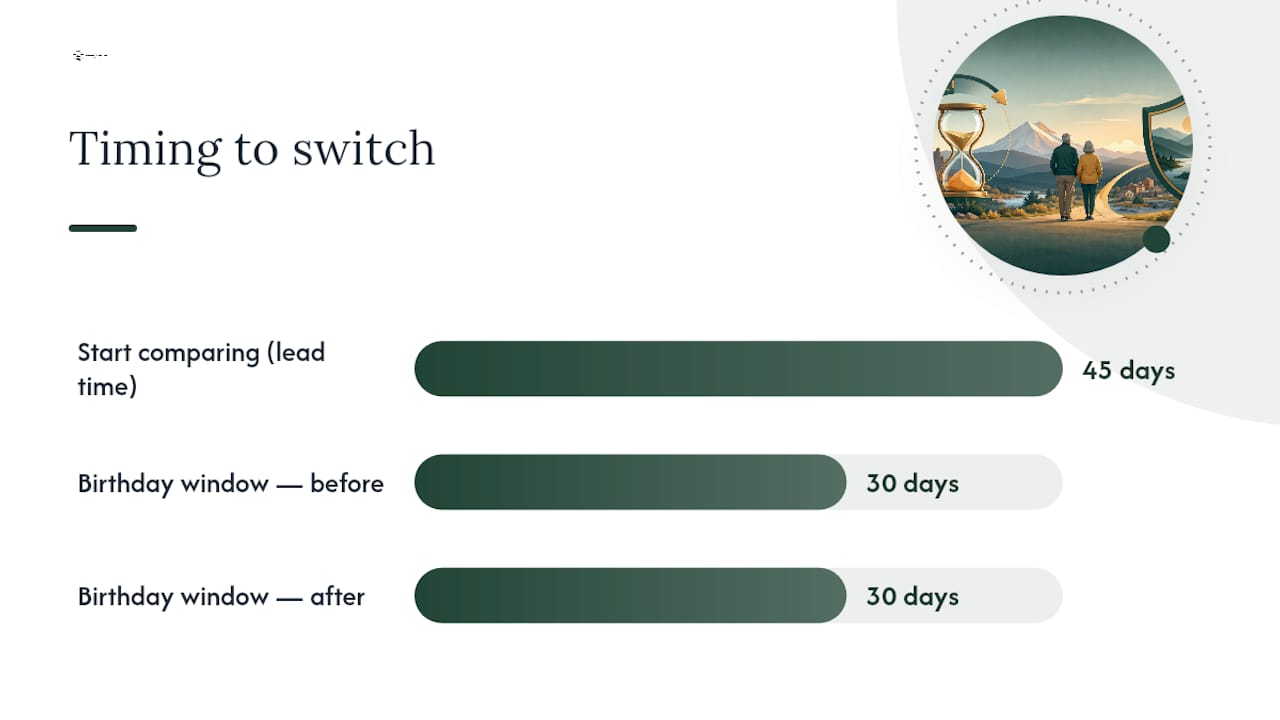
Oregon’s Birthday Rule gives every Medigap policyholder a 30-day window before their birthday plus 30 days after (60 days total) to switch to a different insurer without answering a single health question. The catch is that you can only move to a plan offering the same or lesser benefits than what you already have. This is governed by a formal Birthday Rule fact sheet and codified replacement matrix, so an agent needs to map your current plan letter against the matrix to confirm what you’re eligible to buy.
A few practical notes for Oregon residents:
- The guarantee applies annually, not just once, so you can use it every year if it makes sense to shop
- Switching under this rule can reset counts toward a high-deductible plan’s annual deductible, so check that before you commit
- The rule doesn’t apply to self-funded employer group plans, only individual Medigap policies
Oregon’s rule is codified in OAR 836-052-0143, which prohibits insurers from denying coverage or asking health questions inside that 60-day window. If you’re outside Oregon, don’t assume you’re out of luck. Many states have their own versions of continuous or annual open enrollment for Medigap. Your State Insurance Department or local SHIP office can tell you exactly what applies where you live.
Pro Tip: If you’re in Oregon and thinking about switching near your birthday, start the comparison process at least 45 days out. That gives you time to get quotes, confirm the replacement matrix allows your target plan, and still apply within the 60-day window if something takes longer than expected.
How to Switch Medigap Plans Step by Step
Switching safely is a sequencing problem more than a shopping problem. Follow this order and you avoid the two most common mistakes: applying without proof of eligibility, and cancelling too soon.
- Confirm your eligibility window. Are you inside your six-month Open Enrollment Period, a 63-day guaranteed-issue window, or a state-specific window like Oregon’s Birthday Rule? Write down the exact expiration date.
- Gather your documentation. Termination letters, loss-of-coverage notices, denial letters, and dated correspondence all serve as proof if an insurer questions your guaranteed-issue claim later.
- Compare plans with the same letter designation, or a lesser benefit level if your state’s replacement rules require it. Ask each insurer for a written quote showing the effective date and any waiting period.
- Apply to the new insurer and follow up until you receive actual policy issuance paperwork, not just a confirmation email. Use your 30-day free look to evaluate the coverage before committing.
- Cancel the old policy only after the new one is active and you’ve verified the effective date in writing. Keep a copy of the cancellation confirmation.
For documentation on guaranteed-issue triggers specifically, this breakdown of GI rights walks through what qualifies and what paperwork insurers typically request.
If you’re heading into a consultation with an agent, bring:
- Your current Medigap policy and most recent premium notice
- Any termination, denial, or loss-of-coverage letters
- Your Medicare card and a list of the doctors you want to keep seeing
What Happens After You Switch Medigap Plans
Once your new policy is approved, a few practical details determine how smooth the transition feels.
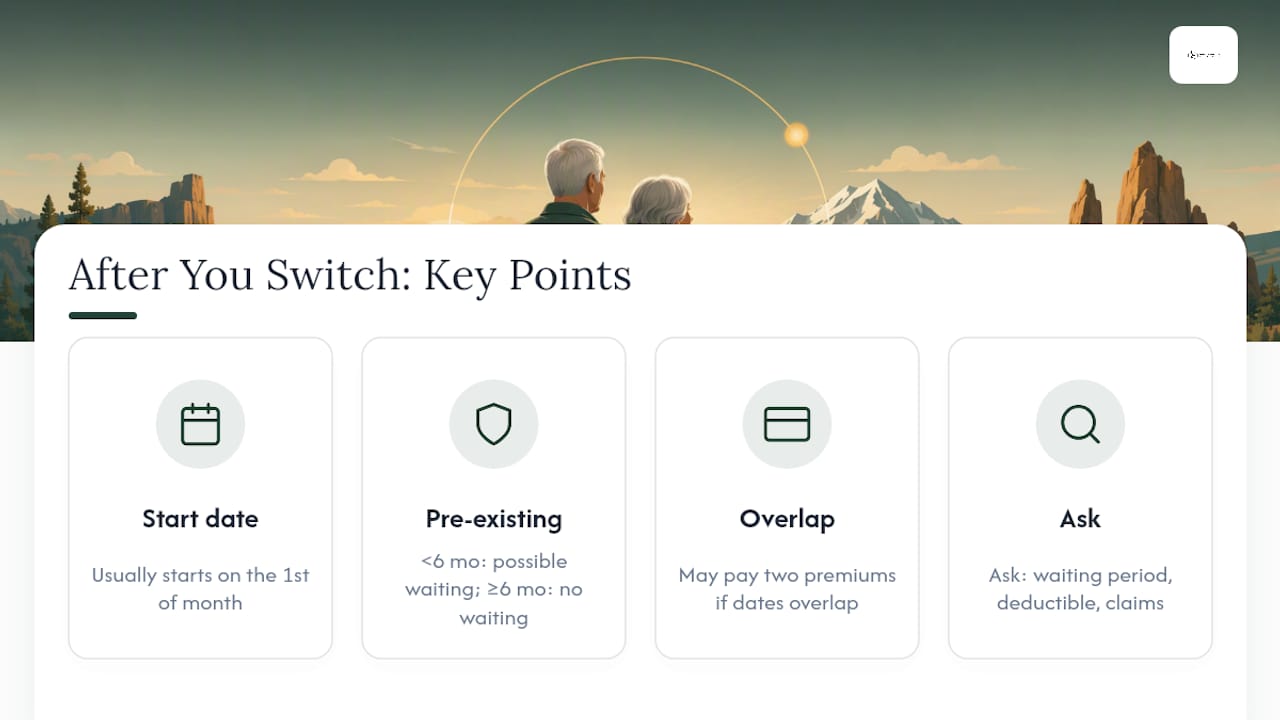
Insurers rarely set effective dates in the middle of a billing cycle. Most default to the first of the month, so if your old policy’s premium is paid through the 30th and your new one starts the 1st, you generally won’t overlap by much. Ask specifically, because some insurers still require a full month’s overlap regardless of timing.
Pre-existing condition crediting depends on how long you’ve held prior coverage. Under CMS’s guidance, fewer than six months of prior creditable coverage means the new insurer can still impose a partial waiting period, while six months or more with equivalent benefits means no new waiting period at all.
You may end up paying two premiums in the same month if your old policy’s cancellation date and your new policy’s start date overlap. You can minimize this by timing your application so the new effective date lines up with your existing policy’s paid through date, though insurers don’t always accommodate the request.
Before you finalize anything, ask the new insurer three questions directly: Will any waiting period apply to me? Does switching reset my deductible if this is a high-deductible plan? And how will claims be processed during the transition month?
When Switching Medigap Plans Isn’t Worth It
Not every switch improves your situation, and a few red flags deserve real attention before you sign an application.
Older Medigap policies sold before 2010, and especially those from before 1990, sometimes carry benefits that current standardized plans don’t replicate. Don’t trade one away just because a new policy looks cheaper on paper; compare the actual benefit language line by line.
Rating structure matters more than most people realize. A community-rated plan charges the same premium regardless of age, while attained-age plans get more expensive as you get older, sometimes sharply. Switching from a community-rated policy into an attained-age one can quietly cost you thousands over a decade.
Watch for these warning signs before finalizing anything:
- A new premium that’s barely lower than your current one once you account for rating structure
- Loss of a legacy benefit your current plan includes but the new plan doesn’t
- A high-deductible plan reset that puts you back at zero for the year
- Any underwriting questions asked outside a protected window, since a denial there can leave you with no policy at all
How a Local Agent Approaches a Switching Case
Reviewing a client’s current policy, checking Oregon’s rules or their home state’s rules, and confirming which documents prove guaranteed-issue eligibility is the actual work behind a safe switch. Timing the application and locking down the effective date matters as much as picking the right plan. Consultations stay education first, no pressure to enroll, with deeper reading available on free look rules, guaranteed-issue rights, and Oregon’s Birthday Rule.
— Jesse Zimmerman
Get Help Switching Medigap Plans in Central Oregon
Mountaintop Insurance is the local alternative to guessing your way through a Medigap switch alone or getting rushed by a national call center. As a Bend, Oregon agency, Mountaintop Insurance walks Central Oregon residents through their Medicare Guidance services with a straightforward, no-pressure consultation, checking your eligibility window, confirming documentation, and timing your application so you’re never left uninsured between policies. If you’re ready to explore your options, Medicare Enrollment Assistance covers the application process directly, while Annual Medicare Plan Reviews help you catch a better rate before your next birthday window closes. Bring your current Medigap policy, your latest premium notice, any termination or denial letters, and your Medicare card. Consultations are free, available in person or remotely, and there’s no obligation to enroll through the agency to get straight answers.
This article is general information, not a substitute for advice from a qualified financial advisor. Consult a qualified financial professional about your own circumstances before acting on anything here.
Sources
- Can I change my Medigap policy? | Medicare
- When can you switch Medigap plans Birthday rule fact sheet (Oregon)
FAQ
Is It Easy to Switch Between Medigap Plans?
It depends entirely on timing. Inside your Open Enrollment Period or a guaranteed-issue window, switching is straightforward and insurers can’t deny you based on health. Outside those windows, most states allow medical underwriting, which means an insurer can charge you more or deny coverage entirely.
Which States Let You Switch Medigap Plans Without Underwriting?
Oregon is a clear example, with its Birthday Rule giving policyholders a 60-day annual window to switch without health questions. Several other states run similar annual or continuous open enrollment protections, so check with your State Insurance Department or SHIP office to confirm what applies where you live.
Can I Switch Medigap Plans During Open Enrollment?
Yes. Your six-month Medigap Open Enrollment Period starts the day your Part B coverage begins, and during that window insurers must sell you any policy they offer at their best rate. Once those six months pass, you generally need a guaranteed-issue right or a state-specific protection to switch without underwriting.
Can You Change Medigap Plans If You Move to Another State?
Moving out of your Medigap plan’s service area is one of the standard guaranteed-issue triggers listed by Medicare.gov, so you typically get a 63-day window to apply for a new policy without medical underwriting. Confirm the exact rules with your new state’s insurance department, since replacement requirements can vary.
Recommended
Disclaimer: This article is for general educational purposes only and does not constitute personalized advice. Medicare rules and plan details change frequently.
Discuss Your Situation With Us