Turning 65 in Oregon: Your Medicare Timeline and First Steps

If you are turning 65 in Oregon, your Medicare clock starts three months before your birthday month and runs for seven months in total. What you do inside that window decides whether you pay penalties, which doctors you can see and how much you spend on coverage for years. Some people are enrolled automatically. Others have to sign up themselves. Anyone still working needs to check one rule before doing anything. And if you already have a Medigap policy, Oregon gives you a yearly chance to switch to a cheaper one without health questions.
We are a local agency in Bend, and we walk Central Oregon residents through this every day. Consultations are free, in person or remote, so you can get the timeline sorted before a deadline matters.
TL;DR
- Your Initial Enrollment Period is seven months: the three months before your birthday month, the birthday month and the three months after.
- If you already receive Social Security or Railroad Retirement benefits, Parts A and B start automatically. If not, you must sign up yourself.
- Still working for an employer? You may be able to delay Part B without a penalty, but COBRA and retiree plans do not count.
- In Oregon, anyone with a Medigap policy can switch to a plan with the same or lesser benefits, with no health questions, in the 60 days around their birthday.
- Oregon’s SHIBA program gives free, unbiased Medicare help to anyone, and so do we.
Table of Contents
- Your seven-month window, month by month
- Automatic enrollment or doing it yourself
- Still working at 65? Check this before you delay
- Choosing how you get your coverage
- Oregon help that costs you nothing
- The Medigap window and Oregon’s birthday rule
- Free guidance from a Bend agency
- Our perspective
- FAQ
- Sources
Your seven-month window, month by month
The Initial Enrollment Period, or IEP, is seven months long: three months before the month you turn 65, your birth month, and three months after. It applies to Part A (hospital), Part B (medical) and the private plans that sit on top of them. KFF gives a simple example: a June birthday means March 1 through September 30.
When you sign up decides when coverage begins:
| When you sign up | When coverage starts |
|---|---|
| Any of the 3 months before your birth month | First day of your birth month |
| During your birth month | First day of the following month |
| During the 3 months after your birth month | First day of the month after you sign up |
The exception: if your birthday falls on the first of the month, Medicare counts from the month before. The Medicare and You 2027 handbook spells this out.
The practical lesson is to sign up in the first three months of the window. Waiting until your birth month or later creates a gap between your birthday and the day coverage begins. If you are coming off other insurance, that gap can mean weeks with no coverage at all.
Automatic enrollment or doing it yourself
Which path you are on depends on one thing: whether you already collect Social Security or Railroad Retirement Board (RRB) benefits.
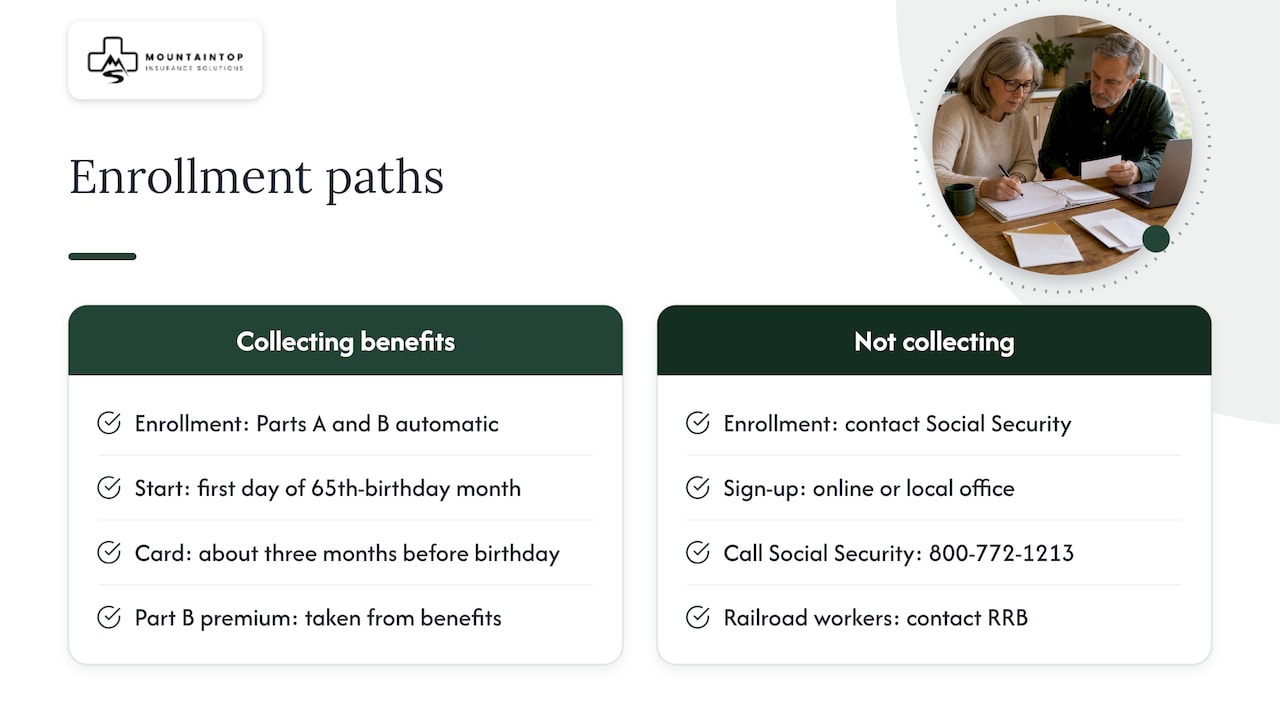
You already collect benefits. You are enrolled in Parts A and B automatically, starting the first day of the month you turn 65. Your red, white and blue Medicare card should arrive about three months before your 65th birthday. If you do nothing, you keep Part B and the premium is taken from your benefits.
You do not collect benefits yet. Many people who plan to work past 65 or delay Social Security fall here. The SHIBA guide says to contact Social Security at 800-772-1213 to sign up or find out whether you can delay without penalty. You can sign up online or at a local Social Security office. If you or your spouse worked for a railroad, call the Railroad Retirement Board instead. Your welcome package arrives about two weeks after you sign up.
Signing up with Social Security is a step the law gives to a federal agency, so every enrollment goes through it. We help Central Oregon residents through the process, and our Medicare enrollment assistance covers Parts A, B, C and D.
What happens if you miss the window
Part B is the one part that is truly voluntary, and it carries a lasting penalty. SHIBA states that people who delay Part B without qualifying for a special enrollment period pay a 10 percent premium penalty for every year they were eligible but went without, and it is added for as long as they have Medicare.
If you do miss your IEP, you can sign up in the General Enrollment Period, January 1 through March 31 each year. Coverage then starts the month after you sign up, and late penalties may apply.
Still working at 65? Check this before you delay
You may not need Part B at 65 if you or your spouse are covered by an employer group health plan through current work. The SHIBA guide says you can delay without penalty and that the group plan pays first if the employer has 20 or more employees. With fewer than 20 employees, Medicare pays first, so skipping Part B can leave you with gaps.
Three details trip people up:
- COBRA does not count as working. SHIBA is explicit: being on COBRA means you do not qualify to delay Part B without penalty. Retiree coverage from a former employer works the same way.
- You get eight months after work coverage ends. Medicare gives you an 8-month Special Enrollment Period that starts when you stop working or your coverage ends, whichever comes first, even if you choose COBRA. To avoid a gap, sign up the month before you plan to retire.
- Drug coverage must be creditable. If you skip Part D because of your employer plan, that plan’s drug coverage has to be “creditable,” meaning it is expected to pay at least as much as standard Medicare drug coverage. Otherwise a Part D late penalty can follow.
SHIBA suggests asking your employer four things: whether to take premium-free Part A and keep the group plan, whether you need Part B, whether the drug coverage is creditable, and whether retiree benefits exist. We go through the same questions with you, and our 20 employee rule guide explains how this works for Oregon workers.
Also worth knowing: Medicare.gov notes that the six-month Medigap open enrollment window still starts when you enroll in Part B, even while employer coverage continues.
Choosing how you get your coverage
Parts A and B are only the starting point. Medicare.gov describes two main routes. With Original Medicare you can see any provider that accepts Medicare, and you may add a stand-alone Part D drug plan and a Medigap policy. With Medicare Advantage (Part C), a private plan bundles A and B, usually includes drug coverage and often adds extras such as vision, dental and hearing, typically with network rules.
Why this matters: SHIBA notes that Original Medicare leaves you responsible for deductibles and 20 percent of medical bills and has no drug coverage. How you fill those gaps is the big decision of your first year.
| Original Medicare route | Medicare Advantage route | |
|---|---|---|
| What you have | Parts A and B | A private plan that bundles A and B |
| Drug coverage | Separate Part D plan | Usually included |
| Gap protection | Optional Medigap policy | Plan’s own copays and out-of-pocket limits |
| Providers | Any that accept Medicare | Usually a plan network |
We explain both routes in plain language in our guides to how Medicare Part C works and Medicare Advantage plans in Bend. Part D is available to everyone with Medicare regardless of income or health, but it is not automatic, and enrolling when you are first eligible protects you from a late penalty.
If you want to understand what Part A pays for at the end of life, this overview of what Part A covers in hospice is a clear read.
Dental and vision
Parts A, B and D do not cover dental services. The SHIBA guide lists the routes: a stand-alone dental plan, an agent’s comparison, or a Medicare Advantage plan that includes dental benefits. We help with dental coverage and vision coverage alongside your Medicare choice, so everything is decided together.
Oregon help that costs you nothing
Oregon has two supports worth knowing about before you spend a dollar.
SHIBA. The Senior Health Insurance Benefits Assistance program is a free statewide service through the Oregon Department of Human Services that helps people understand their Medicare options.
Programs that help pay costs. People with Part A may be eligible for Medicare Savings Programs that help pay premiums, deductibles and copays. If you have the Oregon Health Plan (OHP), your benefits change when you go on Medicare. The Oregon Health Authority explains that OHP can help pay Medicare premiums, deductibles and coinsurance and cover extras like rides and dental. Dual Special Needs Plans are Medicare Advantage plans designed to work with OHP in many parts of Oregon. If you think you may qualify, raise it in your first consultation, because it changes which plan makes sense.
The Medigap window and Oregon’s birthday rule
Medigap, also called Medicare Supplement, is a private policy that pays part of what Original Medicare leaves you with. Two windows matter.
Your first six months. The Medigap open enrollment period begins the first month you have Part B and are 65 or older and lasts six months. During it, insurers cannot turn you down or charge more because of your health. Our guides to choosing a Medigap plan during open enrollment and preexisting conditions in Oregon cover what that means in practice.
Every year after that. This is where many Oregonians save money. Under Oregon’s birthday rule, anyone who already has a Medigap policy gets a 60-day window each year, from 30 days before to 30 days after their birthday, to switch to a plan with the same or lesser benefits, with the same or a different company, and with no health questions. The rule took effect in 2013 and was amended on January 1, 2023.
A worked example: your birthday is June 15. Your window runs from May 16 to July 15. In that period you can move from your current Plan G, say, to a Plan G from a different carrier, or to a plan with fewer benefits, without answering a single health question.
Points to check before you switch:
- The new plan must have the same or lesser benefits. Moving to richer coverage is not guaranteed.
- The rule is for people who already hold a Medigap policy, so it does not apply during your very first enrollment.
- Members of self-funded employer-sponsored group Medigap plans are not eligible, as The Oregonian reported in October 2026.
- Premiums for the same plan letter can differ between carriers, which is the reason to look every year rather than only when you are unhappy.
We lay out the timing in more depth in our Oregon birthday rule guide and a walkthrough of how to switch Medigap plans in the 60-day window. For a full picture of plans and costs, see Medigap in Oregon.
Free guidance from a Bend agency
Turning 65 involves a handful of dates, a few forms and some decisions that are hard to undo. Our Medicare enrollment assistance helps Central Oregon residents with Parts A, B, C and D, and our annual Medicare plan reviews give you a yearly look at whether your coverage still fits. Consultations are free, in person or remote, and we focus on education, not pressure. You can reach us through the Mountaintop Insurance site, and our step-by-step guide to turning 65 is a good place to start reading.
Our perspective
Most people who come to us at 64 are not confused about Medicare as a whole. They are worried about one deadline, usually the wrong one. Some think they must act on their birthday. Others assume a retiree plan lets them wait. The seven-month window is generous, and the way to use it is to start early, three or four months ahead, so decisions are made calmly.
We built our agency on education before enrollment. That means walking through Parts A, B, C and D, the dates that apply to you and what each path costs you in flexibility, before anyone signs anything. We are local, so the conversation includes Central Oregon realities: the plans available here, the doctors people already see and the Oregon protections such as the birthday rule that national call centers rarely bring up.
If you already have a Medigap policy and your premium keeps climbing, mark your birthday window on the calendar. It comes every year, it requires no health questions, and a conversation costs you nothing.
Jesse Zimmerman
FAQ
When should I apply for Medicare if I turn 65 in Oregon?
Your window opens three months before your birth month. Signing up in those first three months means coverage starts on the first day of your birthday month. If you are not receiving Social Security or RRB benefits, you must sign up yourself, since enrollment is not automatic for you.
Do I have to take Medicare Part B at 65 if I am still working?
Not necessarily. If you or your spouse have employer coverage through current work, you can delay Part B without a penalty, and you get an eight-month Special Enrollment Period after that coverage ends. COBRA and retiree coverage do not qualify, so talk to your employer’s benefits administrator first.
What is the Oregon Medigap birthday rule?
It gives people who already have a Medigap policy a 60-day window each year, 30 days before to 30 days after their birthday, to switch to a plan with the same or lesser benefits. No health questions are asked, and you can stay with your company or change to another.
Does Medicare cover dental care?
Original Medicare Parts A, B and D do not cover dental services. Dental coverage can come from a stand-alone dental plan or from a Medicare Advantage plan that includes dental benefits.
Is there free Medicare help in Oregon?
Yes. SHIBA is a free statewide service through the Oregon Department of Human Services. In Central Oregon you can also book a free consultation with us in Bend, in person or remotely.
Sources
- 2027 Oregon Guide to Medicare Insurance Plans (SHIBA)
- 2026 Oregon Guide to Medicare Insurance Plans (SHIBA)
- Medicare and You 2027 handbook
- KFF: I am turning 65 next year. When can I sign up for Medicare?
- Medicare.gov: How do I sign up for Medicare?
- Medicare.gov: When can I sign up for Medicare?
- Medicare.gov: When can I buy a Medigap policy?
- Medicare.gov: Your coverage options
- SHIBA Medicare FAQs
- Oregon Department of Human Services: Health Insurance and Medicare
- Oregon Health Authority: Medicare and the Oregon Health Plan
Recommended
Disclaimer: This article is for general educational purposes only and does not constitute personalized advice. Medicare rules and plan details change frequently.
Discuss Your Situation With Us